2026 Tech Trends in Hot Forging Machine Tool Manufacturing
Discover how AI toolpaths, conformal cooling, and advanced metallurgy are transforming hot forging machine tool manufacturing in 2026.
The Evolution of Extreme-Environment Tooling
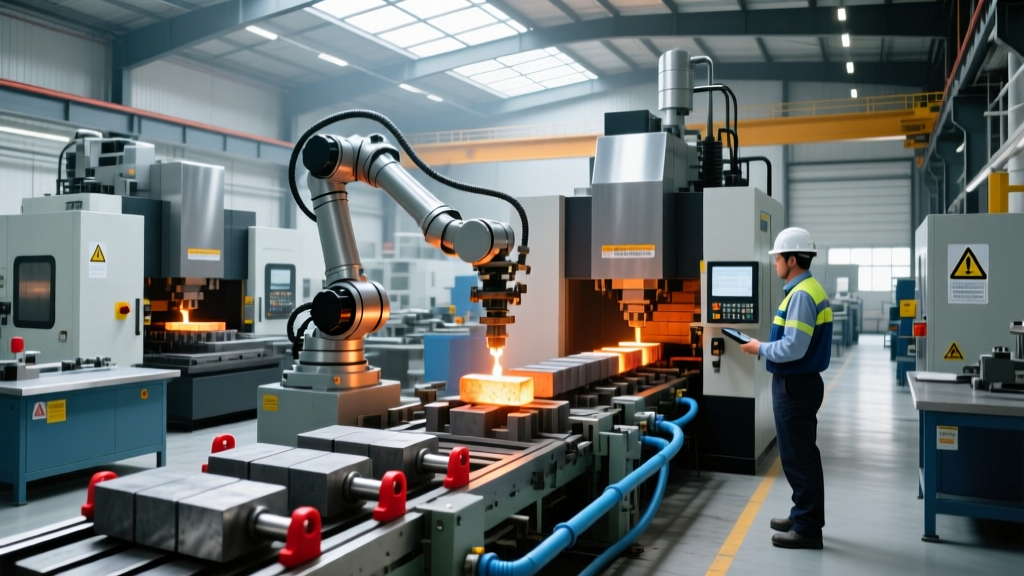
Hot forging operates in some of the most punishing conditions in industrial manufacturing. Workpiece temperatures routinely exceed 1,200°C, while impact loads on the dies and machine tools can surpass 10,000 tons. Historically, the manufacturing of these tools relied almost exclusively on subtractive machining of standard AISI H13 tool steel. However, the landscape of hot forging machine tool manufacturing has shifted dramatically. In 2026, producing forging dies, mandrels, and press components is a hybrid discipline that integrates artificial intelligence, laser powder bed fusion (LPBF), and next-generation high-thermal-conductivity alloys.
For forge shops and tooling suppliers, understanding these technological pivots is no longer optional; it is the baseline for maintaining die life margins and reducing cost-per-forging. Below is a technical breakdown of the innovations currently redefining the sector.
2026 Industry Snapshot: Tooling Economics- Average Die Life Increase: 35-45% when switching from standard H13 to HTCS-150 with conformal cooling.
- Machining Time Reduction: 28% average cycle time drop using AI-optimized trochoidal toolpaths for deep-cavity roughing.
- Scrap Rate Reduction: 18% decrease in thermal fatigue (heat checking) failures via hybrid additive/subtractive manufacturing.
Advanced Metallurgy: Moving Beyond Standard H13
For decades, AISI H13 has been the undisputed workhorse of hot forging dies. While it offers excellent toughness, its thermal conductivity bottlenecks at high operating temperatures, leading to rapid heat checking (alligator cracking). Modern hot forging machine tool manufacturing now leverages premium electroslag remelted (ESR) and powder metallurgy (PM) steels to solve this thermal bottleneck.
Metallurgical Comparison Matrix
| Alloy Designation | Thermal Conductivity at 700°C | Working Hardness | Approx. Cost (2026) | Primary Application |
|---|---|---|---|---|
| AISI H13 (Standard ESR) | ~24 W/mK | 46-48 HRC | $4.50 - $6.00 / lb | General purpose dies, low-volume runs, bolster plates. |
| QRO 90 Supreme | ~28 W/mK | 48-50 HRC | $8.50 - $11.00 / lb | High-stress crankshaft dies, tools requiring superior tempering resistance. |
| HTCS-150 (PM Steel) | ~52 W/mK | 50-54 HRC | $15.00 - $18.00 / lb | High-volume automotive forgings, tools prone to severe thermal fatigue. |
The upfront material cost of High Thermal Conductivity Steel (HTCS-150) is roughly triple that of standard H13. However, because HTCS-150 extracts heat from the forged billet nearly twice as fast, the die surface temperature drops significantly between strokes. This reduces the thermal gradient that causes micro-cracking, often extending die life from 15,000 strikes to over 45,000 strikes, yielding a massive reduction in cost-per-part over the tool's lifecycle.
AI-Driven Toolpath Optimization in 5-Axis Die Milling
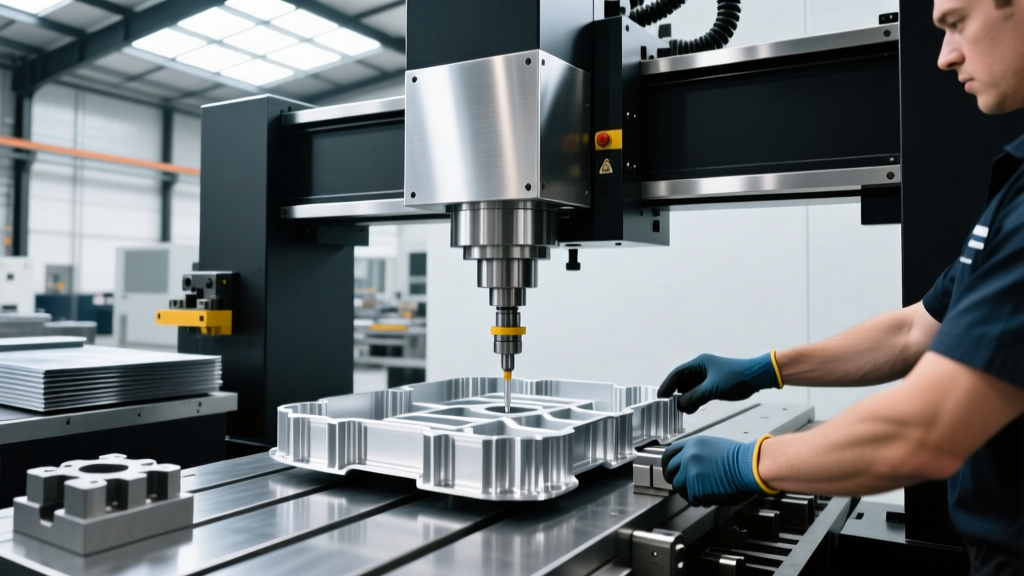
Machining deep, complex cavities for forging dies—such as those used for automotive steering knuckles or aerospace landing gear components—traditionally required conservative feed rates to prevent tool deflection and catastrophic insert failure. The integration of AI-driven CAM (Computer-Aided Manufacturing) modules has revolutionized this phase of hot forging machine tool manufacturing.
Modern CAM systems now utilize machine learning algorithms to analyze the exact geometry of the die cavity and dynamically adjust the tool engagement angle in real-time. Instead of constant step-over rates, the software employs adaptive trochoidal milling and variable helix interpolation.
Real-World Machining Data: Connecting Rod Die
- Workpiece: 600mm x 300mm x 200mm block of QRO 90 Supreme (Pre-hardened to 38 HRC).
- Operation: Deep cavity roughing using a 20mm solid carbide end mill.
- Traditional CAM Toolpath: 42 hours machining time, 14 tool changes due to localized flank wear.
- AI-Optimized Toolpath: 29 hours machining time, 4 tool changes. The AI maintains a constant chip load, eliminating the shock spikes that occur when the tool enters corners or engages with residual stock.
By maintaining a constant radial depth of cut and dynamically scaling the feed rate based on the cutter's exact engagement, manufacturers are seeing a 30% reduction in roughing cycle times and a 400% increase in carbide insert life. According to the National Institute of Standards and Technology (NIST), the integration of AI in subtractive manufacturing processes is a primary driver for reducing energy consumption and tooling waste in heavy industry.
Additive Manufacturing for Conformal Cooling Channels
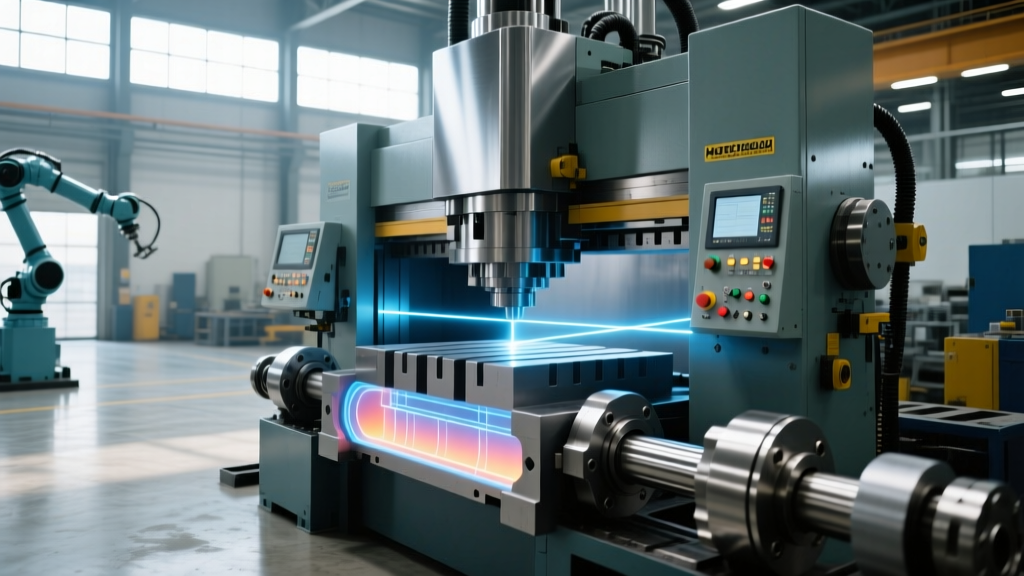
One of the most critical innovations in 2026 is the use of hybrid manufacturing—combining CNC machining with Laser Powder Bed Fusion (LPBF)—to create conformal cooling channels inside hot forging dies.
"Traditional drilled cooling lines are straight and distant from the complex die surface, creating hot spots that accelerate thermal fatigue. Conformal cooling channels follow the exact contour of the forging cavity, sitting just 4 to 6 millimeters beneath the surface, ensuring uniform heat extraction."
The Hybrid Manufacturing Workflow
- Subtractive Base Preparation: The main body of the die is rough-machined from a standard tool steel billet (e.g., H11 or H13) using a 5-axis CNC mill.
- Additive Deposition: The die is moved to a hybrid DED (Directed Energy Deposition) or LPBF machine. A high-performance alloy, typically Maraging steel (e.g., 18Ni-300) or Inconel 718, is printed directly onto the die face, simultaneously forming the complex, curved internal cooling channels.
- Final Hard Milling: The part is heat-treated, and the die surface is finish-milled to its final net-shape geometry and surface finish (Ra 0.4 µm).
This technique reduces cycle times on the forging press by up to 15% because the billet cools faster in the die, allowing the press to open sooner. The Society of Manufacturing Engineers (SME) notes that hybrid additive-subtractive workflows are rapidly becoming the standard for high-wear tooling applications where thermal management dictates tool survival.
Troubleshooting Thermal Fatigue: The EDM Recast Layer Problem
Despite advanced materials, many tooling manufacturers still suffer from premature die failure due to outdated finishing processes. A common culprit is the Electrical Discharge Machining (EDM) recast layer.
When EDM is used to machine tight radii or deep ribs in a forging die, the intense localized heat melts and instantly re-solidifies a thin layer of the tool steel. This "recast layer" (typically 10 to 25 microns thick) is highly brittle, riddled with micro-cracks, and possesses zero ductility. In a hot forging environment, these micro-cracks rapidly propagate under thermal cycling, leading to catastrophic spalling or heat checking within the first 2,000 strikes.
⚠️ Critical Manufacturing Directive:If EDM must be used for complex die geometries, the recast layer must be entirely removed before the tool is deployed. This requires either aggressive manual polishing (which risks altering critical dimensional tolerances) or, preferably, a secondary CNC hard-milling pass using specialized PVD-coated carbide ball-nose end mills to skim the final 30 microns of material.
Digital Twins and IoT-Embedded Tooling
The physical manufacturing of the tool is now just the first step. Leading hot forging machine tool manufacturers are embedding IoT architecture directly into the tooling during the fabrication process.
During the CNC machining phase, deep micro-channels are milled into the non-working faces of the die to house high-temperature fiber Bragg grating (FBG) optical sensors. These sensors are capable of surviving the 300°C+ ambient temperatures of the die block during forging operations. They provide real-time telemetry on thermal gradients and mechanical strain back to the press controller.
By pairing this physical sensor data with a digital twin of the die, forging operators can predict exactly when a specific section of the die is approaching its thermal fatigue limit, scheduling preventative re-machining or polishing before a catastrophic failure occurs. The U.S. Department of Energy's Advanced Manufacturing Office highlights that integrating digital sensing into heavy machinery tooling is vital for achieving the next generation of industrial energy efficiency and predictive maintenance.
Strategic Framework for Selecting a Tooling Partner
For forging facilities evaluating new tooling suppliers in 2026, rely on this technical audit checklist to verify their manufacturing capabilities:
- Metallurgical Traceability: Demand full ESR/PM certification and ultrasonic testing (UT) reports for all tool steel blocks to ensure zero internal pipe or segregation.
- Hard Milling Capability: Verify the supplier utilizes 5-axis CNC centers capable of hard milling up to 62 HRC, minimizing reliance on EDM and eliminating recast layer risks.
- Thermal Simulation: Require FEA (Finite Element Analysis) thermal cycling reports during the design phase to prove that cooling channel placement effectively mitigates predicted hot spots.
- Surface Integrity: Specify surface finish requirements (e.g., Ra 0.2 µm in high-flow zones) and demand profilometer readings to ensure optimal lubricant retention and reduced galling.
The manufacturing of hot forging tools has evolved from a brute-force machining exercise into a highly engineered, data-driven science. By adopting advanced PM steels, AI-optimized toolpaths, and hybrid additive manufacturing, the industry is finally solving the historic limitations of thermal fatigue and die wear.