Hot Forging Automation Equipment Manufacturer: Training Best Practices
Maximize ROI from your hot forging automation equipment manufacturer with advanced operator training frameworks, EOAT maintenance, and press synchronization.
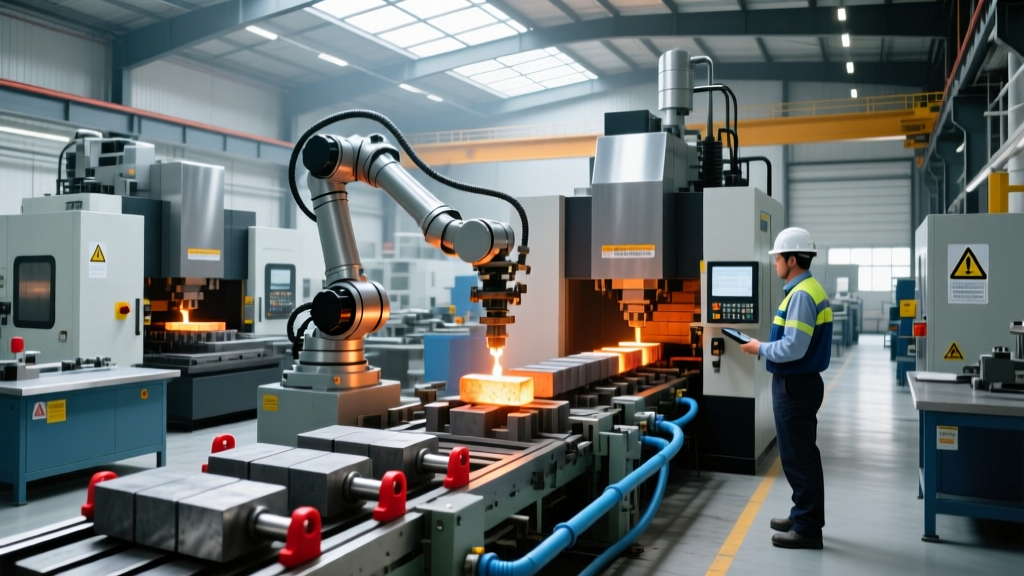
Selecting the right hot forging automation equipment manufacturer is only the first step; maximizing the ROI of that $3.5 million to $8 million investment requires a rigorous, post-commissioning operator training protocol. When a facility integrates a fully automated hot forging line—combining induction heaters, robotic tending, and high-tonnage mechanical or hydraulic presses—the OEM’s standard 14-day site acceptance training is rarely sufficient. OEM engineers optimize for ideal cycle times under controlled conditions. Daily floor operations, however, involve scale buildup, induction heater fluctuations, and severe thermal cycling of robotic end-of-arm tooling (EOAT).
Bridging the gap between OEM handover and sustained 85%+ Overall Equipment Effectiveness (OEE) demands a specialized training architecture. This guide outlines the critical competencies, fault-diagnosis frameworks, and safety protocols required to train operators on modern automated forging cells in 2026.
The Limitations of Standard OEM Commissioning Training
Most hot forging automation equipment manufacturer training programs focus heavily on basic HMI navigation, emergency stop resets, and standard cycle initiation. While essential, these sessions often bypass the edge cases responsible for 80% of unplanned downtime. Operators are taught how to run the machine when it is perfectly calibrated, but they are rarely trained on how to recover the cell when a billet sticks to the die, when the induction heater drops 40°C below setpoint, or when robotic gripper cooling lines experience a flow restriction.
⚠️ WARNING: The EOAT Thermal Blind SpotStandard OEM training frequently glosses over the active water-cooling circuits required for forging grippers. If operators bypass or ignore flow-rate alarms on the EOAT cooling lines to maintain cycle speed, the internal polyurethane seals and pneumatic cylinders will suffer catastrophic thermal degradation within 48 hours. Always train operators to monitor the 35°C inlet / 45°C outlet temperature delta on foundry-grade grippers (e.g., Schunk or FANUC foundry packages).
Critical Operator Competencies for Automated Forging Cells
To move beyond basic machine tending, lead operators and cell technicians must master three core domains specific to automated hot forging.
1. Induction Heating and Press Synchronization
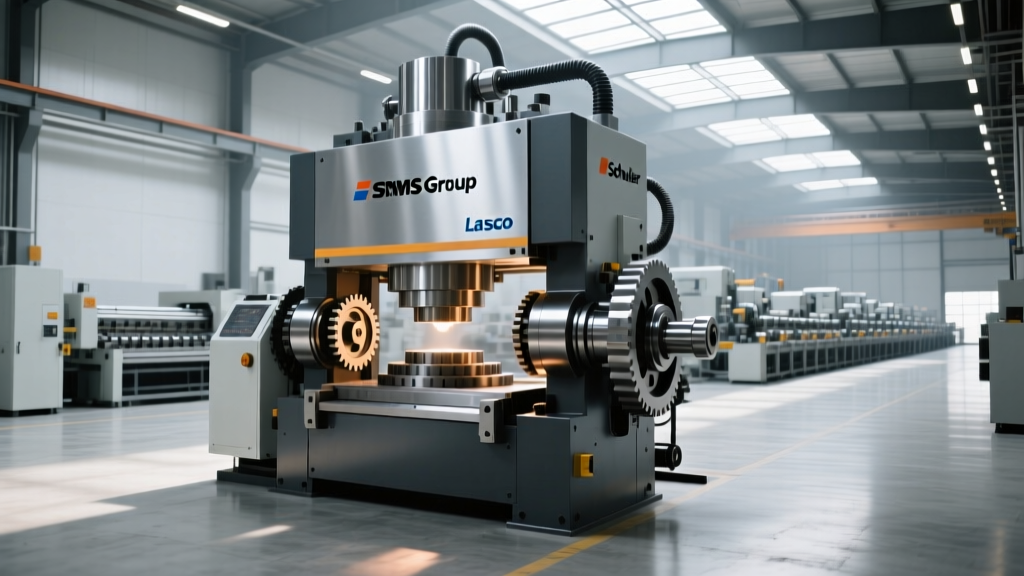
In an automated line, the induction heater dictates the pace of the press. Operators must be trained to read the pyrometer feedback loops. If a 100mm diameter 4140 steel billet exits the induction coil at 1,180°C instead of the target 1,220°C, the forging load on the press will spike. Modern press monitoring systems (like those on Schuler MSP or SMS group hydraulic presses) will automatically halt the stroke if the tonnage exceeds the die-safe threshold. Operators must be trained to adjust the billet dwell time in the inductor via the HMI rather than forcing the press cycle, which risks cracking the die inserts.
2. Robotic Tending and Singularity Recovery
Automated forging cells typically utilize 6-axis articulated robots with foundry wrist protections (e.g., KUKA KR Quantec F series or ABB IRB 6700). A common failure mode occurs when a dropped billet forces the robot into an unexpected singularity or joint limit during the transfer from the heater to the press. Operators must be trained in manual joint-jogging and tool center point (TCP) recalibration using the teach pendant, rather than relying on automated recovery routines that can drive the robot arm into the press bolster.
3. Automated Die Lubrication Management
Robotic die-spraying systems apply water-based graphite lubricants in precise millisecond bursts. Operators must be trained to visually verify the spray pattern and adjust the atomization air pressure. Over-spraying causes thermal shock and micro-cracking in the H13 tool steel dies; under-spraying leads to part sticking and tearing.
Automated Forging Fault Diagnosis Matrix
Provide operators with a physical and digital matrix for rapid troubleshooting. The table below outlines common automated forging faults and the exact operator interventions required.
| Fault Code / Symptom | Root Cause | Operator Intervention | Preventative Best Practice |
|---|---|---|---|
| Press Tonnage Overload (Stroke Halt) | Billet temperature below 1,150°C; excessive scale buildup in die cavity. | Reject cold billet. Initiate automated die-spray and air-blow cycle. Reset tonnage monitor. | Calibrate induction pyrometer weekly. Verify descaling pressure at 150+ bar. |
| Robot Transfer Fault (Grip Loss) | Scale accumulation on gripper fingers reducing friction; pneumatic pressure drop. | Manually clean EOAT fingers with brass wire brush. Check FRL (Filter-Regulator-Lubricator) unit. | Implement a 500-cycle EOAT wire-brush routine. Replace gripper fingers every 10,000 cycles. |
| Inductor Over-Temp Alarm | Scaling inside the copper induction coil water jacket restricting flow. | Switch to backup cooling pump. Flush coil with descaling solution during shift change. | Maintain closed-loop cooling water conductivity below 10 µS/cm to prevent mineral scaling. |
| Part Ejection Failure (Stuck in Lower Die) | Insufficient die lubrication; damaged knockout pin. | Halt cell. Enter LOTO. Manually extract part. Inspect knockout pins for shearing. | Verify graphite concentration in lubricant mix (target 15-20%). Test knockout stroke daily. |
The 90-Day Post-Commissioning Training Matrix
Relying on a single training week results in rapid knowledge decay. Implement this phased 90-day training framework to build deep, autonomous cell expertise.
- Days 1–14 (Shadowing & HMI Mastery): Operators shadow the OEM commissioning engineers. Focus strictly on safe startup/shutdown sequences, HMI alarm acknowledgment, and basic manual jogging of the press and robot.
- Days 15–30 (Fault Recovery & EOAT): Introduce controlled fault scenarios. Operators must demonstrate the ability to clear a jammed billet, swap out robotic gripper fingers, and purge the die-spray lines without OEM assistance.
- Days 31–60 (Process Optimization): Train operators on the relationship between induction heating parameters and press tonnage. Introduce statistical process control (SPC) for monitoring part flash thickness and adjusting the billet temperature accordingly.
- Days 61–90 (Preventative Maintenance Integration): Operators cross-train with the maintenance team on weekly tasks: checking hydraulic accumulator nitrogen pre-charge, testing light curtain muting functions, and verifying robot gearbox oil levels.
'The ROI of a fully automated forging line isn't realized on the day the OEM leaves the site. It is realized on day 400, when the night shift operator correctly diagnoses a 5% drop in induction heater efficiency and adjusts the dwell time before a single die is cracked.' — Director of Operations, Tier 1 Automotive Forging Supplier
Safety and LOTO Protocols for Integrated Robotic Presses
Automated forging cells merge the crushing hazards of mechanical power presses with the unpredictable kinetic energy of 6-axis robots. Compliance with ANSI B11.1 standards for mechanical power presses and OSHA robotics safety guidelines is non-negotiable. Operator training must heavily emphasize the following safety protocols:
- Light Curtain Muting Logic: Operators must understand when and why light curtains are muted (e.g., allowing the robot arm to pass through the perimeter). Training must cover how to verify that the muting lamps are functioning and that the physical safety interlocks on the robot's entry path are intact.
- Hydraulic Stored Energy: Unlike mechanical presses that rely on flywheel brakes, hydraulic forging presses store massive energy in accumulators. Operators must be trained to verify zero-energy states via physical pressure gauges, not just HMI readings, before entering the die space.
- Thermal PPE Requirements: Even in fully automated cells, operators must enter the cell for die changes and maintenance. Aluminized Kevlar proximity suits and face shields with IR filtering must be mandatory, as radiant heat from 1,200°C billets and dies persists long after the cell is powered down.
Continuous Improvement and Industry Standards
Finally, align your internal training documentation with the broader industry benchmarks provided by the Forging Industry Association (FIA). The FIA regularly updates safety and operational guidelines that reflect the latest advancements in automation and metallurgy. By integrating these external standards into your internal SOPs, you ensure your operators are not just running machines, but actively participating in a world-class manufacturing ecosystem.
Summary: Key Takeaways for Plant Managers
- Supplement OEM commissioning with a structured 90-day internal training matrix focused on edge-case fault recovery.
- Train operators to monitor EOAT cooling water temperatures and flow rates to prevent catastrophic gripper failure.
- Empower operators to adjust induction heater dwell times based on real-time press tonnage feedback to protect expensive die inserts.
- Enforce strict LOTO protocols that account for both robotic kinetic energy and hydraulic accumulator stored energy.