Choosing a Hot Forging Machine Tool Company: Top Alternatives
Compare top hot forging machine tool companies in 2026. Analyze SMS group, Schuler, and Lasco press alternatives, pricing, and drive technologies.
The Capital Reality of Hot Forging Procurement
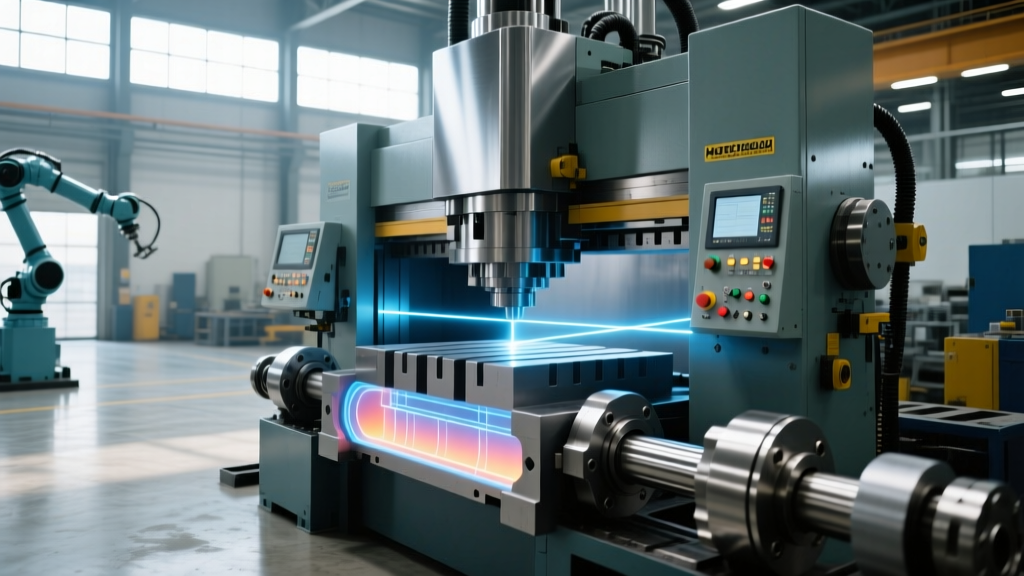
Procuring a new hot forging press line is a $5M to $15M capital commitment that dictates a plant's Overall Equipment Effectiveness (OEE) for the next 30 to 40 years. When evaluating a hot forging machine tool company, buyers are no longer just purchasing a press; they are acquiring an integrated thermal-mechanical ecosystem. In 2026, the market is dominated by a few elite OEMs, each offering distinct drive technologies, automation integrations, and metallurgical specialties. Selecting the wrong partner results in mismatched stroke rates, excessive H13 tool steel die wear, and bottlenecked induction heating cells.
2026 CapEx Benchmark: A fully automated 25,000 kN (2,500 ton) hot forging line—including induction heater, 6-axis robotic manipulator, and closed-die press—currently ranges from $5.8M to $8.4M USD, reflecting a 12% increase in servo-drive and hydraulic accumulator component costs since 2023.Profiling the Elite: Which Hot Forging Machine Tool Company Fits?
The global landscape is anchored by European and North American heavyweights. Here is how the top contenders differentiate their engineering philosophies.
SMS group (Eumuco Hasenclever Legacy)
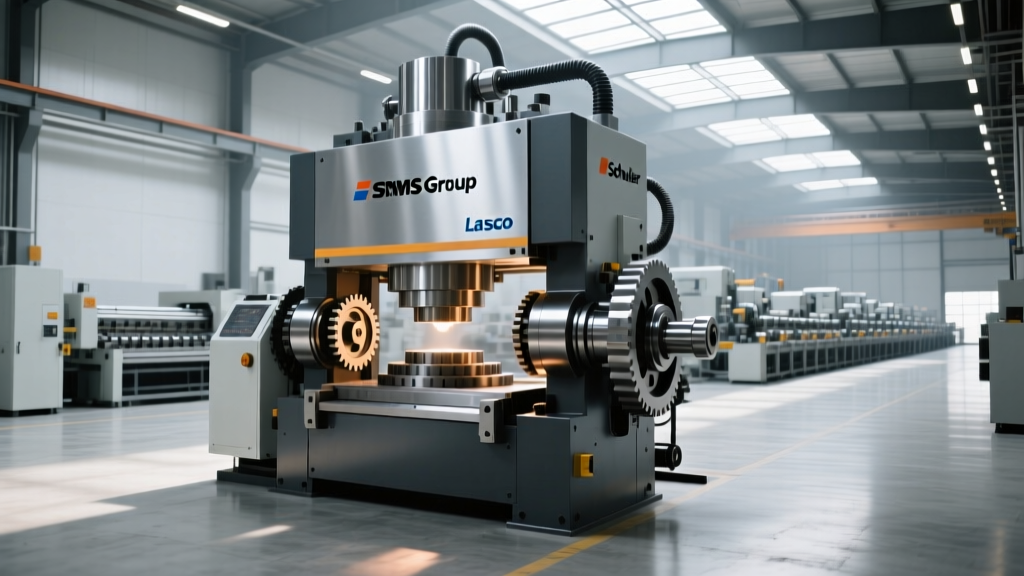
Following its strategic acquisitions, SMS group leverages the legendary Eumuco Hasenclever engineering lineage. They are the undisputed leaders in heavy eccentric and hydraulic hot forging presses. Their HPF (Hot Press Forging) eccentric lines are engineered for high-volume automotive components like crankshafts and steering knuckles. SMS excels in integrating linear manipulators directly with their press controls, achieving stroke-to-manipulation synchronization that reduces cycle times by up to 18% compared to retrofitted cells.
Schuler
Schuler approaches hot forging with a heavy emphasis on servo-driven technology and digital twin integration. While traditionally dominant in cold and warm forging, Schuler's automated hot forging lines utilize advanced servo motors to provide programmable stroke profiles. This allows the ram to decelerate precisely before die impact, reducing peak impact forces and extending die life when forging high-carbon steels. Their 'Digital Suite' provides real-time tonnage monitoring and predictive maintenance for the main drive bearings.
Lasco
For aerospace and specialty alloy forgings, Lasco is the premier hot forging machine tool company to evaluate. Their TZP series hydraulic screw presses combine the energy efficiency of a screw press with the programmable force of a hydraulic system. Lasco presses are uniquely suited for isothermal forging and slow-strain-rate applications required for titanium (Ti-6Al-4V) and nickel-based superalloys (Inconel 718), where dwell time and precise temperature retention are critical to preventing microstructural cracking.
2026 CapEx & Tonnage Comparison Matrix
| OEM | Flagship Hot Forging Tech | Tonnage Range | Drive Type | Best Application | Est. Base Price (USD) |
|---|---|---|---|---|---|
| SMS group | HPF Eccentric / Hydraulic | 6,300 - 63,000 kN | Eccentric Flywheel / Hydraulic | High-volume auto (crankshafts, axles) | $4.2M - $12.5M |
| Schuler | Automated Servo Forging | 10,000 - 40,000 kN | Servo-Eccentric | Precision auto, complex gears | $5.8M - $9.8M |
| Lasco | TZP Hydraulic Screw Press | 4,000 - 32,000 kN | Hydraulic Screw | Aerospace (Titanium, Inconel) | $3.9M - $8.1M |
| National Machinery | FORMAX / Heavy Eccentric | Up to 12,000 kN | Mechanical Eccentric | Warm/Hot multi-station parts | $2.8M - $5.5M |
Drive Technology Alternatives: The Engineering Trade-Offs
The most critical decision when selecting a hot forging machine tool company is the underlying drive technology. This choice dictates your energy consumption, die wear rates, and permissible metallurgical profiles.
Hydraulic Presses: The Dwell-Time Advantage
Hydraulic presses deliver full tonnage at any point in the stroke and allow for adjustable dwell times. According to data published by the Forging Industry Association (FIA), dwell time is essential when forging deep-cavity aerospace components. The sustained pressure allows the metal to flow into complex die radii without requiring excessive peak loads, reducing thermal shock and micro-cracking in H13 die inserts. However, hydraulic systems traditionally suffer from lower strokes-per-minute (SPM) and require rigorous maintenance of hydraulic fluid cooling systems to prevent viscosity breakdown in high-ambient-heat forge shops.
Eccentric Presses: The Volume Champion
Eccentric (crank) presses rely on a massive flywheel to store kinetic energy, delivering high impact velocity at the bottom dead center (BDC). They are vastly superior for high-volume, shallow-draft steel forgings. An eccentric press can easily achieve 25 to 40 SPM, dwarfing the 8 to 15 SPM of a standard hydraulic press. The trade-off is the inability to dwell; if the billet temperature drops or the volume varies slightly, the press will either fail to close the die (causing a 'hit') or transmit catastrophic shock loads through the frame.
"The shift toward servo-driven eccentric presses in 2026 bridges the historical gap. By utilizing high-torque servo motors instead of traditional induction motors and flywheels, OEMs can program the ram to strike fast, dwell for milliseconds to allow grain flow, and retract rapidly—optimizing both die life and cycle time." — Adapted from Forging Magazine technical analyses on servo press adoption.
Automation & Industry 4.0 Ecosystems
A press is only as profitable as the material handling system feeding it. When evaluating a hot forging machine tool company, scrutinize their native automation integration.
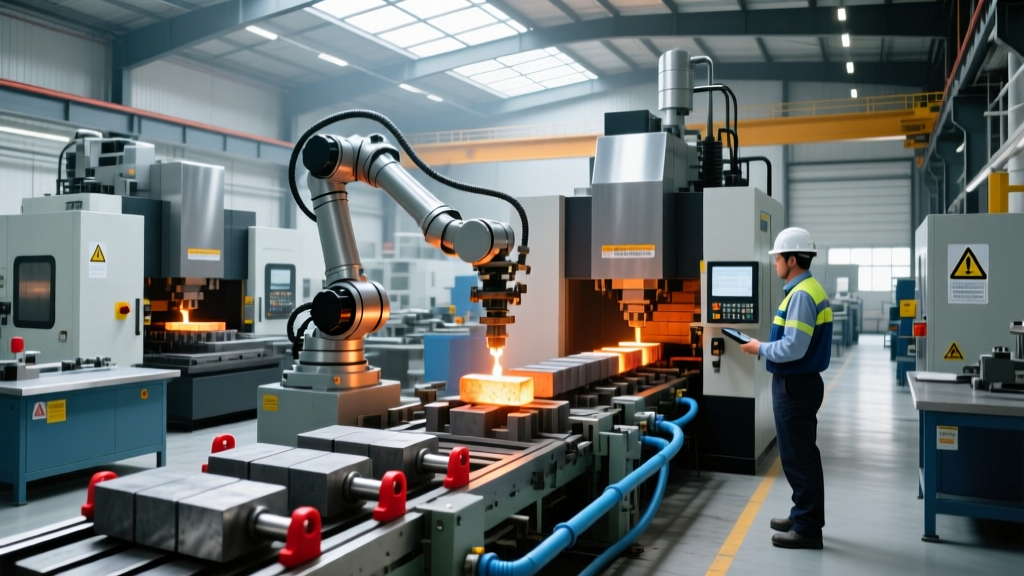
- Linear Manipulators vs. 6-Axis Robots: For billets exceeding 50 kg, heavy-duty linear manipulators (often supplied by partners like Gasparini or integrated natively by SMS) offer superior rigidity and speed over 6-axis articulated robots, which suffer from joint wear under extreme thermal radiation and heavy payload inertia.
- Induction Heating Synchronization: Top-tier companies integrate the press PLC directly with the induction heater (e.g., SMS Elotherm or Inductotherm). If the press faults or pauses, the PLC automatically reduces the induction coil voltage to prevent billet overheating and grain growth, a feature absent in budget-tier integrations.
- Die Lubrication Systems: Automated, programmable graphite-based or synthetic lubrication nozzles mapped to specific die zones are now standard on premium lines. This reduces lubricant waste by up to 30% and prevents localized die chilling, which causes premature thermal fatigue cracking.
Decision Framework: Selecting Your OEM Partner
Use this conditional logic tree to narrow down your hot forging machine tool company selection based on your specific production profile:
- If your primary output is high-volume automotive steel (crankshafts, connecting rods) exceeding 50,000 parts/month: Choose SMS group or National Machinery. You need the high SPM, heavy flywheel energy, and rugged mechanical eccentric architecture to maintain unit economics.
- If you are forging complex, near-net-shape gears or components requiring tight metallurgical tolerances with variable batch sizes: Choose Schuler. Their servo-eccentric technology allows you to save specific stroke profiles for different part numbers, eliminating the need for mechanical flywheel adjustments and reducing setup time by up to 40%.
- If your shop focuses on aerospace, medical, or defense alloys (Titanium, Inconel, Waspaloy) requiring slow strain rates and isothermal conditions: Choose Lasco. Their hydraulic screw presses provide the exact programmable dwell and controlled velocity required to prevent adiabatic shear banding in superalloys.
- If floor space is severely constrained and you require a compact, multi-operation cell: Evaluate Schuler's multi-station automated transfer lines, which integrate pre-forming, finishing, and piercing into a single press footprint, eliminating the need for separate reheating furnaces between operations.
Ultimately, the right hot forging machine tool company aligns its drive physics with your specific metallurgical reality. Prioritize OEMs that offer native PLC integration between the press, manipulator, and induction heater, ensuring your $8M investment operates as a single, synchronized organism rather than a collection of isolated machines.