2026 Packaging Machinery Industry News Today: Vacuum Sealer Safety
Explore 2026 packaging machinery industry news today focusing on vacuum sealer safety, FDA compliance, MAP gas risks, and UL 508A electrical standards.
Executive Briefing: 2026 Vacuum Sealer Compliance
Food preservation vacuum packaging machinery operates at the intersection of two strict regulatory domains: food contact safety and industrial machine guarding. For facility managers and safety directors tracking packaging machinery industry news today, the most critical 2026 updates revolve around heightened USDA enforcement of Modified Atmosphere Packaging (MAP) gas monitoring, and stricter UL 508A interpretations for IP69K washdown electrical panels. This guide details the exact compliance frameworks, hardware safety upgrades, and failure modes associated with modern chamber sealers and automated thermoformers.
The Shift in 2026 Regulatory Enforcement
Historically, packaging line safety focused primarily on mechanical guarding. In 2026, regulatory bodies are aggressively targeting the invisible hazards of vacuum sealing: atmospheric asphyxiation risks from MAP gases and micro-biological contamination from degraded sealing components. The FDA and OSHA have increased joint-audit frequencies in meat and poultry processing facilities, specifically targeting the intersection of machine lockout/tagout (LOTO) procedures and food contact surface validation.
Core Compliance Frameworks for Vacuum Sealers
Procuring or upgrading vacuum packaging equipment requires navigating a matrix of overlapping standards. Below is the definitive compliance matrix for 2026 food-grade vacuum sealers.
| Standard / Regulation | Governing Body | Application to Vacuum Sealers | 2026 Enforcement Focus |
|---|---|---|---|
| 21 CFR 177.1550 | FDA | Regulates fluorocarbon resins and PTFE coatings on sealing bars to prevent food contamination. | Mandatory migration testing logs for PTFE tape replacement cycles. |
| UL 508A / IP69K | UL / IEC | Electrical control panel safety and ingress protection for high-pressure, high-temperature washdowns. | Cracking down on unsealed conduit fittings causing 24V DC short circuits in wet environments. |
| ANSI/PMMI B155.1 | PMMI / ANSI | Baseline safety requirements for packaging machinery, including risk assessment and hazard mitigation. | Validation of Category 3 / PLd safety circuits on automated thermoformer loading zones. |
| OSHA 1910.147 | OSHA | Control of Hazardous Energy (LOTO) during film roll changes and sealing bar maintenance. | Verification of pneumatic energy bleed-off valves on chamber sealer lid actuators. |
Hardware Safety: Chamber Sealers vs. Thermoformers
Safety protocols and compliance costs scale dramatically depending on the automation level of the vacuum sealer. Understanding the specific failure modes of your machinery class is essential for passing modern safety audits.
Chamber Sealers (e.g., Henkelman Boxer 52 II)
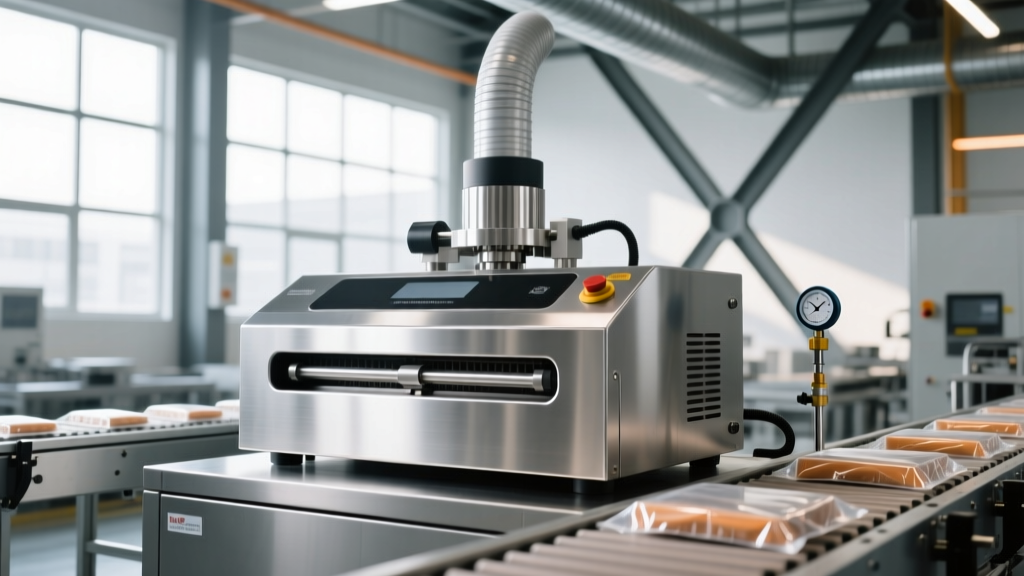
Chamber sealers are the workhorses of mid-volume food preservation. A standard unit like the Henkelman Boxer 52 II (pricing typically between $4,500 and $6,200) utilizes a heavy acrylic or stainless steel lid driven by pneumatic cylinders.
- Pneumatic Crush Hazards: The primary safety risk is the downward force of the lid closing. 2026 compliance requires these machines to be equipped with a mechanical safety strut or a pneumatic soft-stop valve that prevents lid closure if an obstruction (like an operator's hand) breaks a light beam or physical sensor.
- Sealing Bar Maintenance: The Teflon (PTFE) coating on the heating element must be replaced exactly every 40,000 to 50,000 cycles. Degraded PTFE flakes off into the vacuum pouch, violating FDA food contact regulations and causing micro-leaks that compromise the vacuum seal, leading to premature food spoilage.
Automated Thermoformers (e.g., Multivac R 245)
High-speed thermoformers (capital expenditure ranging from $250,000 to over $450,000) present severe mechanical and electrical hazards. The Multivac R 245 operates with massive clamping forces (up to 120 kN) and high-speed indexing chains.
- Light Curtain Integration: Manual loading zones must be guarded by muting light curtains (such as the SICK deTec4 Core series, costing roughly $2,800 per pair). These must be wired to a safety PLC achieving ISO 13849-1 Performance Level d (PLd).
- Electrical Washdown Compliance: Because thermoformers undergo daily caustic foam cleaning, all servo motors and sensors must carry an IP69K rating. Control panels must meet UL 508A standards with positive-pressure purging systems to prevent corrosive washdown chemicals from entering the enclosure and degrading the contactors.
MAP Gas Hazards: The Silent Compliance Trap
Modified Atmosphere Packaging (MAP) extends shelf life by flushing the vacuum chamber with a gas mixture—typically Nitrogen (N2) and Carbon Dioxide (CO2)—before the final seal. While highly effective for preserving red meat and poultry, CO2 presents a severe, often overlooked asphyxiation hazard.
CRITICAL SAFETY WARNING: CO2 Pooling
Carbon dioxide is 1.5 times heavier than air. In the event of a micro-leak in the MAP gas manifold or a faulty vacuum pump exhaust valve, CO2 will not dissipate. It pools in floor drains, machine pits, and trenching. According to NIOSH guidelines on asphyxiation, oxygen displacement in these low-lying areas can cause sudden unconsciousness without warning. Facilities utilizing MAP vacuum sealers must install fixed CO2 monitors (e.g., Dräger Polytron 8100) at ankle height, hardwired to trigger facility exhaust fans if concentrations exceed the OSHA PEL of 5,000 ppm.
Troubleshooting Common Validation Failures
During 2026 third-party safety audits (such as those conducted by AIB International or SGS), facilities frequently fail on highly specific, easily preventable vacuum sealer maintenance issues. Use this troubleshooting matrix to prep your packaging line:
- Failure Mode: Vacuum pump oil aerosolization contaminating the food product.
Root Cause: Clogged exhaust filters on the rotary vane vacuum pump (e.g., Busch R5 series).
Compliance Fix: Install a secondary inline HEPA coalescing filter on the exhaust line and log filter differential pressure checks weekly. - Failure Mode: LOTO audit failure during sealing bar replacement.
Root Cause: Operators relying solely on the E-Stop and main disconnect, ignoring stored pneumatic energy in the lid actuators.
Compliance Fix: Retrofit the pneumatic manifold with a lockable dump valve (e.g., Festo MS6-EE series) that physically bleeds air pressure to zero when locked out, satisfying OSHA's Control of Hazardous Energy standard. - Failure Mode: Inconsistent vacuum levels causing anaerobic bacteria growth (Clostridium botulinum).
Root Cause: Micro-abrasions on the chamber seal gaskets allowing atmospheric air ingress during the final seal phase.
Compliance Fix: Transition from standard silicone gaskets to FDA-compliant Viton (FKM) gaskets, which resist degradation from high-fat meat juices and acidic marinades, extending replacement intervals from 3 months to 14 months.
Expert Procurement Checklist for 2026 Facility Upgrades
When specifying new vacuum packaging machinery, embed these non-negotiable safety and compliance requirements into your RFQ (Request for Quote):
- Material Traceability: Require the OEM to provide 3.1 material certificates for all 316L stainless steel contact surfaces, proving compliance with FDA 21 CFR requirements.
- Safety Circuit Architecture: Mandate that all safety interlocks (lid switches, guarding doors) are wired via dual-channel safety relays, not standard PLC inputs, to prevent single-point-of-failure bypasses.
- Washdown Documentation: Require IP69K certification documentation specifically for the HMI touchscreens and cable glands, not just the main machine chassis.
- Gas Manifold Integrity: Specify electropolished 316 stainless steel gas mixing manifolds with automated leak-test routines programmed into the HMI startup sequence.
'The cost of a vacuum sealer is no longer just the capital invoice; it is the total cost of compliance. A $5,000 chamber sealer that lacks proper pneumatic LOTO valves or FDA-documented PTFE supply chains will cost a facility ten times that amount in audit remediation and product hold delays.' — 2026 PMMI Safety Task Force Briefing Notes.
By aligning your vacuum packaging operations with these rigorous 2026 safety and food-contact standards, facilities can eliminate mechanical hazards, prevent catastrophic MAP gas incidents, and ensure uninterrupted compliance with federal food safety mandates.