Shrink vs Stretch Wrappers: Packaging Machinery News December 2025
Compare shrink vs stretch wrapping equipment based on packaging machinery news December 2025. Find 2026 pricing, film costs, and model specs.
Capital expenditure allocations for Q1 2026 require precise differentiation between secondary packaging technologies. Following the major equipment reveals and market shifts highlighted in packaging machinery news December 2025, buyers face a critical divergence in automation strategies. The choice between shrink wrapping and stretch wrapping is rarely interchangeable; it is dictated by load geometry, thermal sensitivity, and specific film-yield economics. This guide dissects the technical specifications, exact pricing tiers, and failure modes of both systems to provide an actionable procurement framework.
Rapid Diagnostic: Which Technology Fits Your Line?
- Select Shrink Wrapping If: You are packaging consumer-facing retail goods, multi-packs (e.g., beverage cans), or irregularly shaped items requiring tight, tamper-evident, high-clarity containment.
- Select Stretch Wrapping If: You are securing uniform pallet loads for transit, dealing with heat-sensitive products (e.g., chocolate, certain chemicals), or require high-throughput unitization at the end of a distribution line.
Shrink Wrapping Equipment: 2026 Market & Model Breakdown
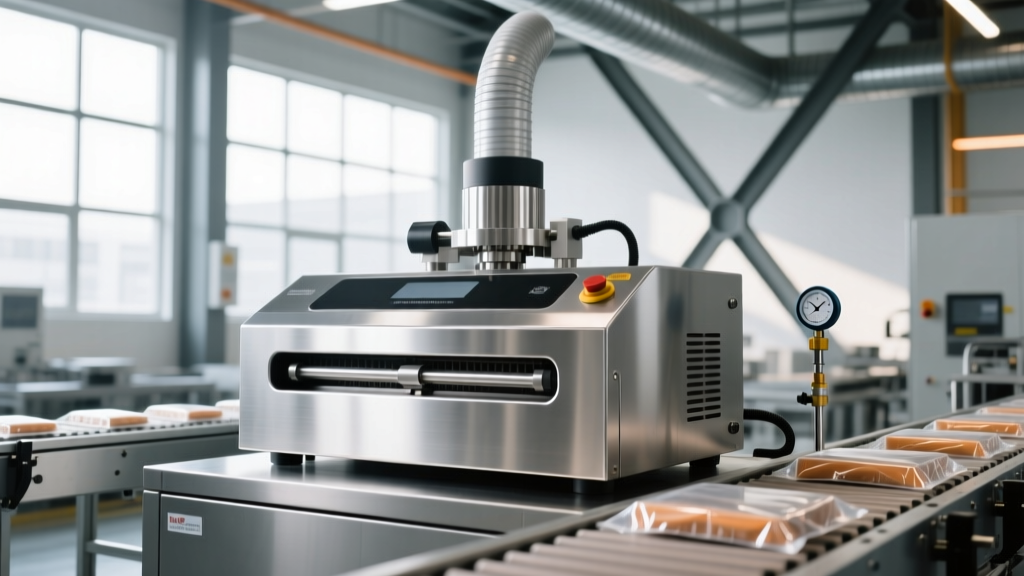
Shrink wrapping relies on the application of heat to a polymer film (typically Polyolefin or PVC), causing it to contract tightly around the product. The December 2025 trade cycle emphasized a shift toward energy-efficient tunnel designs and automated L-bar sealers with integrated film tracking.
Core Equipment Models and Pricing
For semi-automatic operations processing 10 to 20 packages per minute, the Eastey ERV-225 remains a benchmark L-bar sealer, typically priced between $7,200 and $8,500. For higher volumes (30+ PPM), fully automatic side-seal systems like the Sealed Air Cryovac C-400 command prices ranging from $28,000 to $42,000, depending on conveyor length and infeed automation.
Film Specifications and Yield
Modern shrink operations predominantly use cross-linked Polyolefin (POF) due to its superior clarity and lack of toxic off-gassing compared to PVC. A standard 12-inch x 6,000-foot roll of 75-gauge POF costs approximately $135 to $155. Because shrink film does not stretch prior to application, the film cost per package is strictly a function of the product's surface area plus a 15% allowance for the seal trim.
Critical Failure Mode Warning: The most common point of failure in L-bar sealers is the degradation of the Teflon tape covering the seal wire. When the tape wears through, the 350°F+ seal bar melts the film directly to the metal, causing catastrophic web breaks and requiring 45+ minutes of downtime for wire cleaning and tape replacement. Procure high-density, 0.015-inch Teflon covers and schedule replacements every 250,000 cycles.Stretch Wrapping Equipment: Pallet Unitization Specs
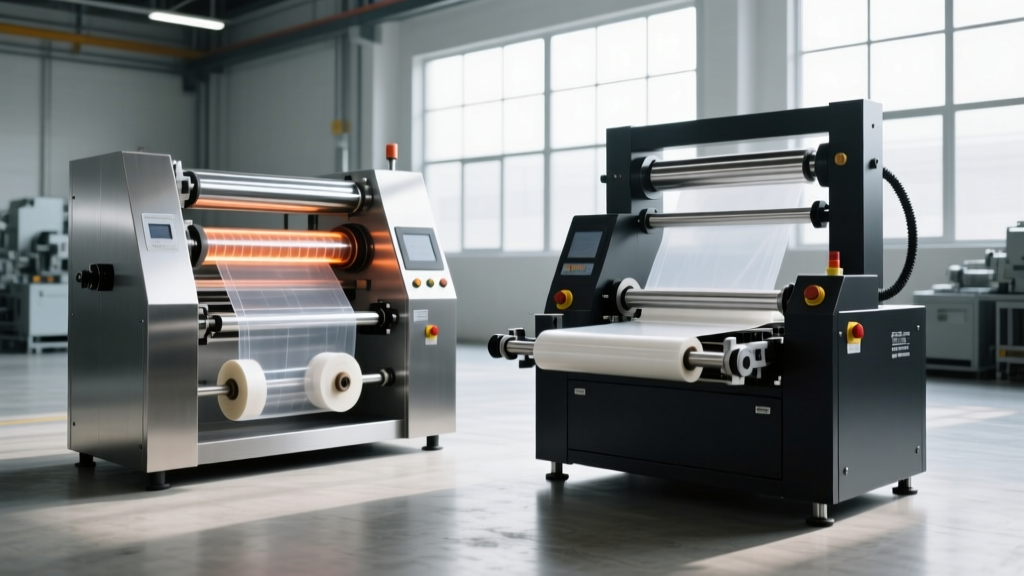
Stretch wrapping utilizes the elastic recovery of Linear Low-Density Polyethylene (LLDPE) to bind palletized loads. The mechanical advantage of stretch wrappers lies in the pre-stretch carriage, which thins the film before application, drastically reducing material costs per load.
Turntable vs. Rotary Arm Configurations
For standard loads under 4,500 lbs, turntable wrappers like the Lantech Q-300XT (priced at $16,500 to $19,000) dominate the market. These units utilize a powered roller pre-stretch carriage capable of achieving 250% to 300% stretch ratios. For unstable or exceptionally heavy loads (up to 12,000 lbs), rotary arm systems like the Robopac Rotoplat 108 ($24,000 to $32,000) keep the load stationary while the film carriage rotates, preventing load shifting and crushing.
The Economics of Pre-Stretch and Nano-Layers
A standard 20-inch x 5,000-foot roll of 80-gauge LLDPE stretch film costs roughly $85 to $110. However, raw gauge is a misleading metric. Advanced multi-layer nano-films (often 50-gauge) offer the same puncture resistance as legacy 80-gauge films but yield significantly more footage per roll. When paired with a 250% pre-stretch carriage, one foot of film on the roll covers 3.5 feet of the load. This mechanical advantage reduces film cost per pallet to as low as $0.35 to $0.55, compared to $1.20+ for hand-wrapping without pre-stretch.
"The transition to 300% pre-stretch carriages requires precise tension control. If the film is stretched beyond its elastic recovery limit, it will snap back after application, crushing corrugated cartons on the pallet corners. Always utilize adjustable corner-compensation sensors on loads with sharp edges."
— Technical Bulletin, Packaging Machinery Manufacturers Institute (PMMI)
Head-to-Head Comparison Matrix
| Metric | Shrink Wrapping (Auto L-Bar + Tunnel) | Stretch Wrapping (Turntable) |
|---|---|---|
| Primary Application | Retail multi-packs, tamper evidence, irregular shapes | Pallet unitization, transit stabilization, dust protection |
| Capital Cost (Mid-Range) | $12,000 - $25,000 | $16,500 - $28,000 |
| Energy Requirements | 480V 3-Phase (20-40 Amps for heat tunnel) | 110V/120V Standard (Turntable motor & carriage) |
| Film Cost per Unit/Pallet | $0.08 - $0.25 (per small retail bundle) | $0.35 - $0.60 (per standard 48x40 pallet) |
| Throughput Speed | 20 - 45 packs per minute | 15 - 35 pallets per hour |
| Thermal Impact | High (350°F+ tunnel; unsuitable for heat-sensitive goods) | None (Cold application process) |
The Hidden Costs of Wrapping Lines
When evaluating total cost of ownership (TCO) for 2026 facility planning, buyers must look beyond the initial equipment invoice. The most frequently overlooked variables are energy consumption and film waste.
Energy Consumption Discrepancies
Shrink tunnels are massive energy sinks. A standard 8-foot conveyorized shrink tunnel draws between 15 kW and 30 kW of continuous electrical power to maintain internal ambient temperatures of 350°F to 400°F. In facilities operating two shifts (16 hours/day), this translates to roughly $8,500 to $12,000 annually in electricity costs per tunnel. Stretch wrappers, relying solely on fractional horsepower motors for turntable rotation and carriage elevation, consume less than $400 annually in power.
Maintenance and Wear Components
Stretch wrappers require rigorous mechanical maintenance. The pre-stretch carriage relies on rubberized nip rollers to grip and pull the film. These rollers degrade due to film dust accumulation and must be replaced every 12 to 18 months at a cost of $350 to $500 per set. Failure to replace worn rollers results in uneven stretch, leading to load failure during transit. Shrink wrappers, conversely, have fewer moving parts but require daily cleaning of the seal bar and monthly replacement of the conveyor track chain, which stretches and binds under high-heat conditions.
Sourcing and Industry Standards
Procurement decisions should be aligned with current industry benchmarks and safety standards. Ensure all equipment complies with ANSI/RIA 15.06 safety standards for industrial robots and automated guided vehicles if integrating robotic palletizers upstream of the stretch wrapper. For comprehensive data on secondary packaging trends and equipment certification, consult resources from PMMI (The Association for Packaging and Processing Technologies). Additionally, staying updated on material science advancements in polymer films through publications like Packaging World is essential for optimizing film-yield ratios. For specific shrink film compatibility and sealing temperature profiles, reference technical data sheets provided by major manufacturers such as Sealed Air.
Final Procurement Directive
Do not default to stretch wrapping for retail-ready bundles, nor attempt to use shrink wrapping for heavy pallet unitization. Map your exact load dimensions, calculate the daily volume, and audit your facility's available electrical infrastructure (specifically 480V 3-phase availability) before issuing an RFQ. The right technology, paired with the correct film gauge and pre-stretch ratio, will yield a 20% to 35% reduction in material waste over a 24-month operational cycle.