Inside Automated Packaging Machinery: Case Packing Specs & Mechanics
Explore the technical specifications, PLC architecture, and operating mechanics of automated case packing and cartoning packaging machinery.
Core Kinematics and Operating Principles
Automated case packing and cartoning represent the critical bridge between primary filling operations and tertiary palletizing. When evaluating secondary packaging machinery for end-of-line operations, engineers must match the machine's kinematic profile to the product's fragility, weight, and required throughput. Modern systems have largely abandoned mechanical line-shafts in favor of multi-axis electronic camming (E-Cam), allowing infinite adjustability without physical gear changes.
Baseline Technical Specifications (2026 Standard)
- Throughput Range: 15 to 85 cases per minute (CPM) depending on collation complexity.
- Format Changeover: Under 12 minutes via tool-less, color-coded quick-release starwheels and digital recipe recall.
- Power Requirements: 480V 3-phase, 20-40 Amps; 80-100 PSI clean, dry air (CDA) at 15 CFM.
- Construction: 304 or 316L stainless steel tubular framing with IP65/IP69K washdown ratings for food and beverage environments.
Wrap-Around Case Packers
Wrap-around systems erect a case directly around the product group. A flat corrugated blank is pulled from a magazine, scored, and wrapped around the collated product matrix (e.g., a 2x3 or 4x6 bottle grid). This method provides superior structural integrity because the corrugated flutes are compressed tightly against the product, minimizing transit shift. The flight bars that push the product onto the blank must synchronize perfectly with the blank-feed conveyor. In modern architectures, this is achieved via a 1ms EtherCAT fieldbus linking the master product encoder to the blank-feed servo, eliminating the backlash inherent in legacy chain-driven systems.
Drop-Pack and Side-Load Systems
Drop-packers utilize gravity to load products into pre-formed Regular Slotted Containers (RSC). Products are collated on a staging table, then a grid or drop-board lowers them into the case. This is ideal for heavy, rigid items like glass jars or canned goods where lateral pushing might cause scuffing. Side-load cartoners, conversely, use a horizontal bucket conveyor to push lightweight, fragile items (like pouches or blister packs) into pre-glued cartons. The critical spec here is the insertion force; servo-driven pusher heads monitor torque feedback in real-time to halt the machine if a carton is misaligned, preventing product crushing.
Control Architecture and Automation Components
The brain of any high-speed case packer is its Programmable Logic Controller (PLC) and motion control network. The industry standard has shifted toward integrated motion-logic controllers, such as the Allen-Bradley ControlLogix series or Beckhoff TwinCAT 3 systems. These platforms handle high-speed registration, where an optical sensor reads a fiducial mark on the corrugated blank and dynamically adjusts the servo phase to ensure the product drops into the exact center of the case.
Human-Machine Interfaces (HMIs) have evolved from simple push-button panels to 15-inch or 21-inch edge-computing touchscreens. These panels not only display OEE (Overall Equipment Effectiveness) metrics but also run 3D augmented reality (AR) changeover guides, showing operators exactly which handwheels to adjust for a new SKU. Vision systems, typically Cognex In-Sight or Keyence XG series, are mounted pre-case-drop to verify lot codes and label orientation, rejecting faulty primary packages before they contaminate a secondary case.
Comparative Analysis: Case Packing Technologies
| Technology | Best Application | Speed (CPM) | Material Efficiency | Capital Cost (USD) |
|---|---|---|---|---|
| Wrap-Around | Beverages, cans, rigid bottles | 30 - 85 | High (uses flat blanks, saves 15% vs RSC) | $250,000 - $450,000 |
| Drop-Pack | Heavy glass jars, fragile ceramics | 15 - 40 | Medium (requires pre-formed RSC) | $120,000 - $220,000 |
| Robotic Pick-and-Place | Mixed SKUs, low-volume/high-mix | 20 - 60 (per robot) | High flexibility, handles varied case sizes | $180,000 - $350,000 |
Adhesive Application and Sealing Mechanics
Case sealing relies heavily on hot melt adhesive systems. Nordson and ITW Dynatec dominate this space. In 2026, melt-on-demand (MOD) systems like the Nordson ProBlue Freedom are standard. Unlike traditional melters that keep a large reservoir of glue at 350°F (176°C) continuously—leading to adhesive charring and nozzle clogging—MOD systems melt only the exact volume of adhesive required for the current production run.
For high-speed wrap-around packers, metallocene-based hot melt adhesives are specified over standard EVA (Ethylene Vinyl Acetate). Metallocene offers superior thermal stability and maintains bond strength across the extreme temperature fluctuations encountered in unclimate-controlled warehouses and refrigerated transit containers. The glue pattern is typically a 2mm bead with precise start/stop cutoffs controlled by a high-speed solenoid valve pulsing at up to 500 Hz.
Real-World Failure Modes and Edge Cases
Designing and maintaining case packing machinery requires anticipating specific, non-obvious failure modes that plague end-of-line operations:
- Corrugated Dust Blinding Optics: The friction of moving cardboard generates microscopic corrugated dust. This dust coats standard photoelectric sensors (e.g., SICK or Banner), causing false 'case present' or 'jam' faults. Solution: Specify polarized retro-reflective sensors or ultrasonic sensors for case detection in the magazine and discharge zones, and install automated air-purge nozzles over critical optical lenses.
- Vacuum Cup Degradation on Porous Blanks: Standard nitrile vacuum cups lose suction on rough, recycled-content corrugated blanks due to micro-leaks. Solution: Utilize multi-bellows cups (like Piab piGRIP) with integrated vacuum-check valves that isolate the leak and maintain system pressure across the remaining cups.
- Servo Drift on E-Cam Profiles: Over time, mechanical wear in the gearbox of the flight-bar servo can cause micro-milliseconds of lag, resulting in the product colliding with the trailing edge of the case. Solution: Implement closed-loop auto-tuning routines that run during the machine's daily CIP (Clean-in-Place) or idle cycles to recalibrate the electronic cam master-slave offset.
Capital Expenditure and ROI Considerations
Procuring automated case packing machinery is a significant capital expenditure. A baseline semi-automatic drop-packer starts around $85,000, but fully automated, high-speed wrap-around systems with integrated case erecting and taping easily command $350,000 to $450,000. When calculating ROI, facilities must factor in the labor savings of eliminating 2 to 4 manual case packers per shift, alongside the reduction in ergonomic injury claims associated with repetitive lifting.
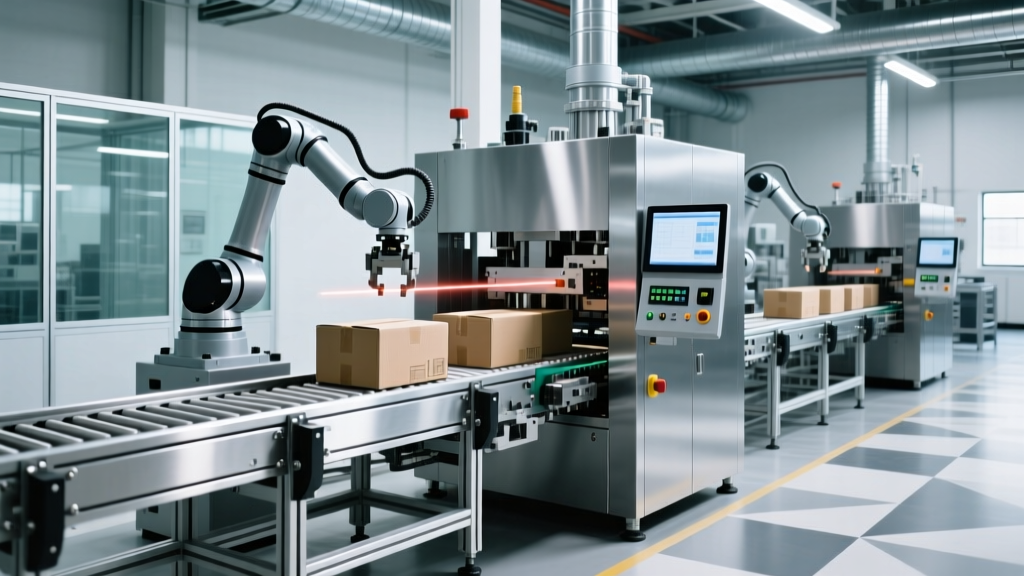
Furthermore, the shift toward e-commerce fulfillment requires machinery capable of handling Right-Sized Packaging on Demand (RSPOD). Modern robotic case packers equipped with 3D vision can dynamically measure the product matrix and cut a custom corrugated blank on the fly, eliminating void-fill materials and reducing dimensional weight shipping costs by up to 22%. This level of integration transforms the case packer from a simple end-of-line utility into a strategic logistics optimization node.