Integrated Packaging Machinery: 2026 Multi-Head Weigher Trends
Explore how integrated packaging machinery and AI-driven multi-head weighers optimize snack food lines, reduce giveaway, and maximize OEE in 2026.
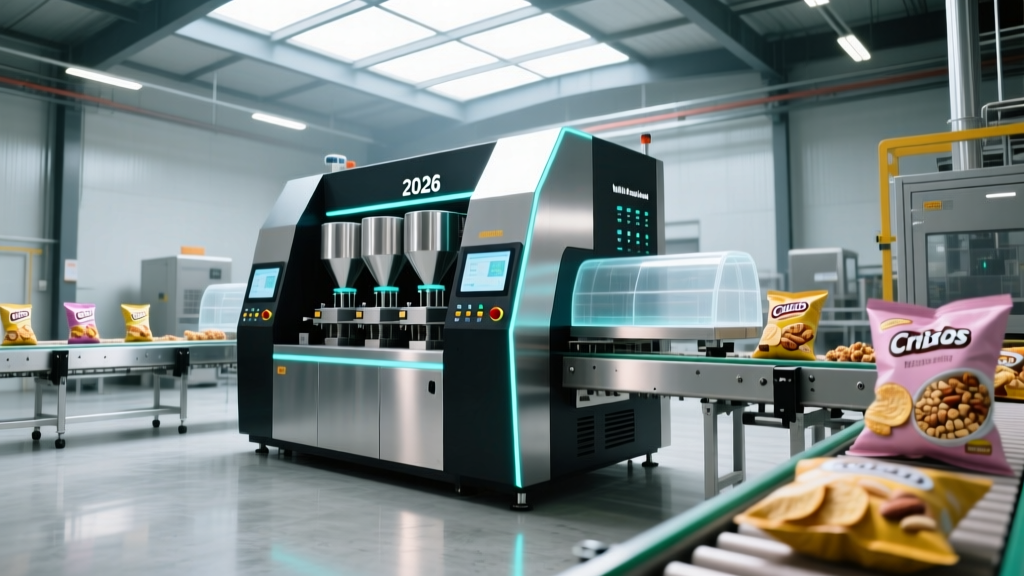
Snack food manufacturers operate on razor-thin margins where a single gram of product giveaway per bag can erode millions in annual revenue. As consumer demand for diverse snack formats—from fragile kettle chips to sticky gummy confections—accelerates, legacy weighing systems can no longer keep pace. The solution lies in deploying advanced integrated packaging machinery that treats the multi-head weigher not as an isolated island, but as the central nervous system of the entire vertical form-fill-seal (VFFS) or cartoning line.
The Architecture of Modern Snack Packaging Lines
In 2026, standalone weighers are obsolete. True efficiency requires bidirectional communication between the weighing system, the film transport, the sealing jaws, and the downstream checkweighers. When configuring integrated packaging machinery for snack foods, the multi-head weigher must dynamically adjust its discharge timing based on the real-time thermal status of the VFFS seal bars. If the seal bar temperature drops by 2°C due to a draft or film thickness variation, the weigher's PLC automatically delays the product drop by milliseconds to prevent film burn-through and leaker bags.
2026 Industry Benchmark: Modern 24-head integrated weighers operating in sync with continuous-motion VFFS systems are achieving sustained speeds of 210 weighments per minute (wpm) with a standard deviation of just 0.3 grams, effectively eliminating overfill giveaway on standard 150g chip bags.Algorithmic Combinatorics and AI Vision
The core innovation driving modern multi-head weighers is the shift from standard combinatorial math to AI-driven neural networks. Legacy 14-head systems calculated combinations using basic statistical probability. Today's 20- and 24-head systems, such as the latest iterations of the Ishida CCW-RV and Yamato CCW-AS series, utilize machine learning algorithms that adapt to product density shifts in real time.
How AI Adjusts to Snack Variability
Potato chips are notorious for varying in density depending on the harvest season and fryer oil temperature. An AI-equipped weigher uses inline near-infrared (NIR) sensors and load-cell feedback to map the volume-to-weight ratio of every single bucket. If the system detects a batch of highly aerated, low-density chips, it automatically alters the vibration amplitude of the radial feeder to prevent product bridging, while simultaneously calculating combinations that prioritize volume limits to ensure the bag can physically close without crushing the product.
| Feature | Legacy 14-Head (Pre-2022) | AI-Integrated 24-Head (2026 Standard) |
|---|---|---|
| Max Speed (wpm) | 120 wpm | 210 - 240 wpm |
| Giveaway (Std. Dev) | 1.5g - 2.5g | 0.2g - 0.5g |
| Changeover Time | 45 - 60 minutes (manual wash) | 12 minutes (Auto CIP & Recipe recall) |
| Communication Protocol | Hardwired I/O, Basic RS-232 | OPC-UA, PackML, MQTT for IIoT |
| CapEx Range (USD) | $55,000 - $75,000 | $135,000 - $185,000 |
Overcoming Snack-Specific Edge Cases
Integrating a weigher into a high-speed line is only half the battle; handling the physical characteristics of the snack is where most OEE (Overall Equipment Effectiveness) losses occur. Below is a troubleshooting matrix for the three most problematic snack categories.
1. High-Fat and Sticky Products (Gummies, Chocolate-Covered Nuts)
Failure Mode: Product adheres to the pool plates and hopper doors, causing under-weighing and misfires.
Hardware Solution: Specify C4 (tungsten carbide) coated contact parts or specialized dimpled 316L stainless steel plates. For extreme stickiness, integrate ultrasonic vibration motors on the discharge chutes rather than standard mechanical knockers, which can fracture delicate gummies.
2. Fragile and Irregular Shapes (Kettle Chips, Tortilla Scoops)
Failure Mode: High drop distances and aggressive vibration shatter the product, generating excessive dust and 'fines' that foul the VFFS seal jaws.
Hardware Solution: Implement 'staircase' or staggered discharge chutes with shallow angles (under 45 degrees). Utilize integrated packaging machinery that features 'soft-drop' technology, where the weigher times the discharge so the product lands on a cushion of previously dropped product already sitting in the VFFS forming tube.
3. Static-Prone Products (Extruded Puffs, Cheese Curls)
Failure Mode: Triboelectric charging causes lightweight puffs to cling to the sides of the forming tube, leading to jammed seal jaws and skewed bags.
Hardware Solution: Install active ionizing air bars directly at the weigher discharge collar. According to Packaging World engineering analyses, neutralizing static before the product enters the forming tube reduces seal-jaw cleaning downtime by up to 40% on extruded snack lines.
Financial Justification: ROI and Giveaway Reduction
The capital expenditure for a fully integrated 24-head system with Clean-in-Place (CIP) capabilities and OPC-UA connectivity typically ranges between $145,000 and $185,000. However, the ROI is almost entirely driven by giveaway reduction.
'When you reduce standard deviation from 2.0 grams to 0.4 grams on a line running 150 bags per minute, 24 hours a day, you save roughly 345 kilograms of product per week. For a premium snack retailing at $8 per kilogram, that single weigher upgrade yields over $140,000 in recovered product value annually.' — PMMI (The Association for Packaging and Processing Technologies) Operations Outlook.
Furthermore, integrated Clean-in-Place (CIP) systems reduce sanitation water usage by 60% and cut changeover labor from a two-person, one-hour task to a single-operator, 15-minute automated cycle. This directly boosts OEE by reclaiming up to 4 hours of production time per week on lines running multiple SKUs.
Step-by-Step Integration Checklist for VFFS Lines
To ensure your multi-head weigher functions as true integrated packaging machinery rather than a bottleneck, follow this commissioning protocol:
- Establish OPC-UA Handshakes: Map the weigher's 'Ready to Drop' and 'VFFS Jaws Clear' tags. Never rely on simple photo-eyes for high-speed synchronization.
- Calibrate the Forming Tube Air Cushion: Adjust the internal air pressure of the VFFS tube to match the terminal velocity of your specific snack to prevent product bounce-back.
- Implement Checkweigher Feedback Loops: Connect the downstream dynamic checkweigher to the weigher's auto-zero function. If the checkweigher detects a 1g upward drift over 50 consecutive bags, it must automatically command the weigher to offset its target weight downward.
- Validate Dust Extraction: Ensure the central dust collection system pulls a negative pressure of at least -1.5 inches of water gauge at the weigher collar to prevent seasoning buildup on the load cells.
Frequently Asked Questions (FAQ)
Can I retrofit an older VFFS to work with a 2026 AI multi-head weigher?
Yes, but it requires an edge-computing gateway. Modern weighers output MQTT or OPC-UA data. If your VFFS is pre-2018 and only accepts hardwired dry contacts or basic Modbus, you will need a protocol converter (such as a Moxa or HMS Anybus gateway) to translate the AI weigher's predictive timing signals into basic trigger pulses. Expect to spend $4,000 to $8,000 on integration hardware and PLC reprogramming.
What is the maximum drop height for fragile snacks before breakage becomes unacceptable?
For standard potato chips, the free-fall distance from the weigher discharge chute to the top of the product bed in the bag should not exceed 400mm. If your facility requires a higher drop due to ceiling constraints or mezzanine layouts, you must specify a specialized 'cushion-drop' forming tube with internal baffles, or utilize a secondary elevator system integrated directly beneath the weigher.
How often do load cells need recalibration in a high-vibration snack environment?
With modern digital load cells featuring built-in vibration filtering, physical recalibration is only required every 12 months or after a physical impact event. However, automated dynamic span checks—where the system drops a known internal test weight during brief line stoppages—should be programmed to run every 4 hours to ensure the weighing manufacturer's accuracy tolerances are maintained without manual intervention.