Triangle Packaging Machinery: Sleeve vs PS Labeler Maintenance
Compare maintenance schedules, wear parts, and downtime costs for pressure-sensitive vs. sleeve labelers on Triangle Packaging Machinery lines.
The Maintenance Divide: Pressure-Sensitive vs. Shrink Sleeve
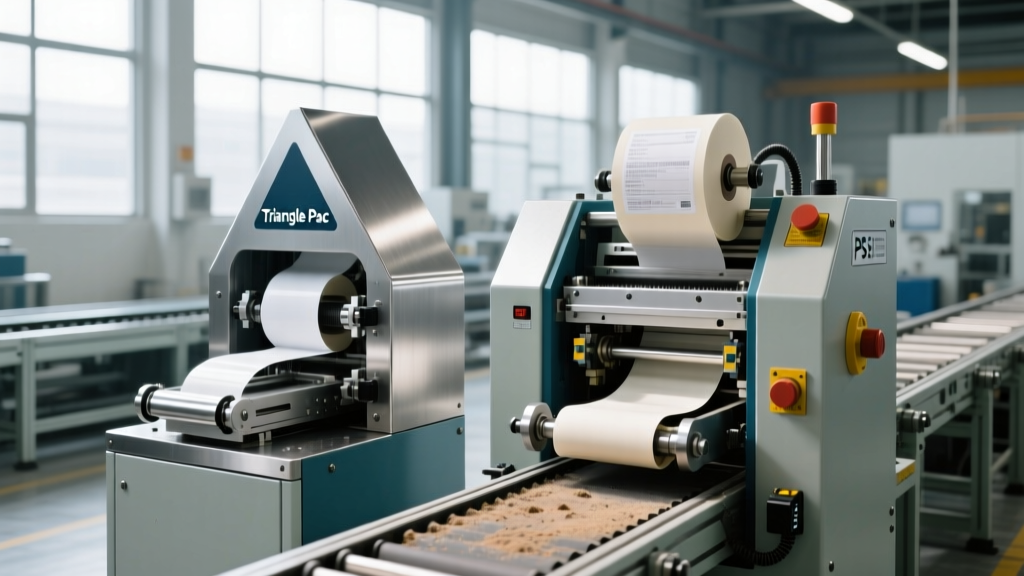
Integrating secondary labeling equipment downstream of primary form-fill-seal systems requires precise mechanical and electrical synchronization. When operating high-speed vertical baggers and cartoners—such as the Flex1 or XYT series from Triangle Packaging Machinery—the downstream labeler must match the pulse of the primary packaging line without becoming a bottleneck. As of 2026, the choice between pressure-sensitive (PS) and shrink sleeve labeling technologies dictates entirely different preventative maintenance (PM) schedules, wear-part inventories, and downtime risks.
Pressure-sensitive labelers rely on precise web tension, adhesive integrity, and servo-driven peel plates. Shrink sleeve applicators, conversely, depend on high-speed rotary cutting mandrels, film feed rollers, and steam tunnel thermodynamics. Understanding the distinct maintenance profiles of these two systems is critical for packaging engineers aiming to maximize Overall Equipment Effectiveness (OEE) on integrated lines.
Comparative Maintenance Matrix
The table below outlines the core maintenance differences between PS and sleeve labelers when deployed in high-speed consumer packaged goods (CPG) environments.
| Maintenance Parameter | Pressure-Sensitive (PS) Labelers | Shrink Sleeve Applicators & Tunnels |
|---|---|---|
| Primary Wear Parts | Peel plates, applicator pads, web guide rollers, rewind clutch corks | Tungsten carbide rotary blades, UHMWPE mandrels, steam nozzles, feed belts |
| Daily Cleaning Agent | 99% Isopropyl Alcohol (IPA) and non-abrasive wipes | Warm water and mild surfactant; avoid solvents on PET/PVC film paths |
| 500-Hour PM Focus | Web tension brake calibration, stepper/servo motor alignment | Cutting blade gap verification, steam condensate trap clearing |
| 2,000-Hour PM Focus | Backing paper rewind clutch rebuild, PLC encoder feedback testing | Steam generator descaling, blower motor bearing replacement |
| Common Failure Mode | Web breaks due to peel plate adhesive buildup or clutch slippage | Label skewing due to dull rotary knives or steam nozzle scaling |
| Avg. Downtime per PM | 45 - 90 minutes | 2 - 4 hours (including steam tunnel cool-down and heat-up) |
Pressure-Sensitive (PS) Labeler Service Schedules
PS labelers are highly sensitive to dust, adhesive ooze, and mechanical misalignment. Because they apply labels directly to the substrate using a tamp, blow, or wipe-on method, physical contact with the container necessitates rigorous upkeep of the application head.
Daily and Shift-Level Upkeep
- Peel Plate Decontamination: The sharp edge of the peel plate (often the 'dispensing beak') accumulates microscopic adhesive residue. Operators must wipe the edge with 99% IPA every 4 hours. Never use metal scrapers; use a brass or plastic putty knife to prevent altering the bevel angle, which is typically machined to exactly 30 or 45 degrees.
- Applicator Pad Inspection: For tamp-blow systems, inspect the foam or polyurethane tamp pad for uneven wear. A compressed pad will cause label edge lift on curved containers.
- Sensor Optics: Wipe the registration mark (eye-mark) and gap sensors with a dry microfiber cloth. Dust from corrugated secondary packaging often migrates to these optical sensors, causing false triggers.
500-Hour Preventative Maintenance
At the 500-hour mark (roughly every 3 to 4 weeks on a 24/7 line), mechanical wear components require adjustment.
- Web Tension Brake Calibration: Use a digital tension gauge to verify the unwind brake is applying exactly 1.5 to 2.0 lbs of tension across the web. Too little tension causes web flutter and misregistration; too much stretches the backing paper, leading to premature breaks.
- Rewind Clutch Cork Inspection: The backing paper rewind spindle utilizes a cork-lined friction clutch. Inspect the cork for glazing. If glazed, scuff it lightly with 400-grit sandpaper to restore friction. Replace the cork assembly if thickness is reduced by more than 20%.
Shrink Sleeve Applicator & Steam Tunnel Maintenance
Shrink sleeve systems eliminate the need for adhesives but introduce complex film-cutting mechanics and high-temperature steam thermodynamics. Maintaining these systems requires strict adherence to fluid management and precision machining tolerances.
Mandrel and Blade Care (500-Hour Interval)
The heart of a sleeve applicator is the bullet-shaped mandrel and the rotary cutting assembly. As the flat sleeve film is pulled over the mandrel, it is severed by a spinning tungsten carbide blade.
Expert Insight: Tungsten carbide rotary knives typically last for 2 million cuts. However, if your film contains aggressive slip agents or titanium dioxide (TiO2) pigments for high-opacity white sleeves, blade degradation accelerates by up to 40%. Inspect the blade edge under a 10x loupe every 500 hours for micro-chipping.
The mandrel itself is usually machined from Ultra-High-Molecular-Weight Polyethylene (UHMWPE) to reduce friction. Over time, static electricity builds up, attracting film dust. Clean the mandrel with an anti-static ionizing air gun weekly, and apply a food-grade dry PTFE spray monthly to maintain a low coefficient of friction.
Steam Tunnel Descaling (2,000-Hour Interval)
The steam tunnel shrinks the film using precisely angled steam jets. If your facility's water hardness exceeds 3 grains per gallon, calcium carbonate will rapidly scale the internal nozzles, resulting in uneven shrinking and 'dog-ear' label defects.
- Descaling Procedure: Isolate the steam generator. Flush the system with a 10% citric acid solution heated to 140°F (60°C). Circulate for 45 minutes to dissolve mineral deposits. Never use hydrochloric acid, as it will corrode the 316L stainless steel internal piping and void the manufacturer warranty.
- Condensate Traps: Purge the steam trap valves. If condensate pools inside the tunnel floor, it will cause severe temperature stratification, leading to asymmetric shrinkage on the left and right sides of the container.
Line Synchronization: Triangle Packaging Machinery Integration
When a labeler is positioned immediately downstream of a Triangle VFFS bagger or cartoner, the labeling system must synchronize with the primary machine's discharge rate. Triangle systems often operate at variable speeds, such as ramping up to 120 bags per minute (bpm) for pillow bags or 200 bpm for stick packs.
Modern 2026 servo-driven labelers utilize absolute encoders linked to the Triangle line's master PLC (typically Allen-Bradley/Rockwell or Siemens). During the 2,000-hour PM, maintenance technicians must verify the encoder coupling on the conveyor drive. A loose coupling will introduce a 2mm to 5mm phase shift in label placement, which is unacceptable for tight-tolerance barcodes or GS1 compliance.
⚠️ SAFETY DIRECTIVE: Lockout/Tagout (LOTO)Both PS rewind clutches and sleeve rotary knives store kinetic energy. Before performing any web threading, blade replacement, or steam tunnel maintenance, strict adherence to OSHA Lockout/Tagout guidelines is mandatory. Ensure all servo drives are powered down and pneumatic tamp cylinders are bled to 0 PSI before reaching into the application zone.
Troubleshooting Decision Matrix: Label Defects
When defects arise on the integrated line, use this rapid-response framework to isolate the root cause without halting the upstream Triangle Packaging Machinery.
Symptom: Label Skewing or 'Flagging' on the Container
- If using PS: Check the tamp pad for uneven compression. Check the conveyor side-guides; if the container is twisting as it passes the applicator, the label will flag on the leading edge. Fix: Adjust side-guide clearance to container width + 2mm.
- If using Sleeve: Check the steam tunnel nozzle alignment. If steam is hitting one side of the bottle before the other, the film will shrink asymmetrically. Fix: Rebalance the steam manifold valves to ensure equal pressure (typically 15-20 PSI) across all quadrants.
Symptom: Registration Drift (Label Applied Too High/Low)
- If using PS: The web tension brake is likely slipping, or the backing paper rewind clutch is dragging. Fix: Clean the brake disc with IPA and recalibrate tension to 1.8 lbs.
- If using Sleeve: The servo-driven feed rollers gripping the flat sleeve film are worn or contaminated with slip-agent dust. Fix: Replace the polyurethane feed belts and verify the servo following error is within +/- 0.5mm in the HMI diagnostics.
Symptom: Frequent Web or Film Breaks
- If using PS: Inspect the web path for burrs on idler rollers. A microscopic burr will slice the backing paper under tension. Fix: Run a cotton glove along all idler rollers; replace any roller that snags the fabric.
- If using Sleeve: The rotary blade is dull, causing a micro-tear that propagates as the film is pulled over the mandrel. Fix: Index the tungsten carbide blade to a fresh edge or replace the cartridge.
Strategic Spare Parts Inventory
To maintain high OEE on lines utilizing PMMI-standardized packaging machinery, facility managers must stock critical spares based on the labeler type. For PS systems, keep a minimum of three peel plates, two tamp pads, and one complete rewind clutch assembly on-site. For sleeve systems, inventory at least two UHMWPE mandrels (specific to your container diameter), four tungsten carbide blades, and a set of matched polyurethane feed belts. By aligning your PM schedules with the specific mechanical realities of your chosen labeling technology, you ensure that your secondary packaging keeps pace with the high-speed output of your primary form-fill-seal equipment.