Shrink vs Stretch Wrappers in the India Packaging Machinery Market
Compare shrink and stretch wrapping equipment for the India packaging machinery market. Detailed CapEx, OpEx, and technical decision frameworks.
Navigating Wrapper Selection in a High-Growth Market
The India packaging machinery market is undergoing a rapid structural shift. Driven by expanding FMCG distribution networks, stringent pharmaceutical export regulations, and the push toward automated logistics, facility managers are forced to critically evaluate end-of-line packaging investments. When securing unitized loads or bundling multi-packs, the fundamental choice between shrink wrapping and stretch wrapping equipment dictates not just line speed, but long-term operational expenditure (OpEx) and load integrity across India's challenging supply chain.
Selecting the wrong technology results in either excessive film waste, compromised load stability during transit on rough national highways, or thermal damage to sensitive products. This guide provides a technical and financial framework for sourcing the correct wrapping equipment within the current Indian manufacturing landscape.
Market Context (2026): According to the India Brand Equity Foundation (IBEF), the domestic packaging industry is scaling aggressively, with machinery modernization heavily focused on reducing material waste and improving pallet stability for export. The Invest India portal highlights that automated end-of-line machinery is seeing the highest adoption in the food processing and pharmaceutical sectors, where tamper evidence and load containment are non-negotiable.Polymer Science and Core Mechanics: Heat vs. Tension
To make an informed CapEx decision, engineers must understand the mechanical forces and polymer behaviors inherent to each system.
Shrink Wrapping: Thermal Contraction
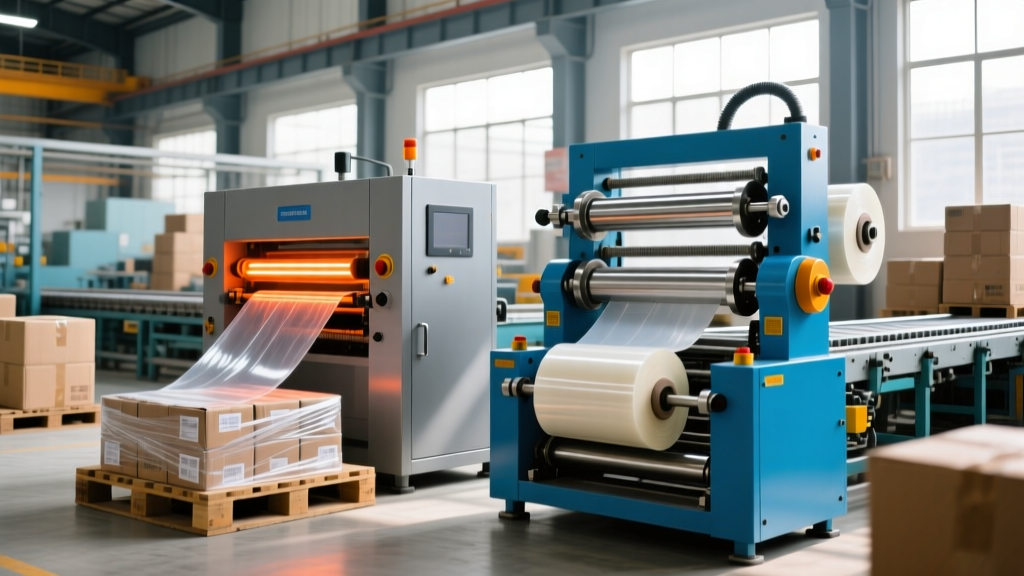
Shrink wrapping relies on heat to activate the cross-linked polymer chains in films like Polyolefin (POF) or Polyethylene (PE). The product passes through a shrink tunnel operating between 150°C and 200°C. As the film exits the tunnel and hits the cooling phase, it contracts, creating a rigid, tamper-evident shell. This is ideal for multi-pack bundling (e.g., water bottles, biscuit cartons) where a tight, printable surface is required.
Stretch Wrapping: Elastic Tension and Memory
Stretch wrapping uses Linear Low-Density Polyethylene (LLDPE). The film is mechanically stretched (pre-stretched) by 200% to 300% before application. The elastic recovery—or 'memory'—of the film applies continuous tension to the load. Unlike shrink film, stretch film does not require heat, making it the undisputed standard for palletizing heavy, heat-sensitive, or irregularly shaped industrial goods.
CapEx and OpEx Comparison Matrix
Pricing in the India packaging machinery market varies wildly depending on whether you source from local hubs (Rajkot, Ahmedabad) or import European machinery. Below is a realistic breakdown of equipment costs and running expenses for mid-to-high volume operations.
| Equipment Type | Example Model / Origin | Approx. CapEx (INR / USD) | Power Draw | Film Type & Cost | Primary Use Case |
|---|---|---|---|---|---|
| Semi-Auto L-Bar Shrink | Local Indian Make (Rajkot) | ₹90,000 - ₹1,50,000 ($1,100 - $1,800) | 8 - 12 kW | POF / PVC (₹220/kg) | Low-volume promo packs, small boxes |
| Auto Sleeve Shrink Wrapper | SMI Pack SK 450T (Italy) | ₹18,00,000 - ₹25,00,000 ($21,500 - $30,000) | 18 - 25 kW | PE Shrink (₹160/kg) | FMCG multi-packs, beverage bundling |
| Turntable Stretch Wrapper | Lantech Q-300XT (Global) | ₹3,50,000 - ₹5,50,000 ($4,200 - $6,600) | 1.5 - 3 kW | LLDPE Stretch (₹130/kg) | Standard palletizing, warehousing |
| Rotary Arm Stretch Wrapper | Robopac Presto (Italy) | ₹28,00,000+ ($33,500+) | 3 - 5 kW | Pre-stretch LLDPE (₹140/kg) | Heavy/unstable loads, high-speed lines |
The Hidden OpEx: Industrial Power Tariffs
A frequently overlooked factor in the India packaging machinery market is industrial electricity costs, which average ₹8 to ₹12 per kWh depending on the state. A continuous motion sleeve shrink tunnel drawing 22 kW running 10 hours a day will consume approximately ₹2,000 to ₹3,000 daily in power alone. Conversely, a rotary arm stretch wrapper drawing 4 kW reduces thermal energy costs to near zero, shifting the OpEx burden entirely to film consumption.
Decision Framework: Matching Equipment to Your Line
Use this diagnostic tree to determine the optimal technology for your specific production environment.
- IF your product requires tamper-evident, retail-ready packaging (e.g., pharmaceutical bundles, cosmetic gift sets) AND the product can withstand 180°C ambient tunnel heat → Select an L-Bar or Sleeve Shrink Wrapper.
- IF you are shipping heavy, sharp-edged industrial components (e.g., automotive parts, ceramic tiles) on wooden pallets → Select a Turntable Stretch Wrapper with a roping attachment for edge protection.
- IF your pallet loads are highly unstable, extremely heavy, or consist of crushable goods (e.g., empty PET bottles, corrugated boxes) that cannot withstand the centrifugal force of a spinning turntable → Select a Rotary Arm Stretch Wrapper.
- IF your facility requires weather-proofing for open-air transit or monsoon storage → Select a Stretch Wrapper equipped with a top-sheet dispenser.
Edge Case: High-Ambient Temperature Manufacturing
Facility managers operating in regions like Gujarat, Tamil Nadu, or Rajasthan face a unique engineering challenge: summer ambient temperatures on the factory floor frequently exceed 42°C.
Engineering Warning: Shrink wrapping relies on a rapid cooling phase immediately after the heat tunnel to 'set' the polymer. If your factory lacks adequate HVAC or exhaust ventilation near the packaging line, the high ambient air prevents the film from crystallizing quickly. This results in 'dog-ears' (loose film at the corners), micro-tears, and weakened bundle integrity. In non-climate-controlled Indian warehouses, stretch wrapping completely bypasses this thermal vulnerability.
Sourcing Strategy and Spare Parts Availability
When procuring equipment within the India packaging machinery market, the origin of the machine dictates your maintenance lifecycle.
Domestic Manufacturers (Pune, Ahmedabad, Rajkot)
Indian OEMs excel at producing robust, semi-automatic L-bar sealers and basic sleeve wrappers. The primary advantage is immediate spare parts availability and localized PLC programming support. However, domestic machines often lack advanced pre-stretch film carriages (limiting stretch to 150% compared to the 300% achieved by imported models), which increases long-term stretch film consumption.
Imported European/US Machinery
Brands like SMI, Robopac, and Lantech dominate the high-speed, fully automated tier. While CapEx is 40% to 60% higher, the precision of their motorized pre-stretch systems reduces film usage by up to 35%. For export-oriented units (EOUs) where packaging consistency is audited by global retailers, the ROI on imported stretch wrappers typically materializes within 18 months through film savings alone.
Frequently Asked Questions
Can I use stretch film for retail-ready multi-packs?
No. Stretch film is opaque or hazy and lacks the tensile rigidity required to hold small, lightweight items together without a corrugated tray underneath. For retail-ready multi-packs (like canned beverages or snack boxes), PE shrink film is mandatory to provide a tight, printable, and rigid bundle.
How does the monsoon season affect stretch wrapping operations?
High humidity does not affect the LLDPE stretch film itself, but it can cause condensation on cold products (like refrigerated beverages) before they are wrapped. Trapping moisture inside a stretch-wrapped pallet can lead to corrugated box degradation and mold. Facilities must ensure products reach ambient temperature or use ventilated (macro-perforated) stretch film for cold-chain goods.
What is the minimum ROI timeline for upgrading from manual to automatic stretch wrapping?
For a facility wrapping more than 40 pallets per day, upgrading from manual hand-wrapping to a semi-automatic turntable wrapper yields an ROI in 4 to 7 months. Hand-wrapping typically uses 400-600 grams of film per pallet, whereas an automated machine with a 250% pre-stretch carriage uses just 150-200 grams, drastically cutting material costs.