German Packaging Machinery Manufacturers: Palletizer Training
Master end-of-line palletizer operation with this training guide covering HMI navigation, changeovers, and fault recovery for top German packaging machinery manufacturers.
The Control Architecture of German End-of-Line Systems
Operating end-of-line palletizing systems engineered by german packaging machinery manufacturers requires a distinct technical skill set. Unlike standard PLC-driven wrappers, high-speed German palletizers—such as the Krones Modulpac or Gerhard Schubert TLM (Toploading Machine) series—are built on decentralized automation architectures. Operators must understand that these machines rely heavily on Siemens TIA Portal environments and PROFINET IRT (Isochronous Real-Time) communication. When a fault occurs, it is rarely a simple mechanical jam; it is often a network topology dropout or a drive encoder misalignment.
Training operators to merely press 'Reset' on a Siemens Simatic TP1500 Comfort Panel is insufficient. True operational proficiency requires navigating the Sinamics drive fault trees to identify whether a stoppage originated from a servo motor overload, a safety circuit interruption, or a fieldbus communication timeout. According to the VDMA Packaging Machinery Forum, over 40% of unplanned downtime in automated palletizing cells stems from improper operator responses to secondary PROFINET alarms.
CRITICAL SAFETY WARNING: SICK Safety Laser ResetsGerman palletizing cells universally utilize SICK microScan3 or microScan13 safety laser scanners. If the safety field is breached and the scanner locks out, operators must never attempt to bypass the interlock. Furthermore, if the scanner lens is smudged with corrugated dust, the scanner will report a 'Contamination Error' (Code 114). Cleaning requires a microfiber cloth and isopropyl alcohol—never use compressed air, which forces dust into the IP67 seals, resulting in a $3,800 replacement cost.
Fault Diagnostics and PROFINET Recovery Matrix
When a KUKA KR QUANTEC PA palletizing robot or a Möllers FSA palletizer halts, the HMI will generate a primary alarm and often several secondary alarms. Operators must be trained to isolate the root cause using the diagnostic buffer. Below is a decision matrix for the most common end-of-line faults encountered on German-engineered equipment.
| Symptom / HMI Code | Root Cause Analysis | Operator Action & Resolution |
|---|---|---|
| PROFINET Station Drop (Code 8103) | Physical break in the green PROFINET cable or unseated M12 connector on a remote I/O block. | Trace the daisy-chain from the main PLC cabinet. Reseat M12 connectors. Do not reset until the physical link LED turns solid green. |
| Vacuum Pressure Drop (Code 4042) | Corrugated dust clogging the Festo VAD-M vacuum generator filter or a torn Schmalz suction cup. | Check the inline pneumatic filter. If vacuum is below -0.6 bar, replace the suction cup lip. Never increase system pressure to compensate. |
| Axis Following Error (Code 2504) | Servo motor (Siemens 1FK7) encountered physical resistance, often due to a misaligned pallet or jammed chain conveyor. | Clear the physical jam in the infeed zone. Acknowledge the fault in the Sinamics drive menu, not just the main HMI. |
| Format RFID Mismatch (Code 9011) | Schubert TLM format part inserted does not match the HMI recipe selection. | Verify the RFID tag on the format tool. Clean the RFID reader window on the machine carriage with a dry cloth and re-seat the tool. |
Mastering the 15-Minute Format Changeover
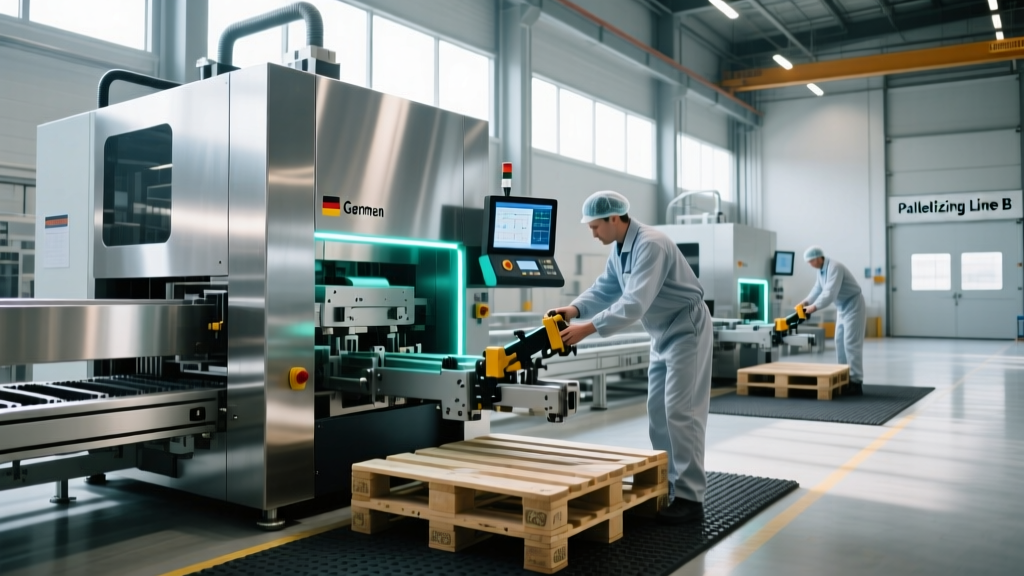
Top-tier german packaging machinery manufacturers design their palletizers for rapid SKU changeovers, often advertising sub-15-minute transitions. However, achieving this requires strict adherence to tool-less changeover protocols. The Schubert TLM system, for example, utilizes RFID-embedded format parts to automatically adjust servo parameters, but physical installation must be flawless.
Step-by-Step Changeover Protocol
- HMI Recipe Selection: Select the incoming SKU on the TP1500 panel. The system will illuminate the specific carriage and tooling locations requiring changes via LED strip indicators (usually green for 'remove', blue for 'install').
- Unlocking Tool-less Clamps: Depress the pneumatic release valves on the Festo clamping units. Never use pry bars on the aluminum format rails; the tolerances are machined to +/- 0.1mm.
- RFID Verification: Slide the new format parts into the linear guides. The machine's internal RFID reader will automatically scan the part. Wait for the HMI to display 'Format Verified' before proceeding. If it fails, remove and re-insert the part to ensure the tag is within the 15mm read range.
- Gripper Calibration Check: Run a single dry-cycle. Observe the end-of-arm tooling (EOAT). The suction cups must compress exactly 5mm to 8mm against the top of the case. Adjust the Z-axis stopper bolts if compression is outside this range to prevent case crushing.
If your facility experiences temperature swings greater than 10°C between shifts, German linear guides may experience microscopic thermal expansion. Operators should run the automated 'Reference Run' (Homing cycle) during the first changeover of a new shift to recalibrate the absolute encoders, preventing cumulative positioning drift over a 24-hour run.
Pneumatic and EOAT Maintenance for Operators
While heavy mechanical maintenance is reserved for technicians, operators are the first line of defense for the pneumatic systems that drive the grippers. German systems operate on highly regulated 6-bar (87 psi) clean air networks. The PMMI Certified Training guidelines emphasize that pneumatic degradation is the leading cause of dropped loads in automated palletizing.
- FRL Unit Inspection: Check the Festo Filter-Regulator-Lubricator (FRL) service units daily. The condensate drain must be emptied if it reaches the red line. If the air contains moisture, it will destroy the internal diaphragms of the vacuum ejectors within weeks.
- Vacuum Cup Integrity: Silicone-free Schmalz suction cups are standard for food-grade packaging. Inspect the sealing lips for micro-tears. A single torn cup on a 4-cup array reduces total holding force by 25%, which is enough to drop a 15kg case during high-speed deceleration.
- Exhaust Silencer Cleaning: The sintered bronze exhaust silencers on the directional control valves will clog with ambient cardboard dust. If the gripper release time exceeds 0.2 seconds, unscrew the silencers and soak them in a solvent bath. A slow release causes cases to drag and misalign on the pallet layer.
Vision System Calibration and Edge Cases
Modern end-of-line automation relies on 2D/3D vision to verify pallet patterns and read SSCC (Serial Shipping Container Code) labels. Systems integrated by german packaging machinery manufacturers frequently utilize Cognex In-Sight or SICK Ranger cameras. Operators must understand how environmental factors affect these sensors.
'Vision systems in palletizing cells do not fail due to software errors; they fail due to lighting degradation and lens contamination. Training operators to perform daily white-balance and contrast checks reduces false-reject rates by up to 60%.' — Association for Advancing Automation (A3) Safety Standards
If the HMI indicates a high rate of 'No-Read' faults on the label scanner, operators should first check the overhead LED array. If one of the LED bars has dimmed or failed, the contrast ratio on the corrugated label drops below the 2.0:1 threshold required for reliable decoding. Operators must be authorized to swap modular LED bars and trigger the camera's auto-focus routine via the HMI maintenance menu, rather than waiting for a vision engineer to arrive.
Summary of Operator Best Practices
Excellence in operating end-of-line packaging machinery from German OEMs hinges on respecting the precision of the engineering. By mastering PROFINET fault isolation, executing flawless RFID-verified changeovers, and maintaining strict pneumatic hygiene, operators transform from passive button-pushers into active reliability engineers. This proactive approach ensures that high-speed palletizers consistently achieve their rated outputs of 15 to 25 cycles per minute without catastrophic unplanned downtime.