Aseptic Filler Repair: When to Call a Packaging Machinery Supplier
Expert troubleshooting guide for aseptic food and beverage fillers. Learn when to execute in-house repairs versus calling your packaging machinery supplier.
The Economics of Aseptic Line Downtime
Aseptic packaging machinery for food and beverage operates under extreme tolerances. Maintaining an ISO 5 (Class 100) sterile environment while processing high-acid or low-acid liquids at speeds exceeding 24,000 packs per hour leaves zero margin for mechanical drift. When an aseptic filler faults, the cost is not merely the halted production; it includes the mandatory Clean-In-Place (CIP) and Sterilize-In-Place (SIP) cycles required to restart, which consume 3 to 5 hours and upwards of $4,000 in chemicals and lost throughput.
Determining whether your internal maintenance team can resolve a fault or if you must escalate to your packaging machinery supplier is a critical decision. Misdiagnosing a sterile zone breach can lead to catastrophic product recalls, while unnecessarily calling a supplier technician for a simple IO-Link sensor reset wastes thousands of dollars in emergency service fees.
CRITICAL WARNING: Never bypass sterile chamber interlocks or HEPA differential pressure alarms to force a line restart. Violating the sterile boundary compromises the commercial sterility of the entire batch, directly violating FDA FSMA Preventive Controls for human food.Diagnostic Matrix: In-House vs. Supplier Intervention
Modern aseptic fillers, such as the Tetra Pak A3/CompactFlex or SIG Combibloc CFA 1224, generate highly specific fault codes via their PLCs. Use the following matrix to triage faults and allocate repair resources effectively.
| Fault Symptom / PLC Code | Probable Root Cause | In-House Action | Supplier Intervention Required |
|---|---|---|---|
| H2O2 Bath Temp < 70°C | Heater element failure or PT100 sensor drift | Replace PT100 sensor; check solid-state relay | No (unless PLC I/O board is fried) |
| Sterile Air Pressure Drop (Alarm 402) | HEPA filter loading or sterile air valve failure | Check pre-filter; replace sterile air solenoid | Yes, if H14 HEPA core requires replacement/re-validation |
| Dosing Volume Variance > 1.5% | Filling valve diaphragm tear or flowmeter fouling | Clean Endress+Hauser Promag flowmeter optics | Yes, for precision recalibration of the magnetic flowmeter |
| Induction Heating Fault (Cap Sealing) | Generator frequency mismatch or coil degradation | Inspect cooling water flow; check capacitor bank | Yes, high-frequency generator tuning requires specialized RF tools |
Critical Failure Mode: Sterile Zone Breach & HEPA Integrity
The sterile chamber is the heart of any aseptic filler. It is maintained at a positive pressure (typically 15 to 30 Pa above ambient) using sterile air filtered through an H14 HEPA filter. If the differential pressure drops, the PLC immediately halts the machine to prevent unfiltered ambient air from entering the packaging zone.
Troubleshooting the Pressure Drop
- Verify the Sensor: Check the differential pressure transmitter (often a Setra or Dwyer model). Condensation in the sensing lines can cause false low-pressure readings. Purge the lines with dry, oil-free compressed air.
- Inspect the Pre-Filter: A heavily loaded HVAC pre-filter upstream of the HEPA unit will starve the blower. Replace pre-filters every 3 to 6 months depending on ambient particulate load.
- Evaluate the HEPA Core: If the blower is at 100% capacity but pressure remains low, the H14 HEPA filter is blinded. Do not attempt to clean a HEPA filter. Replacement costs range from $1,200 to $2,500 per unit.
When to call the supplier: If the HEPA filter requires replacement, your packaging machinery supplier must perform a DOP (Dioctyl Phthalate) or PAO aerosol leak test post-installation to certify the ISO 5 integrity. In-house teams rarely possess the calibrated photometers required for this certification.
Step-by-Step: H2O2 Bath Temperature Recovery
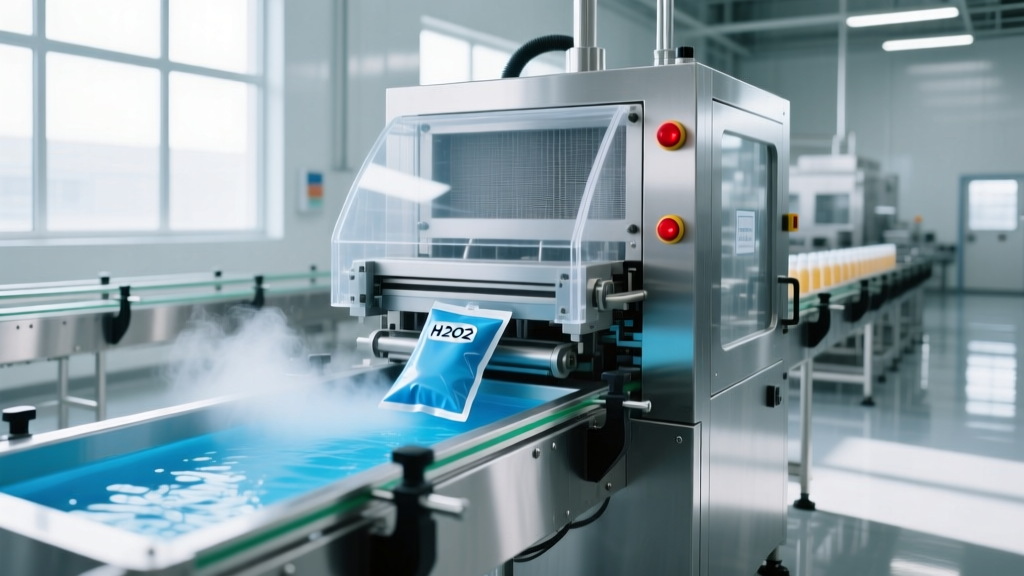
Packaging material sterilization relies on a 35% hydrogen peroxide (H2O2) bath maintained precisely between 70°C and 75°C. According to the NIOSH guidelines on hydrogen peroxide handling, thermal decomposition accelerates rapidly above 80°C, creating dangerous off-gassing and reducing sterilization efficacy. If your bath temperature faults low, follow this recovery sequence:
Pro Tip: Always keep a calibrated Fluke dry-block calibrator on-site. Verifying the PT100 temperature sensor takes 4 minutes and prevents the unnecessary replacement of $3,000 immersion heaters.- Isolate the Heater Circuit: Lock out the main breaker for the H2O2 bath heater bank. Measure the resistance across the heating elements. A standard 15kW element should read between 9 and 12 ohms. An open circuit (infinite resistance) indicates a burnt element.
- Test the Solid State Relay (SSR): SSRs fail 'closed' or 'open' due to thermal fatigue. If the heater element tests fine but receives no voltage when the PLC calls for heat, replace the SSR (typically a Crydom or Carlo Gavazzi unit, costing around $180).
- Check H2O2 Concentration: As H2O2 degrades into water and oxygen, its specific heat capacity changes, causing the PID loop to oscillate. Use a refractometer or titration kit to verify the concentration remains above 32%. If it has diluted, initiate a bath drain and refill cycle.
- Recalibrate the PID Loop: If the temperature hunts (swings ±3°C), access the PLC HMI and perform an auto-tune on the temperature PID controller to adapt to the new thermal mass of the bath.
- Emergency Remote Support: Typically $150–$250 per hour. Most modern PLCs allow secure remote access via edge gateways. 60% of complex software faults can be resolved remotely.
- On-Site Emergency Dispatch: Expect $350–$500 per hour, plus travel expenses, with a guaranteed 24-hour boots-on-the-ground response time.
- Planned Preventative Maintenance (PPM): Negotiate PPM visits during your low-production seasons. Supplier technicians should focus on validating sterile air integrity, calibrating induction sealers, and updating PLC firmware during these planned windows, rather than performing basic lubrication that your internal team can handle.
Sensor Calibration & Actuator Faults
Aseptic fillers utilize dozens of pneumatic actuators to move packaging webbing, fold cartons, and seal caps. In 2026, most modern lines use IO-Link enabled Festo or SMC valves. These smart valves report internal coil temperature and spool shift times back to the PLC.
If a folding station faults for 'Cycle Time Exceeded', do not immediately replace the cylinder. Access the IO-Link master diagnostics. If the spool shift time has degraded from 15ms to 45ms, the valve's internal pilot filter is clogged with compressed air particulates. Replacing a $40 pilot filter kit resolves the issue, whereas unnecessarily swapping the entire actuator assembly wastes $800 and 45 minutes of downtime.
Flowmeter Fouling in Dairy Applications
When packaging high-fat dairy or plant-based milks, protein and fat buildup on the sensing electrodes of magnetic flowmeters causes volume drift. This results in under-filled cartons (a regulatory compliance risk) or over-filled cartons (giveaway cost). Implement an automated CIP sequence using a 2.0% NaOH (caustic soda) solution at 85°C for 20 minutes specifically targeting the filling bowl and flowmeter bypass loops.
Navigating Supplier SLAs in 2026
When a fault exceeds in-house capabilities, invoking your Service Level Agreement (SLA) with the packaging machinery supplier is necessary. However, understanding the financial structure of these contracts prevents budget overruns.
Ultimately, the most effective troubleshooting strategy relies on strict boundaries. Empower your internal technicians with the tools and data to handle sensor drift, pneumatic faults, and thermal element replacements, while reserving your packaging machinery supplier for sterile certifications, high-frequency RF tuning, and proprietary PLC logic repairs. This division of labor maximizes OEE (Overall Equipment Effectiveness) and minimizes unplanned maintenance expenditures.