Troubleshooting Semi Automatic Packaging Machinery for Aseptic F&B Lines
Master troubleshooting for semi automatic packaging machinery in aseptic F&B lines. Fix H2O2 bath, seal, and HEPA failures with expert diagnostics.
Core Failure Modes in Aseptic Semi-Automatic Fillers
Semi automatic packaging machinery occupies a unique niche in food and beverage (F&B) production. Unlike fully automated rotary fillers, semi-auto systems (such as inline piston fillers or gravity-fed volumetric benchtops) require manual container indexing. In aseptic applications—like filling UHT dairy, cold-pressed juices, or nutritional beverages—this manual intervention introduces severe contamination vectors. The primary failure modes do not stem from mechanical wear, but from sterility breaches and fluid dynamic anomalies during the hand-off between automated dosing and manual capping.
Symptom-to-Fix Decision Matrix
Use the following diagnostic matrix to isolate faults on the production floor. This framework prioritizes sterile integrity over mechanical throughput.
| Symptom | Probable Root Cause | Diagnostic Step | Corrective Action |
|---|---|---|---|
| Post-fill seal contamination (mold at 48h) | Nozzle stringing touching container flange | High-speed camera review of drip cut-off | Adjust vacuum suck-back to -0.5 bar minimum |
| H2O2 concentration alarm trigger | Dilution via condensation or heater failure | Titration test of sterilization bath | Replace inline heater element; flush bath |
| Uneven fill volumes in viscous products | Product aeration in semi-auto hopper | Check degassing valve and agitator RPM | Reduce agitator speed to 30 RPM; engage vacuum degas |
| HEPA filter high-pressure alarm | Pre-filter saturation or damper misalignment | Read Magnehelic gauge differential pressure | Swap MERV 14 pre-filter; recalibrate damper |
Deep Dive: H2O2 Sterilization Bath Troubleshooting
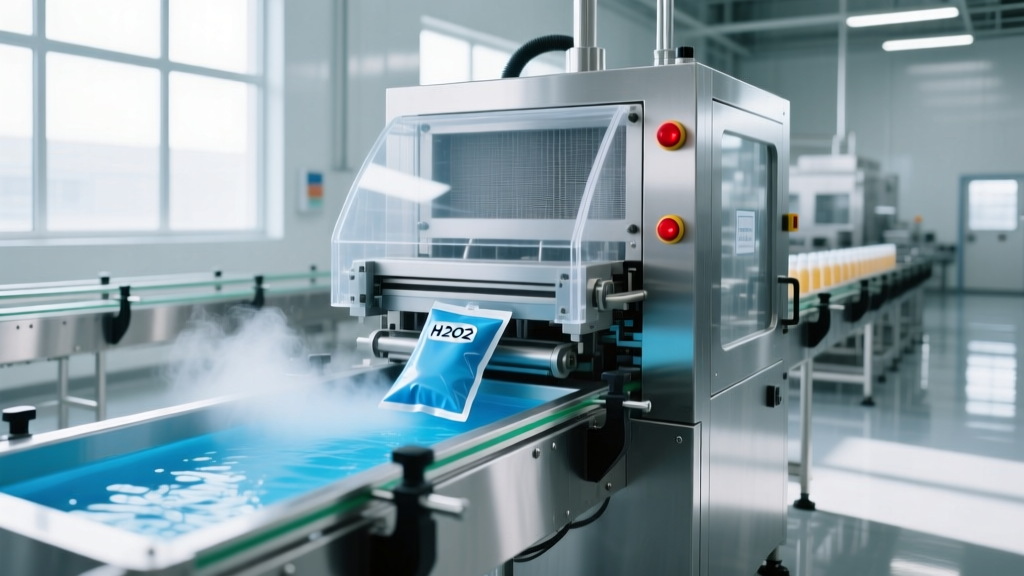
The sterilization tunnel is the heart of any aseptic line. In semi-automatic setups, preforms or empty cups often pass through a hydrogen peroxide (H2O2) bath or spray chamber before reaching the manual loading zone. The FDA's guidance on aseptic processing mandates strict validation of these sterilization parameters to ensure commercial sterility.
Temperature and Concentration Interlock Failures
For effective sporidical kill rates (typically a 6-log reduction of Bacillus subtilis), the H2O2 solution must be maintained at 35% w/w concentration and heated to 60°C–65°C. If the inline heater fails, the temperature drops, exponentially decreasing the sterilization efficacy. Conversely, if the bath temperature exceeds 75°C, the H2O2 rapidly decomposes into water and oxygen, dropping the concentration below the lethal threshold.
- The Fix: Install a dual-redundant PT100 temperature sensor wired to a safety PLC interlock. If the variance exceeds ±1.5°C, the PLC must halt the semi-auto indexing belt immediately.
- Cost Impact: A replacement inline PT100 sensor costs roughly $180–$250. Failing to catch a temperature drop can result in a $50,000+ batch recall due to microbial swelling in sealed pouches.
Managing Viscous Drip and Vacuum Suck-Back
When utilizing semi automatic packaging machinery for high-viscosity F&B products (e.g., Greek yogurt, pudding, or tomato paste), fluid dynamics at the nozzle tip become the primary contamination vector. Viscous products tend to "string" or draw a tail when the dosing valve closes. If this string touches the non-sterile outer flange of the container, mold spores are introduced directly to the seal area.
Pro-Tip: Vacuum Suck-Back CalibrationDo not rely solely on mechanical drip-cut valves for viscous aseptic fills. You must engage the pneumatic suck-back system. Calibrate the vacuum generator to pull between -0.4 and -0.6 bar for exactly 150 milliseconds post-dose. This retracts the product tail cleanly inside the nozzle bore without introducing air bubbles into the next dose.
HEPA Filtration and ISO Class 7 Compliance
The filling zone of an aseptic semi-auto machine must maintain ISO Class 7 (Class 10,000) cleanroom conditions, per ISO 14644-1 cleanroom standards. This requires a laminar airflow hood equipped with HEPA (High-Efficiency Particulate Air) filters positioned directly above the manual loading and filling station.
Diagnosing Airflow and Pressure Drops
Operators often mistake a drop in laminar airflow velocity for a fan failure, when the actual culprit is filter loading. HEPA filters naturally load with particulates over time, increasing static pressure.
- Check the Magnehelic Gauge: A standard 99.99% efficient HEPA filter will show an initial pressure drop of about 1.0 inch w.g. (water gauge) when clean.
- Identify the Threshold: When the gauge reads 2.0 to 2.5 inch w.g., the filter is at its maximum loading capacity. Airflow velocity will drop below the required 0.45 m/s (90 fpm), breaking the sterile air curtain.
- Pre-Filter Maintenance: To extend HEPA life (which costs $800–$1,200 per unit), ensure the upstream MERV 14 pre-filters are swapped every 3 to 6 months depending on ambient facility air quality.
"In semi-auto aseptic lines, the human operator is the highest-risk variable. Troubleshooting shouldn't just focus on the machine's pneumatics; it must address the ergonomic footprint. If the operator has to reach past the laminar airflow curtain to place a cup, the sterile zone is already compromised. Redesign the loading chute to keep human hands outside the ISO 7 boundary." — Lead Validation Engineer, Mid-Sized Dairy Co-Packer
CIP/SIP Cycle Failures in Semi-Auto Fluid Paths
Unlike fully enclosed rotary machines, semi automatic packaging machinery often features open or semi-open product hoppers and manual quick-disconnect (QD) fittings for cleaning. This architecture creates severe blind spots during Clean-in-Place (CIP) and Sterilize-in-Place (SIP) cycles.
Dead Legs and QD Fitting Residue
A "dead leg" is any section of piping where fluid can stagnate, bypassing the turbulent flow required for CIP efficacy. In semi-auto setups, the manual override valves and QD fittings used for end-of-shift teardown frequently harbor Biofilm if not properly flushed.
- Diagnostic: Swab the internal threads of the semi-auto nozzle manifold post-SIP. If ATP (Adenosine Triphosphate) bioluminescence testing yields >10 RLU (Relative Light Units), the SIP steam penetration failed.
- Corrective Action: Replace standard QD fittings with aseptic clamp ferrules (Tri-Clamp style) featuring flush gaskets (e.g., PTFE envelope gaskets) that eliminate the internal crevice. Ensure CIP fluid velocity at the furthest dead leg reaches a minimum of 1.5 meters per second.
Financial Framework: When to Abandon Semi-Auto Troubleshooting
Troubleshooting semi automatic packaging machinery is cost-effective only up to a certain scale. Use this framework to determine if your engineering hours are better spent upgrading to a fully automated rotary aseptic filler.
- OEE (Overall Equipment Effectiveness) Threshold: If your aseptic semi-auto line consistently operates below 65% OEE due to manual loading bottlenecks and frequent CIP/SIP cycle interruptions, the labor costs outweigh the capital savings.
- Scrap and Rework Rates: If post-incubation microbial testing yields a spoilage rate above 0.5% (50 units per 10,000), the semi-auto sterile boundary is fundamentally flawed for your specific product matrix.
- Labor Cost in Gowning: Calculate the fully burdened cost of operators donning ISO-compliant cleanroom suits. If gowning and de-gowning consume more than 15% of the shift time, automated container handling is financially mandatory.
Summary of Critical Tolerances
Quick Reference for Shift Supervisors:- H2O2 Concentration: 35% ± 2% w/w
- H2O2 Bath Temp: 60°C – 65°C (Interlock at 58°C)
- Laminar Airflow Velocity: 0.45 m/s ± 20%
- HEPA Max Pressure Drop: 2.5 inch w.g.
- Nozzle Suck-Back Vacuum: -0.4 to -0.6 bar