Current Trends in Takeaway Food Packaging Machinery Market Analysis
Analyze current trends in takeaway food packaging machinery market analysis, focusing on 2026 multi-head weigher tech for snack food automation.
The 2026 Landscape: Multi-Head Weighers in Snack Automation
The shift toward high-volume ghost kitchens, direct-to-consumer snack boxes, and automated micro-fulfillment centers has radically altered equipment requirements across the packaging sector. When evaluating current trends in takeaway food packaging machinery market analysis, the multi-head weigher emerges as the critical bottleneck—and primary optimization point—for snack food producers. In 2026, the demand for 14-to-18 head combination weighers capable of processing highly irregular, fragile, or oil-coated snacks has driven a wave of hardware and algorithmic innovations. Standard linear scales are obsolete for modern snack lines; operators now require systems that can achieve 140+ weighments per minute (wpm) while maintaining accuracy tolerances of ±0.3 grams to minimize product giveaway.
Key 2026 Market Drivers for Snack Weighing:- Giveaway Reduction: Shifting from ±1.5g to ±0.3g accuracy saves mid-sized facilities up to $140,000 annually in lost product.
- Changeover Agility: Tool-less switchover times reduced from 45 minutes to under 8 minutes via quick-release hoppers.
- Hygiene Standards: Mandatory IP69K ratings and 316L stainless steel construction to meet intensified food safety audits.
Core Technological Innovations in 14-to-18 Head Systems
Neural Network Combination Algorithms
Legacy multi-head weighers relied on static mathematical combinations to calculate the optimal hopper discharge. Modern 2026 systems, such as the Ishida CCW-RVE series, utilize embedded machine learning algorithms that adapt in real-time to product flow variations. When packaging a mixed snack like trail mix—where the ratio of heavy almonds to light raisins fluctuates mid-run—the neural network dynamically adjusts the vibration amplitude of the radial feeders. This prevents the 'clumping' effect that traditionally caused overweight discharges, maintaining a standard deviation of less than 0.5g even with highly heterogeneous products.
IP69K Washdown and CIP Integration
Snack foods, particularly kettle-cooked potato chips and cheese puffs, leave behind heavy oil and particulate residue. To comply with stringent food safety frameworks outlined by the FDA's guidelines on food contact substances, modern weighers feature 3-degree sloped surfaces to prevent water pooling and IP69K-rated load cells that survive high-pressure, high-temperature steam cleaning. Furthermore, integrated Clean-in-Place (CIP) spray balls are now mounted directly above the dispersion table, allowing for automated chemical sanitization without manual disassembly of the upper chassis.
Comparative Analysis of Leading 2026 Multi-Head Weigher Models
| Model / Series | Heads | Max Speed (wpm) | Accuracy (σ) | Est. CapEx Range |
|---|---|---|---|---|
| Ishida CCW-RVE | 14 | 120 | ±0.3g | $55,000 - $68,000 |
| Yamato DATA WEIGH | 18 | 160 | ±0.2g | $72,000 - $89,000 |
| MULTIVAC Multihead | 16 | 140 | ±0.4g | $60,000 - $75,000 |
Real-World Failure Modes and Edge Case Troubleshooting
Deploying a multi-head weigher for snack foods introduces specific mechanical and environmental failure modes that generic packaging guides often overlook. Addressing these edge cases is mandatory for maintaining OEE (Overall Equipment Effectiveness) above 85%.
- Static Buildup on Film and Chutes: Snack packaging environments often suffer from low humidity, causing static cling that traps lightweight products (e.g., popcorn, puffed rice) on the polycarbonate discharge chutes. Fix: Install active ionizing air bars at the top of the chute array and specify anti-static, food-grade UHMW polyethylene liners for all contact surfaces.
- Oil Accumulation and Weigh Cell Drift: Kettle chips and extruded cheese snacks shed oil and dust. Over a 12-hour shift, this sludge builds up on the weigh hopper gates, altering the tare weight and causing the load cell to drift. Fix: Utilize dimple-plate contact surfaces that reduce surface area contact by 40%, paired with automated pneumatic scraper gates that clear residue on every discharge cycle.
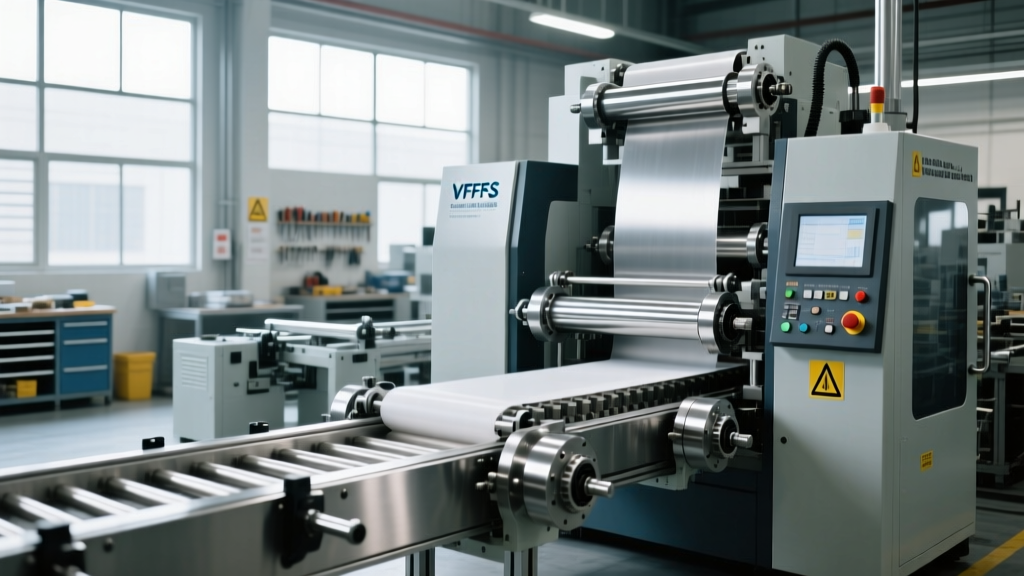
- Product Breakage in Fragile Snacks: Dropping delicate tortilla chips from a 1.5-meter elevation into the bagger collar results in unacceptable breakage rates. Fix: Implement staggered discharge timing (zipper discharge) rather than simultaneous dumping, and install memory hoppers with angled, cushioned baffles to reduce terminal velocity before the product enters the VFFS (Vertical Form Fill Seal) tube.
Capital Expenditure and ROI Calculation Framework
Justifying the $65,000+ capital expenditure for a premium 18-head weigher requires a precise understanding of 'giveaway' economics. If a facility packages 30g bags of premium mixed nuts at 80 wpm, running two shifts a day (96,000 bags/day), a legacy scale with a 1.5g standard deviation forces the operator to set the target weight at 32g to avoid underweight compliance violations.
Giveaway ROI Math (2026 Baseline):Legacy System Giveaway: 2g per bag × 96,000 bags = 192,000g (192 kg) of lost product daily.
AI-Driven System Giveaway (±0.3g): Target weight set at 30.5g. Giveaway = 0.5g per bag × 96,000 = 48 kg daily.
Net Savings: 144 kg of premium nuts saved per day. At a wholesale cost of $18/kg, the facility saves $2,592 daily, yielding a complete ROI on the weigher hardware in less than 26 operating days.
Integration with Industry 4.0 and IIoT Networks
Modern snack packaging lines do not operate in isolation. Alignment with broader automation networks, as promoted by the Association for Advancing Automation (A3), dictates that 2026 multi-head weighers must feature native OPC-UA and MQTT protocol support. This allows the weigher to push real-time diagnostic data directly to the plant's SCADA system.
Predictive maintenance is the most valuable IIoT application here. By monitoring the high-frequency vibration signatures of the radial feeder stepper motors, the system's edge-computing module can detect bearing wear or spring fatigue up to 14 days before a catastrophic failure occurs. This shifts maintenance from reactive downtime events to scheduled micro-interventions during flavor changeovers, effectively eliminating unplanned mechanical stoppages on the packaging floor.