Automated Case Packing for Flexible Packaging Machinery Lines
Technical specs, kinematics, and EOAT tooling for automated case packing systems handling flexible packaging machinery outputs like stand-up pouches.
The Geometric Variability Problem in Secondary Packaging
Secondary packaging of flexible formats—such as stand-up pouches, doy-packs, and flat-bottom bags—presents a unique mechanical challenge. Unlike rigid glass bottles or aluminum cans, the output from modern flexible packaging machinery lacks a fixed geometric bounding box. A 500g stand-up pouch can vary in Z-axis thickness by up to 15mm depending on the nitrogen gas flush volume, product settling during transit, and ambient humidity. This geometric variability breaks standard optical sensors and causes catastrophic jamming in traditional mechanical case packers designed for rigid primary packaging.
⚠️ Warning: The 'Pillowing' Effect and Case OverfillWhen flexible packaging machinery over-flushes a pouch with modified atmosphere packaging (MAP) gases, the resulting 'pillow' effect increases the pouch's volume without changing its weight. If a case packer relies on volumetric indexing rather than Z-axis profiling, these pillowed pouches will cause case overfill, preventing the top flaps from closing and triggering downstream rejection faults on the case sealer.
To mitigate this, automated case packing systems integrated with flexible packaging machinery must utilize 3D vision systems, such as the Cognex In-Sight 3D-L5000, to map the exact Z-axis profile of every pouch before the robotic pick cycle initiates. This allows the programmable logic controller (PLC) to dynamically adjust the drop height and placement angle inside the corrugated case.
Core Kinematics: Robot Selection for Non-Rigid Formats
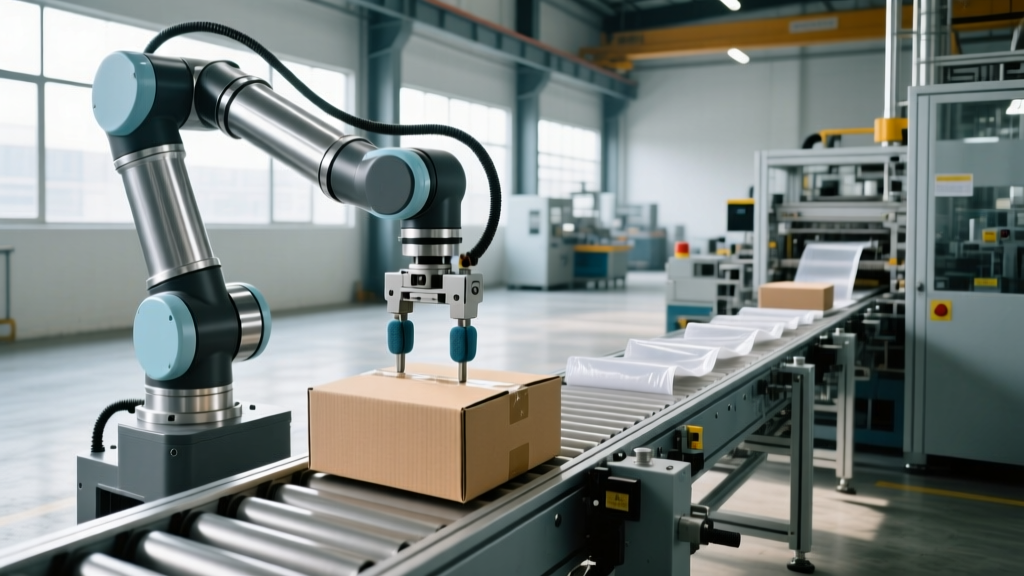
The selection of robotic kinematics for handling flexible packs depends strictly on the payload weight and the required cycles per minute (CPM). While Schubert TLM technology often utilizes highly customized gantry and cross-belt systems, standard integrators typically choose between Delta, SCARA, and Articulated arms.
| Robot Type | Ideal Pouch Payload | Max Speed (CPM) | Best Use Case |
|---|---|---|---|
| Delta (e.g., ABB IRB 360) | 50g – 800g | 120 – 180 CPM | High-speed snack food pouches, single-serve liquid doy-packs |
| SCARA (e.g., Epson T6) | 200g – 2kg | 60 – 90 CPM | Carton loading of multi-packs, retail-ready tray packing |
| Articulated (e.g., FANUC M-20iD) | 2kg – 15kg | 15 – 40 CPM | Heavy bulk bags, multi-layer case packing, palletizing |
End-of-Arm Tooling (EOAT) Decision Matrix
The most critical mechanical interface in flexible packaging case packing is the End-of-Arm Tooling (EOAT). Flexible films (PET/PE laminates, metallized BOPP) are highly susceptible to puncture, static cling, and surface slippage. Standard rigid vacuum cups frequently fail due to micro-leaks on wrinkled film surfaces.
- High-Density Foam Vacuum Grippers: Utilizing Schmalz SPB1 series suction cups with flexible foam lips allows the EOAT to conform to the uneven, wrinkled surface of a flexible pouch. Ideal for flat-bottom pouches weighing under 1kg. Limitation: Fails on highly porous non-woven materials or heavily textured films.
- Soft Robotic Grippers (e.g., Soft Robotics mGrip): Pneumatically actuated elastomer fingers gently wrap around the pouch without requiring a flat sealing surface. This is the superior choice for irregularly shaped stand-up pouches or products with high center-of-gravity variance. Cost: Adds $12,000 to $18,000 per tooling head.
- Mechanical Scoop-and-Clamp: For heavy, bulk flexible packs (e.g., 5kg pet food bags), mechanical fingers slide beneath the pouch while a top clamp stabilizes the load. This completely bypasses the need for vacuum adhesion and prevents product drop during high-acceleration lateral movements.
Upstream Integration: Synchronizing with Flexible Packaging Machinery
A case packer cannot operate efficiently if the upstream flexible packaging machinery delivers inconsistent product orientation. Modern vertical form-fill-seal (VFFS) and horizontal flow-wrap machines must be integrated via a common Ethernet/IP or PROFINET network to synchronize the discharge conveyor speed with the case packer's infeed.
According to PMMI industry intelligence reports, the primary cause of downtime in secondary packaging lines is not the case packer itself, but the accumulation and shingling errors occurring in the transfer zone between the primary flexible packaging machinery and the case packer infeed. Implementing zero-pressure accumulation conveyors reduces this fault rate by up to 42%.
To maintain proper spacing, integrators utilize servo-driven timing belts or intralox modular plastic belt conveyors with low-friction top surfaces. Because flexible pouches have a much lower coefficient of friction than corrugated boxes or glass, the conveyor incline must never exceed 12 degrees without the addition of high-friction urethane cleats; otherwise, pouches will slide backward during acceleration phases.
Real-World Failure Modes and Troubleshooting
When operating automated case packing systems with flexible formats, maintenance teams must monitor specific failure modes unique to non-rigid packaging:
- Static Cling Adhesion: High-speed film cutting and sealing on the VFFS generates significant static electricity. Pouches will stick together in pairs, causing the vision system to read a single thick pouch, leading to case overfill. Mitigation: Install Fraser 3024 ionizing air bars directly over the infeed conveyor to neutralize surface charges before the pick zone.
- Drop-Induced Product Shifting: If a delta robot drops a pouch from a height greater than 150mm, the kinetic energy causes the internal product (especially powders or granules) to shift to the bottom, altering the pouch's center of gravity and causing it to tip over inside the case. Mitigation: Program the PLC with Z-axis deceleration profiling, ensuring the robot slows to <0.2 m/s in the final 50mm of the drop.
- Flap Interference During Insertion: Unlike rigid cartons, flexible pouches compress when pushed into a tight case, causing them to expand outward and catch on the corrugated minor flaps. Mitigation: Utilize a funnel-guide insertion tool or program a 'wiggle' routine in the robot path to settle the pouches past the flap line before releasing the vacuum.
Capital Expenditure and ROI Timelines
Investing in secondary automation for flexible formats requires precise budget allocation. As of 2026, a baseline mechanical wrap-around cartoner (such as the Syntegon Elematic series) tailored for flexible pouches ranges from $140,000 to $210,000. However, for highly variable pouch sizes requiring rapid changeovers, a fully integrated robotic case packing cell is necessary.
A turnkey robotic case packer, including the delta/scara robot, 3D vision system, soft robotic EOAT, and case erector/sealer, typically commands a capital expenditure between $280,000 and $450,000. While the upfront cost is substantial, the reduction in film waste, elimination of manual case loading injuries, and ability to run 24/7 at 150+ ppm typically yields a verifiable ROI within 18 to 26 months for mid-to-large scale consumer packaged goods (CPG) manufacturers.