Coolant Troubleshooting: Flood vs Mist & ToolBoss Vending Machine
Diagnose CNC flood and mist cooling failures. Learn MQL troubleshooting, TSC union repairs, and how a ToolBoss vending machine optimizes part inventory.
Coolant delivery failures account for nearly 22% of unplanned CNC downtime in high-volume machine shops. Whether you are running high-pressure through-spindle coolant (TSC) for titanium milling or utilizing Minimum Quantity Lubrication (MQL) for aluminum aerospace components, a fluid delivery fault halts production immediately. However, the diagnostic process is only half the battle. The true bottleneck occurs when an operator identifies a blown rotary union seal or a clogged MQL capillary tube, only to find the replacement parts are out of stock or locked in a distant purchasing queue.
This guide provides deep-dive troubleshooting protocols for both flood and mist cooling systems, alongside a strategic framework for integrating a ToolBoss vending machine to automate the inventory of critical coolant components, effectively eliminating secondary downtime caused by parts starvation.
Diagnosing High-Pressure Through-Spindle Coolant (TSC) Failures
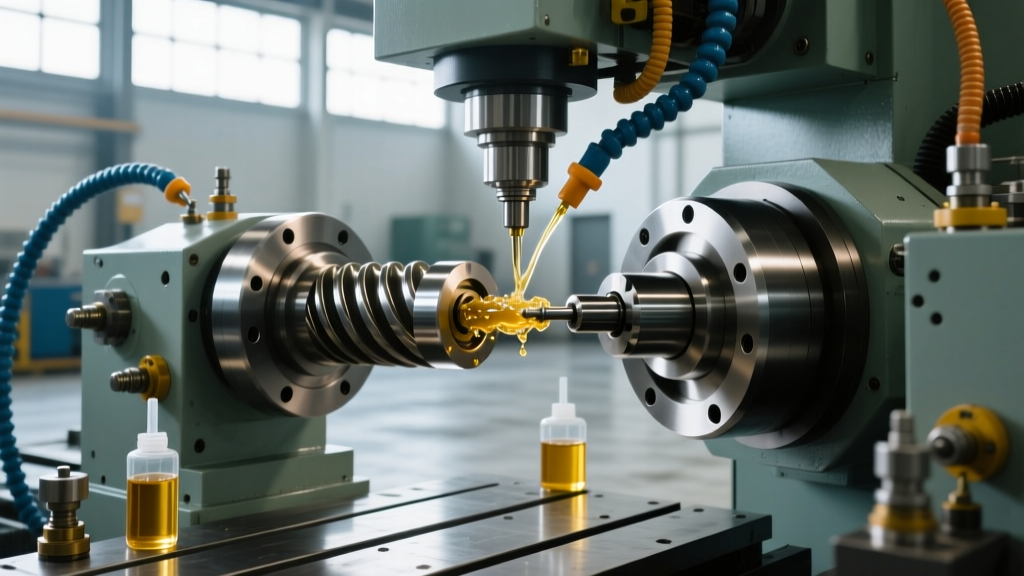
Through-spindle coolant systems operating between 300 and 1,000 PSI rely on precision rotary unions to transfer fluid from the stationary pump to the rotating spindle. The most common failure point is the Deublin rotary union (e.g., the 1117 or 1109 series), which degrades due to micro-abrasions from coolant particulates or misalignment with the spindle drawbar.
Symptom: Intermittent Pressure Drops Under Load
If your machine alarms out for low TSC pressure only during high-RPM operations (above 8,000 RPM), the issue is rarely the pump itself. Instead, suspect the rotating union seal faces. At high speeds, centrifugal force and thermal expansion can cause marginal seal faces to separate, bleeding pressure internally.
- Action Step 1: Verify the union alignment. Use a dial indicator on the union housing while manually rotating the spindle. Runout must not exceed 0.0005 inches (TIR). Excessive runout destroys the mechanical seal within 40 hours of operation.
- Action Step 2: Inspect the closed-loop cooling water for the union. High-pressure unions generate immense friction heat. If the union cooling water flow is restricted, the internal O-rings will melt, causing a catastrophic internal bypass.
- Action Step 3: Check the Y-strainer on the pump intake. A 40-mesh stainless steel strainer clogged with tramp oil sludge will starve the high-pressure pump, causing cavitation that sounds like gravel grinding inside the pump housing.
Minimum Quantity Lubrication (MQL) Mist System Diagnostics
MQL systems replace traditional flood coolant with an aerosolized mist of biodegradable ester-based fluids (such as Accu-Lube LB-2000). According to Sandvik Coromant's machining guidelines, MQL drastically reduces fluid consumption from 50 gallons per hour to less than 50 milliliters per hour. However, MQL is highly sensitive to pneumatic and fluidic imbalances.
Symptom: 'Wet' Mist or Fluid Spitting at the Nozzle
A properly tuned MQL system produces a dry, smoke-like aerosol. If the nozzle is spitting liquid droplets or leaving heavy puddles in the work envelope, the Venturi effect inside the aerosol generator is failing to atomize the fluid.
- Air-to-Fluid Pressure Ratio: The atomizing air pressure must be exactly 2.5 to 3 times higher than the fluid pressure. If your fluid metering pump is set to 20 PSI, your shop air regulator feeding the mixer must be locked at 60 PSI. A drop in shop air pressure during shift changes (when multiple machines cycle simultaneously) will instantly ruin the atomization ratio.
- Delivery Tube Routing: MQL delivery tubes must maintain a continuous, unbroken downward slope from the mixer to the cutting tool. Any U-shaped loops or sagging sections in the polyurethane tubing will allow the heavy ester fluid to pool. When the air pressure spikes, it blows the pooled liquid out as a massive, unatomized slug.
- Capillary Clogging: The internal capillary tubes (often 0.040-inch ID) are prone to clogging if the shop air supply lacks a coalescing filter. Moisture in the shop air reacts with the ester fluid, creating a gummy residue that blocks the nozzle.
Proper MQL application requires strict adherence to OSHA Metalworking Fluids guidelines regarding airborne mist exposure. Ensure your machine enclosure's exhaust mist collectors are rated for sub-micron aerosol capture, as MQL particles easily bypass standard baffle filters designed for liquid coolant splashes.
Flood vs. Mist: Troubleshooting Decision Matrix
Use the following matrix to rapidly isolate the root cause of coolant delivery anomalies based on your specific system architecture.
| Symptom | System Type | Probable Root Cause | Immediate Corrective Action |
|---|---|---|---|
| Pump cavitation noise | Flood (TSC) | Clogged intake strainer or fluid starvation | Clean 40-mesh Y-strainer; check reservoir level |
| Leakage at spindle nose | Flood (TSC) | Worn Deublin union seal faces | Replace rotary union; check drawbar alignment |
| Heavy fluid spitting | Mist (MQL) | Low shop air pressure / Poor atomization | Increase air pressure to 3x fluid pressure |
| Dry cutting / Tool burn | Mist (MQL) | Blocked capillary tube or pooled fluid | Purge lines with solvent; re-route tubing downhill |
| Poor surface finish | Flood (Standard) | Low nozzle velocity / Tramp oil interference | Upgrade to 1/4' NPT high-velocity nozzles; skim oil |
Integrating a ToolBoss Vending Machine for Coolant Component Inventory
The most expensive part of a coolant system failure is not the $185 replacement seal kit; it is the $600 lost in machine downtime while the operator waits for purchasing to source the part. This is where integrating a ToolBoss vending machine into your shop floor workflow transforms maintenance from a reactive scramble into a proactive, automated process.
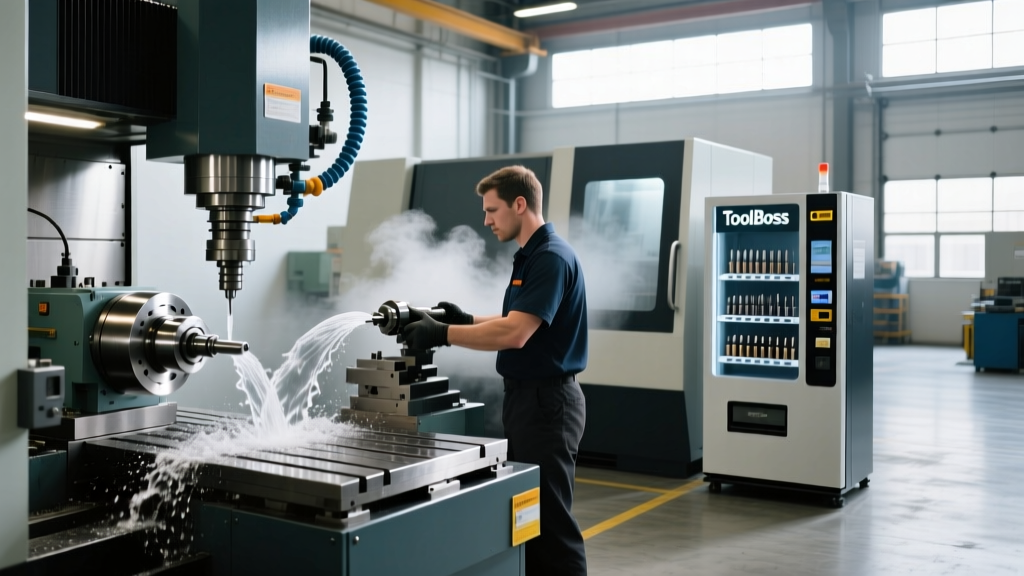
A ToolBoss vending machine is not just for securing expensive carbide end mills. When configured correctly via the CribMaster inventory management software, it becomes a localized, automated critical spares depot for your fluid delivery systems.
Configuring Par Levels for Coolant Hardware
To prevent downtime, you must track the wear rate of your coolant components and set automated reorder triggers within the ToolBoss interface. Navigate to the Item Master menu and configure the following critical spares:
- Loc-Line Modular Hoses (1/4' NPT): These segmented hoses frequently crack when operators use them as leverage handles. Set the ToolBoss vending machine par levels to Minimum: 10, Maximum: 25. When the 10th unit is dispensed, the system automatically generates a purchase order to your MSC Industrial or Kennametal rep.
- Brass Flow-Control Nozzles: Standard flood nozzles erode internally, losing their laminar flow profile and causing chatter. Track these via the ToolBoss weight-sensing coil bins. Set a minimum threshold of 15 units.
- Deublin TSC Repair Kits: These high-value items ($150-$250 each) should be stored in the secure, RFID-tracked drawers of the ToolBoss vending machine. Require operators to scan their badge and input the specific machine asset number (e.g., 'VF-4SS-02') upon checkout. This data allows you to track which specific CNC mills are destroying unions prematurely due to misalignment.
- MQL Coalescing Filters: Essential for protecting MQL capillary tubes. Set a time-based reminder in the ToolBoss software to prompt maintenance staff to check out a replacement filter element every 90 days.
The ROI of Automated Coolant Spares Management
By treating fluid delivery components as critical, tracked inventory within a ToolBoss vending machine, shops typically see a 34% reduction in coolant-related downtime within the first six months. The machine eliminates the 'hoarding' behavior where operators stash brass nozzles and hose segments in their personal toolboxes, ensuring that when a TSC union fails on the night shift, the replacement is securely available, fully tracked, and automatically reordered for the next day's delivery.