Elkins Machine & Tool Co: CNC Retrofit Safety Compliance Guide
Explore CNC retrofit safety compliance standards, featuring Elkins Machine & Tool Co methodologies, NFPA 79 rules, and ISO 13849 control architectures.
The Compliance Gap: Manual vs. CNC Operation
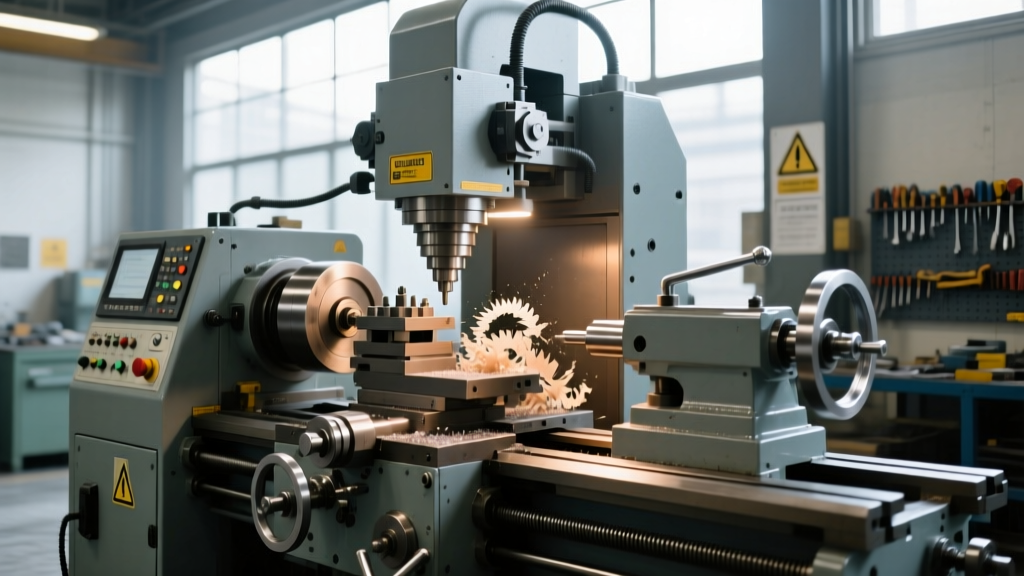
Converting a manual machine tool—such as a Bridgeport Series I mill or a South Bend Heavy 10 lathe—to CNC operation fundamentally alters the equipment's risk profile. Manual machining relies on the operator's physical proximity, tactile feedback, and immediate reaction time to manage hazards. CNC retrofits remove the human from the immediate cutting loop, introducing automated feeds, rapid traverse rates, and unattended kinetic energy.
Despite this shift, many machine shops treat electrical and safety upgrades as an afterthought, focusing entirely on servo motors and controller software. This oversight creates severe liability. According to OSHA 29 CFR 1910.212(a)(1), the point of operation of machines whose operation exposes an employee to injury must be guarded. When a manual mill is automated, the entire work envelope becomes an active point of operation.
OSHA Citation Risk: Retrofitting a machine to CNC without adding automated point-of-operation guarding and hardwired safety interlocks violates federal safety standards. As of 2026, OSHA fines for willful or repeated guarding violations exceed $16,131 per instance, alongside mandatory machine-lockout directives that halt production.Core Safety Standards Governing CNC Retrofits
To legally and safely operate a retrofitted CNC machine in an industrial environment, the control system must comply with two primary frameworks:
- NFPA 79 (Electrical Standard for Industrial Machinery): Dictates the physical wiring, component selection, and circuit architecture for machine controls. Chapter 10 strictly governs how Emergency Stop (E-Stop) circuits must be hardwired, explicitly forbidding software-only logic for safety-critical stops.
- ISO 13849-1 (Safety-Related Parts of Control Systems): Requires risk assessment and the assignment of a Performance Level (PL). A standard CNC milling or turning retrofit requires a minimum of Performance Level d (PLd) and Category 3 architecture, meaning the safety circuit must utilize dual-channel, cross-monitored hardware to detect single-point failures.
The Elkins Machine & Tool Co Approach to Electrical Safety
When evaluating best practices for manual-to-CNC conversions, the safety protocols championed by Elkins Machine & Tool Co provide a rigorous blueprint for compliance. Rather than relying on consumer-grade USB breakout boards or standard programmable logic controllers (PLCs) for safety functions, the Elkins Machine & Tool Co framework mandates a strict physical separation between high-voltage power circuits (240V/480V) and low-voltage safety control circuits (24VDC).
Hardwired E-Stop and Interlock Architectures
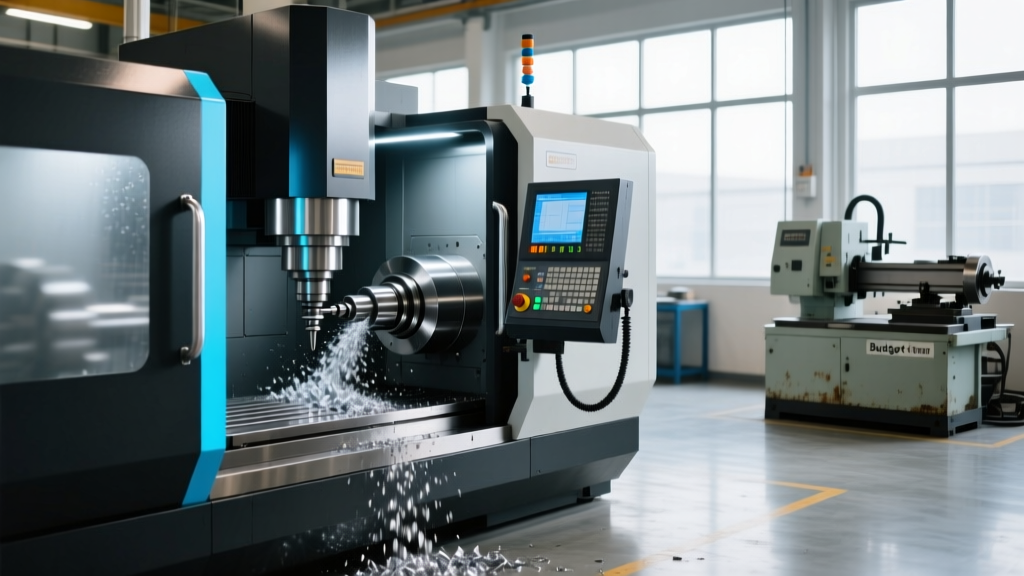
A critical failure mode in budget CNC retrofits is wiring the E-Stop button directly into a standard Mach4 or LinuxCNC parallel-port interface. If the PC crashes or the software hangs, the E-Stop becomes useless. Following the Elkins Machine & Tool Co compliance standard, the E-Stop circuit must physically interrupt the main contactor or trigger a dedicated safety relay that drops power to the spindle drive and axis servos, completely independent of the CNC controller's logic state.
Manual Machine vs. Compliant CNC Retrofit Safety Matrix
| Safety Feature | Manual Machine Standard | Compliant CNC Retrofit (Elkins Standard) |
|---|---|---|
| E-Stop Logic | Single-channel mechanical switch (if present) | Dual-channel Category 3 safety relay (e.g., Allen-Bradley 440R) |
| Door Interlocks | None / Operator discipline | RFID-coded non-contact switches (prevents defeat via magnets) |
| Spindle Braking | Coast to stop (natural friction) | Dynamic braking resistors on VFD (stops <2 seconds) |
| Guarding Material | PETG or Acrylic (splash protection) | 0.250" Polycarbonate (impact resistance to 400 SFPM chips) |
Component Selection and Pricing for Safety Upgrades
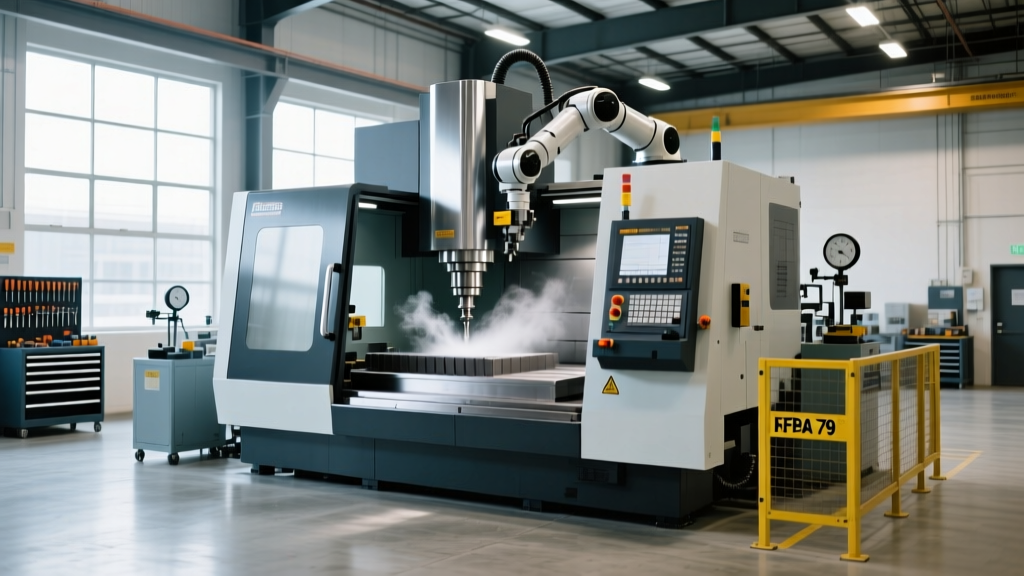
Achieving ISO 13849-1 PLd compliance requires specific, certified hardware. Standard industrial relays do not possess the internal cross-monitoring diagnostics required to detect welded contacts. Below is a breakdown of the specific components required for a compliant 3-axis CNC mill retrofit, reflecting current 2026 industrial pricing.
- SICK TR110 RFID Interlock Switch ($385): Used on enclosure doors. Unlike mechanical tongue switches, the RFID coding prevents operators from defeating the interlock using tape, zip-ties, or spare magnets. Includes dual-channel OSSD outputs.
- Allen-Bradley Guardmaster 440R-C23R2 Safety Relay ($420): The core logic solver for the E-Stop and door interlocks. Monitors the dual-channel wiring for short circuits and cross-faults. If a fault is detected, it locks out the machine until manually reset.
- Plexus 0.250" Polycarbonate Shields ($120/sq ft): CNC machines throw broken carbide inserts and stringy chips at velocities exceeding 300 surface feet per minute (SFPM). Acrylic and PETG will shatter under this impact; polycarbonate is mandatory for containment.
- Schmersal AZM415 Solenoid Guard Lock ($650): Required for lathes with heavy chucks. Prevents the operator from opening the chuck guard until the spindle has completely ceased rotation, verified by a zero-speed monitor.
For a standard knee-mill retrofit, expect to allocate between $4,500 and $7,200 strictly for the safety and guarding hardware, excluding the CNC motion components.
Mechanical Guarding and Chip Containment Dynamics
The NFPA 79 standard emphasizes that electrical safety is only half the compliance equation; mechanical guarding must match the automated hazard. When a manual lathe is retrofitted with a CNC carriage, the automated feed rate can generate continuous, razor-sharp bird-nest chips that eject with significant force.
Compliant retrofits require full-enclosure guarding with specific structural considerations. Hinges must be heavy-duty steel piano hinges mounted on the outside of the enclosure to prevent chip accumulation in the hinge pin, which can cause binding and eventual failure. Furthermore, all polycarbonate windows must be mechanically fastened with steel retainers and neoprene gaskets; relying on industrial adhesives or silicone is a violation, as UV degradation and coolant exposure will compromise the bond within 18 months.
Spindle Braking and Overrun Hazards
A 5HP spindle rotating at 3,000 RPM possesses immense rotational inertia. If an E-Stop is triggered, simply cutting power to the Variable Frequency Drive (VFD) results in a coast-to-stop scenario that can take over 45 seconds. During this overrun period, the cutting tool remains a severe laceration hazard. Compliant retrofits mandate the installation of external dynamic braking resistors wired to the VFD's DC bus, forcing the spindle to decelerate to zero in under 2.0 seconds. The safety relay must be wired to monitor the VFD's "Zero Speed" output before allowing the chuck guard interlock to release.
Frequently Asked Questions
Can I use a standard PLC or CNC breakout board for E-stop logic?
No. NFPA 79 explicitly prohibits the use of standard software logic, standard PLCs, or PC-based breakout boards for Category 0 or Category 1 E-Stop functions. The E-Stop circuit must be hardwired through a certified safety relay or a FSoE (Fail Safe over EtherCAT) certified safety PLC that physically breaks the power circuit to the motor contactors.
Does a manual knee mill retrofit require full enclosure guarding?
While full splash enclosures are ideal, OSHA and ANSI B11.8 standards allow for localized point-of-operation guarding on knee mills if the automated rapid traverse rates are limited and the operator remains within the immediate zone. However, the spindle and workpiece must be shielded by polycarbonate barriers, and the E-Stop and safety interlock architecture must still meet Category 3 / PLd requirements regardless of the enclosure size.