Elkins Machine and Tool Benchmark: Premium vs Budget Machine Tool ROI
Analyze the 5-year ROI of premium vs. budget machine tool brands using Elkins Machine and Tool's high-mix production standards to guide CapEx budgeting.
The CapEx Illusion: Sticker Price vs. 5-Year TCO
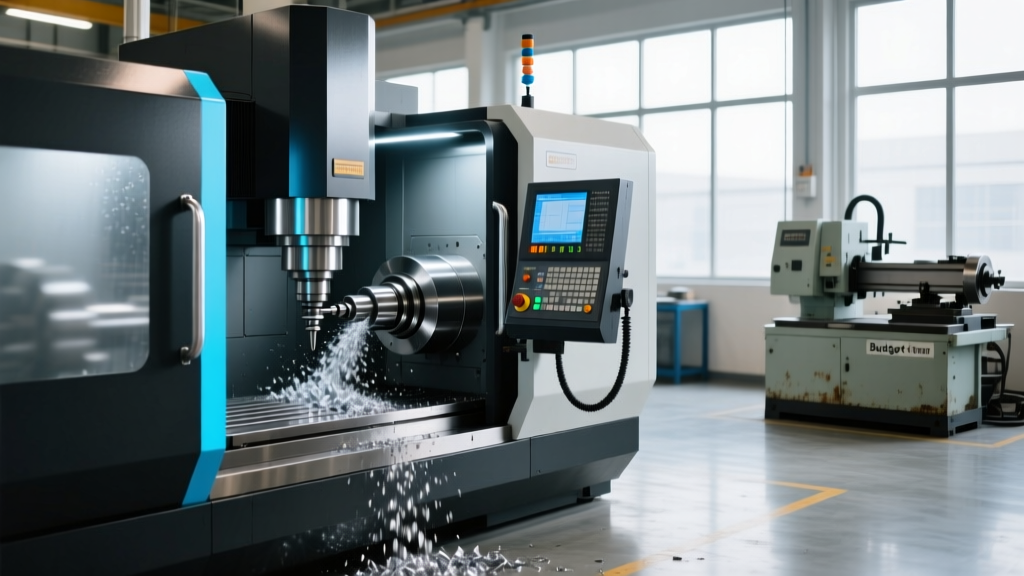
Capital expenditure (CapEx) planning for CNC equipment frequently falls into the trap of optimizing for the initial invoice rather than the Total Cost of Ownership (TCO). For high-mix, tight-tolerance contract manufacturers operating on the level of Elkins Machine and Tool, the true cost of a machine tool is calculated in spindle hours, scrapped aerospace alloys, and setup changeover times. When benchmarking machine tool brand value, shop owners must evaluate how premium iron (Mazak, Okuma, DMG Mori) compares to mid-tier workhorses (Haas, DN Solutions) and budget imports over a 60-month lifecycle.
According to industry data tracked by Modern Machine Shop, the initial purchase price of a vertical machining center (VMC) represents only 25% to 35% of its 5-year operational cost. The remaining 65% to 75% is consumed by energy, tooling, maintenance, floor space, and most critically, unplanned downtime. In 2026, with shop rates for 5-axis aerospace machining averaging $160 to $220 per hour, a single 12-hour unplanned downtime event costs more than the annual maintenance contract on a premium machine.
5-Year Total Cost of Ownership (TCO) Matrix
The following matrix breaks down the realistic 5-year TCO for a standard 40-taper VMC across three distinct brand tiers. These figures assume a 2-shift operation (4,000 spindle hours annually) machining a mix of aluminum 6061 and stainless steel 304/17-4PH.
| Cost Metric (5-Year) | Budget Import (Tier 3) | Mid-Tier (e.g., Haas VF-2SS) | Premium (e.g., Okuma GENOS / Mazak VCN) |
|---|---|---|---|
| Initial CapEx | $75,000 | $115,000 | $215,000 |
| Spindle Rebuilds | $24,000 (2 rebuilds) | $16,000 (1 rebuild) | $0 (Thermal growth managed) |
| Unplanned Downtime Cost | $90,000 (120 hrs/yr) | $30,000 (40 hrs/yr) | $11,250 (15 hrs/yr) |
| Tooling Wear Premium | $18,000 (Chatter/Vibration) | $8,000 | $4,500 (Rigid tapping/HSK) |
| Energy Consumption | $22,500 | $19,000 (Regen drives) | $16,500 (Eco-mode tech) |
| 5-Year TCO Total | $229,500 | $188,000 | $247,250 |
| Cost Per Spindle Hour | $11.47 | $9.40 | $12.36 |
Brand Tier Analysis: Where the Value Actually Lives
Tier 1: Premium (Mazak, Okuma, DMG Mori, Makino)
Premium brands engineer for thermal stability and geometric longevity. Okuma’s Thermo-Friendly Concept and Mazak’s thermal shield designs ensure that a machine cold-started on a Monday morning holds the same ±0.0002-inch tolerance as it does during a heavy cutting cycle on Thursday afternoon. These machines utilize direct-drive torque motors, linear scales (not just rotary encoders on the servo), and heavily ribbed castings. Best for: Medical implants, aerospace structural components, and high-mix shops where first-part inspection must pass without manual CMM adjustments.
Tier 2: Mid-Tier Workhorses (Haas, DN Solutions, Hyundai WIA)
Mid-tier brands dominate the North American market by offering 85% of the capability of premium brands at 55% of the cost. The Haas NGC control and DN Solutions’ linear guideway packages offer exceptional rapid traverse rates (up to 1,400 ipm) and user-friendly interfaces. However, they often rely on standard ball screws without thermal compensation, meaning operators must run warm-up cycles and adjust tool offsets as the shop temperature fluctuates. Best for: High-volume commercial parts, aluminum enclosures, and production runs where tooling and fixturing can compensate for minor machine deflection.
Tier 3: Budget Imports
Often marketed with aggressive financing and included chip conveyors, budget imports suffer from poor way-cover sealing, inferior spindle bearings (often standard P4 grade instead of P2), and fragmented technical support. The hidden cost here is operator frustration; troubleshooting a proprietary, poorly translated PLC fault code can halt production for days. Best for: Secondary operations, roughing, or non-critical hobbyist/prototyping environments.
The Elkins Machine and Tool Standard: High-Mix Economics
To truly understand machine tool value analysis, we must look at the operational benchmark set by elite precision manufacturers like Elkins Machine and Tool. Facilities operating at this caliber do not buy machines based on spindle speed alone; they buy process consolidation.
In high-mix, low-volume environments, the machine tool's purchase price is secondary to its ability to eliminate secondary operations. A 5-axis premium machine that completes a part in one setup saves 4 hours of labor, fixturing costs, and cumulative tolerance stack-up errors.
When Elkins Machine and Tool evaluates a new 5-axis platform (such as a Mazak VARIAXIS i-800 NEO or a DMG Mori DMU 50 3rd Generation), the ROI calculation includes the elimination of manual deburring, secondary milling setups, and CMM queuing time. By utilizing integrated probing and tool-center-point control (TCPC), a premium 5-axis machine ensures that a complex aerospace valve body is finished to within 5 microns in a single clamping. For a shop billing at $185/hour, reducing a part's flow time from 3 days to 4 hours yields an effective ROI that pays off the $450,000 machine investment in under 24 months, entirely bypassing the TCO arguments of cheaper 3-axis alternatives.
2026 Capital Allocation Decision Framework
Use the following decision matrix to align your 2026 machine tool budget with your actual production requirements. Do not over-invest in premium iron for simple parts, and do not risk mid-tier deflection on tight-tolerance medical work.
- If your primary material is Aluminum/Plastics & tolerances are > ±0.001": Allocate budget to Mid-Tier (Haas/Doosan) with high-pressure coolant (1,000 PSI) and high-speed spindles (12,000+ RPM). Focus CapEx on automation (pallet pools) rather than machine casting mass.
- If you machine Titanium/Inconel & tolerances are < ±0.0005": Allocate budget to Premium (Makino/Okuma). You require high torque at low RPMs, massive damping capacity (box ways or heavily preloaded linear guides), and integrated thermal compensation. The Society of Manufacturing Engineers (SME) consistently highlights that rigid machine structures reduce carbide tooling costs by up to 30% in hard-metal applications.
- If you are a High-Mix Job Shop (like the Elkins Machine and Tool model): Invest in mid-tier 5-axis machines with premium control options (e.g., Haas UMC-750 with Renishaw probing and NGC). The value here is in the control's ability to handle complex CAM output and the probing system's ability to set work offsets automatically, reducing setup times from 4 hours to 45 minutes.
Final Budgeting Directive
Stop evaluating machine tools as isolated assets. Evaluate them as nodes in your manufacturing ecosystem. When planning your next equipment purchase, demand a 60-month TCO projection from the dealer that includes guaranteed spindle warranties, local service technician response times (SLA), and energy consumption metrics. The brand that offers the lowest cost per good part—not the lowest cost per spindle hour—will always deliver the highest long-term value.