E-Stop Maintenance: CNC Mills & Mac Tools Air Conditioning Machine
Master safety interlock maintenance for CNC mills and the Mac Tools air conditioning machine. Learn E-stop testing, pressure switch calibration, and schedules.
The Architecture of Shop Safety: CNC vs. HVAC Service Rigs
Maintaining a modern machine shop requires strict adherence to safety interlock protocols across vastly different equipment categories. While a 5-axis CNC machining center and a mobile HVAC service rig operate on entirely different mechanical principles, their safety architectures share a critical dependency on fail-safe interlocks and emergency stop (E-stop) circuits. As of 2026, integrated shop floors increasingly rely on IoT diagnostic dashboards to monitor circuit continuity, but physical mechanical testing and scheduled preventative maintenance remain non-negotiable requirements for OSHA compliance and operator safety.
This guide details the specific maintenance schedules, diagnostic procedures, and failure modes for safety interlocks on heavy machine tools, alongside specialized auxiliary equipment like the Mac Tools air conditioning machine used for in-house fleet and heavy equipment cab servicing.
Dual-Channel Relays in CNC Machining
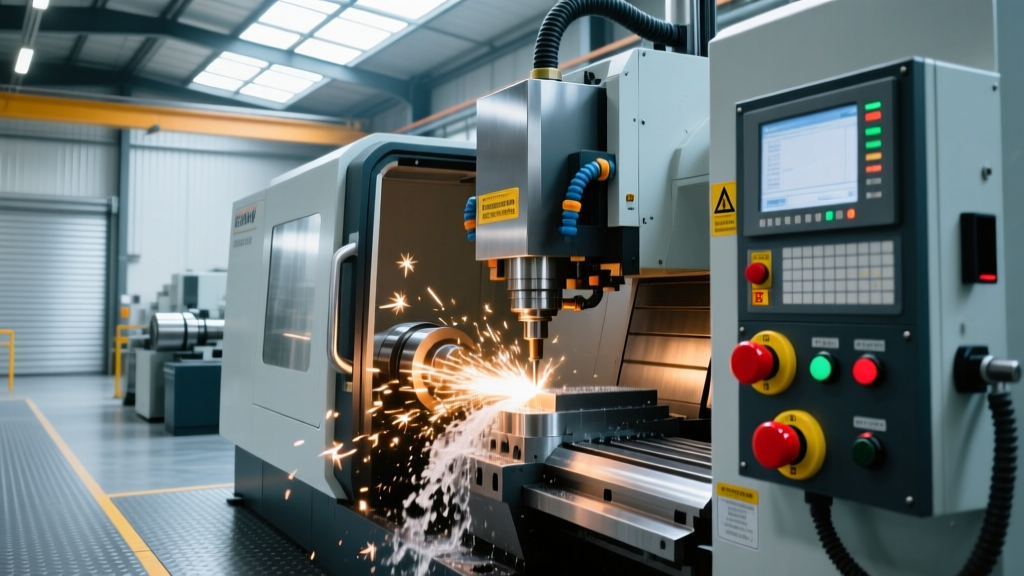
Modern CNC lathes and mills utilize Category 3 or Category 4 safety architectures governed by ISO 13849-1. These systems rely on dual-channel safety relays (such as the Pilz PNOZ series or Allen-Bradley Guardmaster) to monitor E-stop buttons, door interlocks, and light curtains. If one channel fails or detects a discrepancy, the relay drops power to the main drive contactors within milliseconds.
The most common point of failure in CNC interlock systems is not the relay itself, but the field devices: the physical E-stop contact blocks and the solenoid door locks. In harsh machining environments, aerosolized cutting fluids and conductive swarf can infiltrate IP65-rated switch housings, leading to micro-shorts that mask open-circuit faults. Maintenance schedules must prioritize the physical inspection and electrical testing of these field devices over the internal PLC logic.
High-Pressure Interlocks in the Mac Tools Air Conditioning Machine
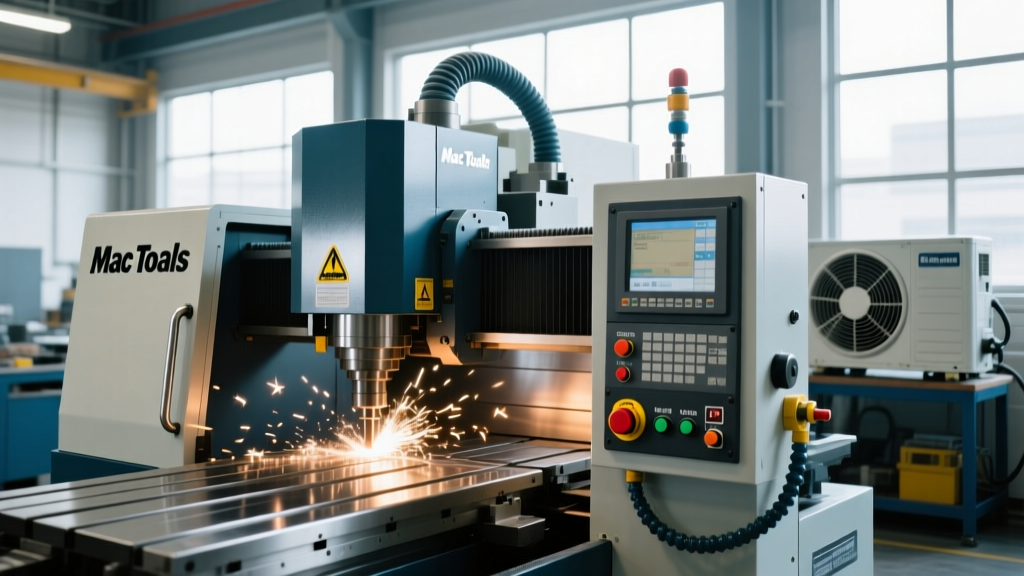
Heavy equipment fleets require rigorous climate control maintenance, bringing specialized Recovery, Recycling, and Recharging (RRR) equipment into the industrial shop. When servicing a Mac Tools air conditioning machine (such as the MAC3520 or newer R-1234yf compatible models), technicians must maintain an entirely different class of safety interlocks driven by thermodynamics and mass limits rather than kinetic energy hazards.
These machines feature two critical, non-negotiable safety interlocks:
- High-Pressure Cut-Off Switch: Typically calibrated to trip at 400 PSI for R-134a systems, or higher thresholds for R-1234yf. This mechanical pressure transducer interrupts the compressor clutch circuit to prevent catastrophic hose rupture or manifold explosion.
- Tank Scale Limit Switch (80% Rule):strong> EPA regulations mandate that recovery tanks must not be filled beyond 80% of their volumetric capacity to allow for liquid expansion. The Mac Tools air conditioning machine uses an internal electronic load cell scale. If the scale drifts out of calibration, the software interlock that halts the recovery process may fail to trigger, risking a hydrostatic lock and subsequent tank rupture.
Never bypass a tripped high-pressure interlock on an A/C RRR machine or a CNC door solenoid with a jumper wire to 'finish the job.' Bypassing dual-channel safety circuits defeats the redundancy designed to prevent fatal kinetic or explosive energy releases. Violations carry severe OSHA penalties and void equipment liability insurance.
Failure Modes: Contact Welding vs. Mechanical Binding
Understanding how interlocks fail dictates how you schedule their replacement. E-stop switches and pressure cut-offs generally fail in two distinct modes:
1. DC Contact Welding (CNC E-Stops)
Most modern CNC E-stop circuits operate on 24VDC. Unlike AC circuits, DC current does not have a natural zero-crossing point, meaning electrical arcs do not self-extinguish easily. Over years of actuation, micro-arcing across the Normally Closed (NC) contacts causes localized melting. Eventually, the contacts weld together. If an operator slams the E-stop button, the mechanical plunger retracts, but the welded contacts remain closed, failing to drop the safety relay. Preventative replacement of DC contact blocks is mandatory every 3 years, regardless of apparent function.
2. Mechanical Binding and Scale Drift (HVAC RRR Machines)
On the Mac Tools air conditioning machine, the high-pressure switch relies on a Bourdon tube or piezoelectric sensor. Exposure to shop vibrations and thermal cycling can cause mechanical binding in the Bourdon tube, delaying the trip point by 50+ PSI. Similarly, the internal tank scale is highly sensitive to shop floor vibrations and accidental impacts. A load cell that is just 5% out of calibration can allow a 30 lb recovery tank to overfill by 1.5 lbs of liquid refrigerant, creating a severe explosive hazard in a hot shop environment.
Diagnostic Matrix for E-Stops and Interlock Switches
Implement this matrix into your shop's Computerized Maintenance Management System (CMMS) to track compliance and component lifecycles.
| Component | Test Method | Frequency | Pass/Fail Criteria |
|---|---|---|---|
| CNC E-Stop NC Contacts | Voltage drop test under load (24VDC) | Monthly | Pass: < 0.05V drop. Fail: > 0.2V drop (replace block). |
| CNC Door Solenoid Lock | Pull-force gauge & RFID alignment check | Quarterly | Pass: >1000N hold force, 5-8mm sensor gap. |
| A/C Machine High-Pressure Switch | Deadweight tester or calibrated manifold | Annually | Pass: Trips within ±5 PSI of rated threshold. |
| A/C Machine Internal Tank Scale | Certified 20 kg deadweight test | Bi-Annually | Pass: Readout within ±10g of test weight. |
| Safety Relay Logic (All) | Simulated channel fault injection | Annually | Pass: Relay drops out & locks out within 50ms. |
Step-by-Step E-Stop Relay Verification Protocol
Visual inspection of an E-stop button is insufficient to verify circuit integrity. Maintenance technicians must perform an active voltage drop test to identify carbon buildup and micro-welding before catastrophic failure occurs.
- Isolate and Secure: Place the CNC machine in a safe state. Engage the primary E-stop to halt spindle and axis drives, but leave the main control cabinet powered to maintain 24VDC logic power.
- Configure the Multimeter: Set a high-precision multimeter (e.g., Fluke 87V) to DC millivolts (mVDC). Connect the test leads directly to the input and output terminals of the E-stop's Normally Closed (NC) contact block.
- Measure Under Load: With the E-stop circuit energized and current flowing through the contacts, record the voltage drop. A pristine contact block will show less than 0.05V (50mV).
- Evaluate the Threshold: If the reading exceeds 0.2V (200mV), internal resistance has increased due to arcing or oxidation. The contact block must be replaced immediately. Do not attempt to clean the contacts; the metallurgical integrity is compromised.
- Verify Mechanical Travel: Depress the E-stop button. The multimeter should instantly read open-line (OL). If the voltage drop remains, the contacts are welded, or the mechanical linkage is broken. Replace the entire E-stop assembly and document the failure mode in your CMMS.
Regulatory Compliance and Recordkeeping
Maintenance logs for safety interlocks are the first documents requested during an incident investigation. Compliance requires adherence to both general machine guarding standards and specific environmental regulations depending on the equipment being serviced.
For CNC equipment and general shop machinery, safeguarding architectures must align with OSHA 1910.212 General Requirements for All Machines, which mandates that point-of-operation guards and interlocks prevent operator exposure to hazards during the machine's operating cycle. Furthermore, when maintaining the Mac Tools air conditioning machine, technicians are bound by EPA Section 609 of the Clean Air Act. Section 609 strictly governs the servicing of Motor Vehicle Air Conditioning (MVAC) systems and mandates that recovery equipment must be certified and properly maintained to prevent refrigerant venting, which directly ties into the legal necessity of maintaining the machine's 80% tank-fill interlocks and pressure cut-offs.
"Employers must ensure that safety interlocks, emergency stops, and pressure relief devices on all shop equipment are tested at intervals specified by the manufacturer or recognized safety standards, and that verifiable records of these tests are retained on-site."
By treating the safety interlocks on your Mac Tools air conditioning machine with the same diagnostic rigor as the dual-channel safety relays on your 5-axis CNC mills, you create a unified, unbreakable culture of safety across your entire manufacturing and maintenance footprint.