Machine Tool Spindle Lubrication: Oil-Air vs Grease Compared
Compare machine tool spindle lubrication systems. Analyze oil-air, grease, and liquid oil alternatives with costs, speed limits, and maintenance schedules.
The Critical Role of Lubrication in Machine Tool Spindle Longevity
When a machine tool spindle fails prematurely, root cause analysis traces the failure back to lubrication breakdown or contamination in over 40% of cases. The lubrication system must simultaneously minimize friction, dissipate heat generated by high-speed rotation, and protect against ingress from coolant or swarf. Selecting the correct lubrication architecture is not a one-size-fits-all decision; it requires matching the system to the spindle's specific speed factor, load profile, and the shop's maintenance capabilities.
CRITICAL METRIC: The Speed Factor (dmn)Before choosing a lubrication alternative, calculate the spindle's speed factor: dmn = (Bearing Pitch Diameter in mm) × (Maximum RPM). Grease systems typically max out at a dmn of 1,000,000. Oil-air systems reliably support dmn values up to 2,000,000, while advanced liquid oil jet systems are required for heavy-load, lower-speed applications where thermal removal is the primary constraint.
Comparative Matrix: Grease vs. Oil-Air vs. Liquid Oil Systems
The three dominant lubrication methods for modern CNC machining centers each offer distinct trade-offs regarding initial capital expenditure, operational speed limits, and long-term maintenance overhead. The table below outlines the core engineering and financial differences.
| System Type | Max Speed (dmn) | Initial Setup Cost | Thermal Dissipation | Maintenance Interval |
|---|---|---|---|---|
| Grease-Packed (Sealed) | ~1,000,000 | $50 - $150 (per rebuild) | Poor | 8,000 - 12,000 hrs (Rebuild) |
| Oil-Air Micro-Lubrication | ~2,000,000+ | $2,500 - $4,500 | Excellent | Continuous (Daily fluid checks) |
| Liquid Oil (Jet/Mist) | ~800,000 | $3,000 - $6,000 | Superior | Monthly (Filter/Fluid changes) |
Deep Dive: Grease-Packed Spindles (The 'Sealed for Life' Alternative)
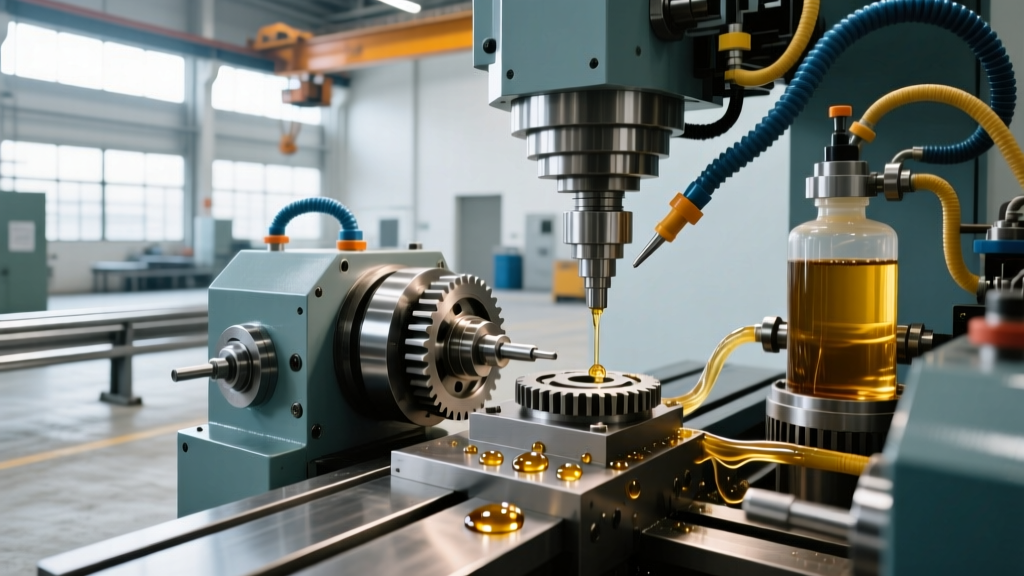
For standard vertical machining centers operating below 12,000 RPM (such as standard BT40/CAT40 configurations), grease-packed angular contact bearings remain the industry standard. Modern high-precision spindles, such as those utilizing NSK super precision angular contact bearings, are frequently pre-packed at the factory with specialized synthetic greases and sealed with non-contact labyrinth seals.
Specific Grease Formulations & Costs
The most prevalent formulation for high-speed machine tool spindle applications is a barium-complex thickener with a low-viscosity synthetic base oil (typically ISO VG 32 or lower). Kluber Isoflex NBU 15 is a benchmark product in this category, featuring a base oil viscosity of 32 mm²/s at 40°C. A 400g cartridge costs approximately $120 to $150. While the material cost is negligible, the labor cost of a spindle teardown, cleaning, and precise volumetric repacking typically ranges from $1,500 to $3,500 at a specialized rebuild facility.
WARNING: The Over-Greasing TrapAttempting to manually regrease a factory-sealed spindle via zerk fittings is a primary cause of thermal runaway. Excess grease causes severe churning, which generates exponential friction heat. This degrades the grease matrix, leading to cage failure and catastrophic bearing seizure within hours. If your spindle lacks engineered relubrication pathways, treat it as sealed until the scheduled rebuild.
Oil-Air Micro-Lubrication: The High-Speed Standard
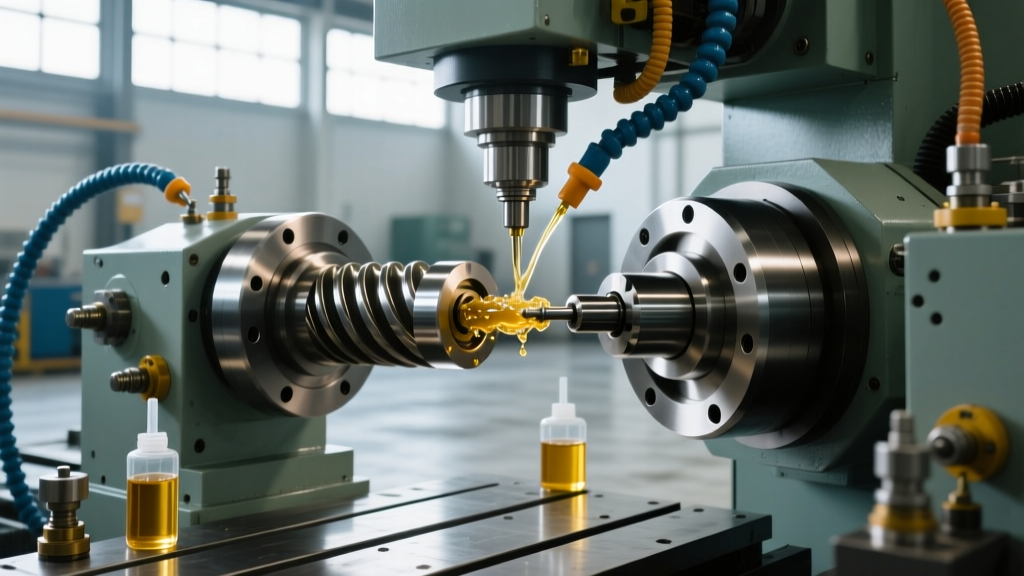
When machining aluminum aerospace components or graphite electrodes requiring spindle speeds of 20,000 to 40,000 RPM, grease fails due to shear degradation. Oil-air systems atomize microscopic droplets of oil into a continuous stream of dry, filtered compressed air. This delivers precise lubrication while the air flow actively purges contaminants and removes heat from the bearing raceways.
System Architecture & Pricing
A complete oil-air retrofit or OEM installation includes a pneumatic pump, a mixing valve block, and a coalescing air filter (rated to 0.01 microns to prevent moisture ingress). Brands like Dropsa, SKF (MicroLube), and Bijur dominate this space. Expect to pay between $2,500 and $4,500 for a fully integrated 4-point oil-air system. The operational cost is remarkably low; a typical high-speed spindle consumes only 0.02 to 0.08 cubic centimeters of oil per hour. The recommended fluid is a specialized spindle oil like Mobil Velocite Oil No. 6 (ISO VG 10), which costs roughly $45 per gallon.
Relubrication Schedules & Condition-Based Monitoring
Maintenance schedules must shift from calendar-based to condition-based monitoring to maximize spindle life. Follow this structured protocol for oil-air and liquid oil systems:
- Daily (Visual & Auditory): Verify the oil-air reservoir level. Check the air pressure gauge at the mixing block; a drop below 2.0 bar indicates a clogged coalescing filter or a line restriction, which will starve the bearings of oil within minutes.
- Monthly (Fluid & Filtration): Drain and replace the 0.01-micron air coalescing filter element. Moisture in the air lines will emulsify the spindle oil, destroying the hydrodynamic film between the rolling elements and raceways.
- Quarterly (Vibration Analysis): Utilize an accelerometer to capture high-frequency enveloping data. Monitor for specific fault frequencies: Ball Pass Frequency Outer race (BPFO) and Ball Pass Frequency Inner race (BPFI). An increase in the amplitude of these frequencies indicates early-stage lubrication starvation or surface spalling, as detailed in the ISO 15243 standard for rolling bearing damage.
- Annually (Thermal Mapping): Use an infrared thermal camera to map the spindle housing during a standardized 30-minute warm-up cycle at 80% max RPM. A temperature rise exceeding 15°C above the baseline indicates degraded oil viscosity or bearing preload shifts.
Liquid Oil Systems: The Heavy-Duty Alternative
For heavy-duty horizontal boring mills or 5-axis machines executing aggressive roughing passes in titanium or Inconel, speed is secondary to thermal stability and load capacity. Liquid oil jet or oil-mist systems flood the bearings with a continuous stream of ISO VG 32 or VG 68 oil. While this creates higher fluid friction (limiting max RPM), the massive volume of oil acts as a liquid heat sink, pulling heat directly away from the cutting zone. These systems require a dedicated chiller unit (adding $4,000 to $8,000 to the setup cost) to maintain the oil temperature within ±0.5°C of the ambient shop temperature, preventing thermal growth in the spindle housing.
Decision Framework: Selecting the Right System for Your Shop
Use the following operational criteria to finalize your lubrication architecture choice:
- Choose Grease-Packed if: Your maximum RPM is under 12,000, you perform standard steel/aluminum milling, and your maintenance team lacks the infrastructure to manage centralized fluid delivery systems. Budget for a complete spindle rebuild every 3 to 5 years.
- Choose Oil-Air if: You operate high-speed spindles (15,000+ RPM), require rapid acceleration/deceleration, and need to minimize thermal growth during high-precision finishing passes.
- Choose Liquid Oil if: You are running heavy interrupted cuts, utilizing large taper tools (CAT50/HSK100), and generating massive amounts of localized heat that grease or micro-oil cannot dissipate.
Troubleshooting FAQ: Common Spindle Lube Failures
Q: Why is my oil-air spindle running hotter than normal despite the pump working?
A: Check the air-to-oil ratio. If the air pressure is too high relative to the oil metering valve, you are blowing the oil past the bearing seals without it adhering to the raceways. Conversely, if the oil viscosity has degraded due to oxidation, the hydrodynamic film will collapse under load, causing metal-to-metal contact and heat generation.
Q: Can I mix synthetic grease with mineral-based grease during a spindle rebuild?
A: Never mix thickeners. Combining a polyurea thickener with a lithium-complex thickener will cause the grease matrix to break down into a liquid state, resulting in immediate leakage and total lubrication failure. Always completely purge and solvent-wash the bearings before applying a new formulation.
By aligning your machine tool spindle lubrication strategy with precise operational metrics rather than generic manufacturer defaults, you can extend mean-time-between-failures (MTBF) by up to 40%, protecting your capital equipment investment and maintaining micron-level part tolerances.