Maintaining Niagara Machine and Tool Works Press Safety Interlocks
Learn the maintenance schedules and upgrade paths for safety interlocks and emergency stops on legacy Niagara Machine and Tool Works mechanical presses.
Legacy Niagara Safety Architecture and Modern Compliance
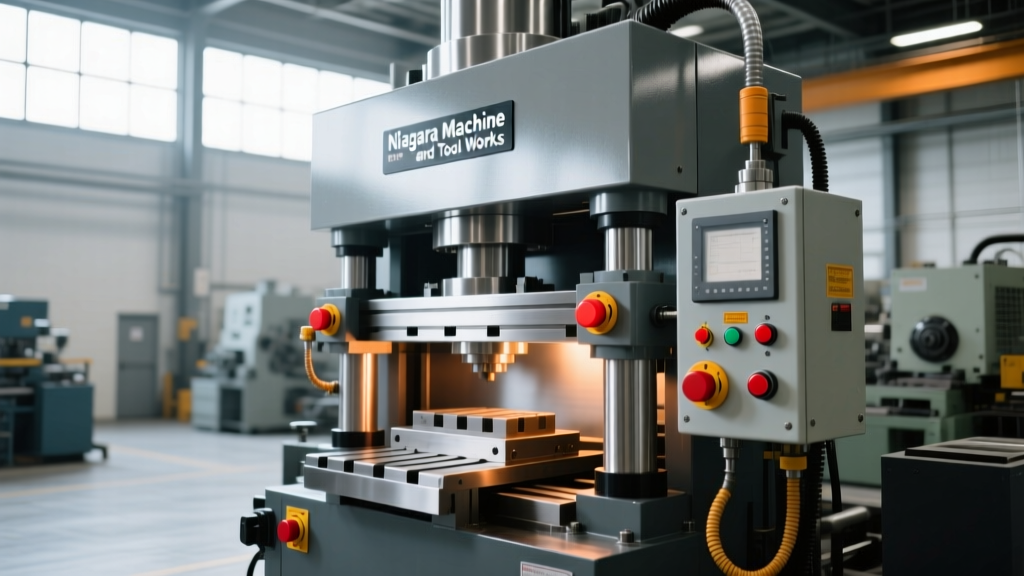
Mechanical power presses manufactured by the historic Niagara Machine and Tool Works remain workhorses in heavy stamping, blanking, and forming operations. Models like the Niagara Model A and the heavy-duty Buffalo line were engineered for extreme longevity, with cast-iron frames and massive flywheels that outlast modern welded alternatives. However, the original safety interlocks and emergency stop (E-stop) circuits installed on these machines decades ago are entirely insufficient for current OSHA 1910.217 Mechanical Power Presses standards.
Maintaining and upgrading the safety interlocks and E-stop systems on a legacy Niagara press requires a deep understanding of both the original mechanical cam-driven architecture and modern Category 3 or 4 safety relay logic. A failure in the dual-valve air clutch system or a drifted cam switch can result in a repeat stroke or uncommanded slide descent, posing catastrophic risks to operators. This guide outlines the exact maintenance schedules, failure modes, and retrofit protocols required to keep Niagara presses safe and compliant in 2026.
⚠️ CRITICAL WARNING: Single vs. Dual Valve SystemsMany older Niagara presses were originally equipped with single-solenoid air valves. OSHA and ANSI B11.1 strictly require a dual-valve (redundant) air clutch system with dynamic monitoring for full-revolution mechanical presses. If your Niagara press still utilizes a single-valve actuation system, it must be retrofitted with a monitored dual-valve (such as a MAC DMF series) before the machine can be legally operated in a production environment.
Mandatory Interlock and E-Stop Maintenance Matrix
Routine maintenance on Niagara press safety systems must go beyond visual inspections. Technicians must perform functional, measured tests to verify stopping times and circuit redundancy. Below is the strict maintenance schedule required for Niagara mechanical presses equipped with pneumatic friction clutches and modern safety PLCs.
| Frequency | Component | Action Required | Acceptable Tolerance |
|---|---|---|---|
| Daily | E-Stop Buttons | Actuate all E-stops at the start of the shift to verify slide immobilization and control circuit drop-out. | Immediate halt; no slide drift. |
| Daily | Light Curtains / AOPDs | Test muting and blanking functions using the manufacturer's test piece (e.g., 14mm or 30mm resolution rod). | Press trip within 20ms of beam break. |
| Weekly | Dual Air Valve | Perform a dynamic dump test. Listen for the simultaneous exhaust of both valve spools when the E-stop is hit. | Exhaust must be simultaneous; no single-spool hesitation. |
| Monthly | Cam Switch Timing | Verify the top-dead-center (TDC) and stop-on-center (SOC) cam switch actuation points using a dial indicator on the slide. | ±1 degree of crankshaft rotation. |
| Quarterly | Brake Wear / Stopping Angle | Measure the stopping angle using a press analyzer (e.g., Wintriss or Toledo Integrated Systems). | Must not exceed the calculated safe stopping angle (usually < 15°). |
| Annually | Safety Relay Injection | Inject simulated faults into the dual-channel safety relay (e.g., Pilz PNOZ or Allen-Bradley Guardmaster) to verify cross-fault detection. | Relay must lock out and require manual reset. |
Upgrading E-Stop Circuits to Category 4
Original Niagara wiring diagrams often show E-stop buttons wired in series on a single 120V AC control line. This single-channel architecture is a severe violation of OSHA 1910.212 General Requirements for All Machines. Upgrading these circuits requires transitioning to a dual-channel, normally closed (NC) topology monitored by a safety-rated controller.
Step-by-Step E-Stop Retrofit Protocol
- Replace Hardware: Remove legacy twist-release E-stop buttons. Install modern, twist-to-release or pull-to-release illuminated E-stops (e.g., Allen-Bradley 800H or Eaton FAK series) with dual NC contacts and one NO contact for indicator feedback.
- Wire Dual Channels: Route Channel 1 and Channel 2 through separate physical conduit paths where possible to prevent a single pinch-point or cable crush from disabling both channels.
- Integrate Safety Relay: Connect the dual channels to a Category 4 / PLe safety relay. For standalone Niagara presses, a Pilz PNOZ s7.2 or a Sick Flexi Soft gateway is the industry standard in 2026.
- Monitor the Dual Valve: The safety relay's output must not only break the electrical circuit to the clutch solenoid but also actively monitor the feedback pins on the MAC dual air valve to ensure both spools have physically shifted to the exhaust position.
Troubleshooting Common Niagara Interlock Faults
When a Niagara press fails to start or unexpectedly faults out, the issue is rarely the safety PLC itself. The root cause usually lies in the mechanical-to-electrical interface. Use this diagnostic framework to isolate the failure.
- Symptom: Press faults out mid-cycle with a 'Valve Discrepancy' alarm.
Cause: Spool stiction in one half of the dual air valve. This is almost always caused by the degradation of ISO VG32 pneumatic oil, which turns into a varnish-like sludge over time, preventing one spool from returning to the center exhaust position within the 50ms monitoring window.
Fix: Rebuild or replace the dual valve. Flush the pneumatic supply line and install a coalescing filter with an automatic drain to eliminate moisture and oil carryover. - Symptom: Slide drifts past Top Dead Center (TDC) during inching mode.
Cause: Cam switch timing drift. The physical cam lobes on the Niagara crankshaft extension can loosen due to high-torque vibrations, causing the Gemco or Camco limit switches to fire late.
Fix: Lock out/tag out the press. Attach a dial indicator to the slide. Manually bar the flywheel to find exact TDC. Loosen the cam collar, reset the lobe to actuate the switch exactly 5 degrees before TDC, and torque the collar set-screws to the manufacturer's specification (typically 45-60 ft-lbs depending on the collar size). - Symptom: E-stop circuit shows 'Cross-Short Fault' on the safety relay.
Cause: Insulation breakdown in the operator station pendant cable. Because the pendant is constantly dragged across the press bed or exposed to stamping fluids, the internal wires for Channel 1 and Channel 2 eventually short together.
Fix: Replace the pendant cable with a continuous-flex, oil-resistant PUR-jacketed cable. Do not use standard PVC control cable for moving operator stations.
Guard Interlocks: Mechanical vs. RFID Switches
Legacy Niagara presses frequently utilize mechanical tongue-and-key interlocks on sliding barrier guards. While robust, mechanical switches are prone to defeat by operators using spare keys or bent pieces of metal, and the physical insertion of the tongue can warp over years of heavy slamming.
For 2026 retrofits, replace mechanical tongue switches with non-contact RFID coded safety switches (e.g., Sick STR1 or Euchner NZ). These switches offer a coding level that makes physical defeat virtually impossible. However, when mounting RFID switches on heavy Niagara slide guards, you must use flexible actuator mounts. The massive vibration of a 200-ton Niagara blanking press will shatter rigidly mounted plastic switch bodies within weeks. Isolate the switch from the guard frame using neoprene dampening pads and ensure the actuator approach tolerance is set to the 'wide' profile (typically 8-12mm) to account for guard sag as the linear bearings wear.
Retrofit Cost and ROI Analysis
Upgrading the safety interlocks and E-stop architecture on a mid-sized Niagara press (e.g., a 150-ton Model B) is a significant capital expense, but it pales in comparison to the cost of an OSHA citation or a catastrophic workplace injury.
Estimated 2026 Retrofit Costs (150-Ton Mechanical Press)
- Dual Air Valve (MAC DMF Series) & Piping: $3,500 - $5,000
- Safety PLC / Relay Panel (Sick Flexi Soft): $4,000 - $6,500
- Light Curtains (Banner EZ-SCREEN LS, 48" protected height): $2,200 - $3,000
- RFID Guard Switches (4 zones) & E-Stop Hardware: $1,800 - $2,500
- Integration Labor & Validation (40 hours @ $150/hr): $6,000
- Total Estimated Investment: $17,500 - $23,000
The ROI on this retrofit is realized through the elimination of nuisance faults, increased stroking speeds (as modern light curtains allow for closer safe-mounting distances compared to physical barriers), and guaranteed regulatory compliance. More importantly, it ensures that when an operator hits the E-stop on a 60-year-old Niagara press, the kinetic energy of the massive flywheel is safely and predictably arrested by a modern, redundant pneumatic and electrical architecture.