Case Study: Machine Learning Tools for Business in Smart CNC Shops
See how machine learning tools for business drive Industry 4.0 ROI in CNC shops. Explore a 2026 case study on smart tooling and predictive maintenance.
The Disconnect Between Boardroom AI and Shop-Floor Reality
When manufacturing executives evaluate machine learning tools for business, they typically focus on enterprise resource planning (ERP), supply chain forecasting, or financial analytics. However, a critical blind spot remains on the shop floor. General-purpose business ML platforms like Tableau AI or Microsoft Azure Machine Learning cannot natively interpret the high-frequency, multi-axis telemetry generated by modern CNC equipment. Without an Operational Technology (OT) data layer, boardroom AI is starved of the physical realities of chip-making.
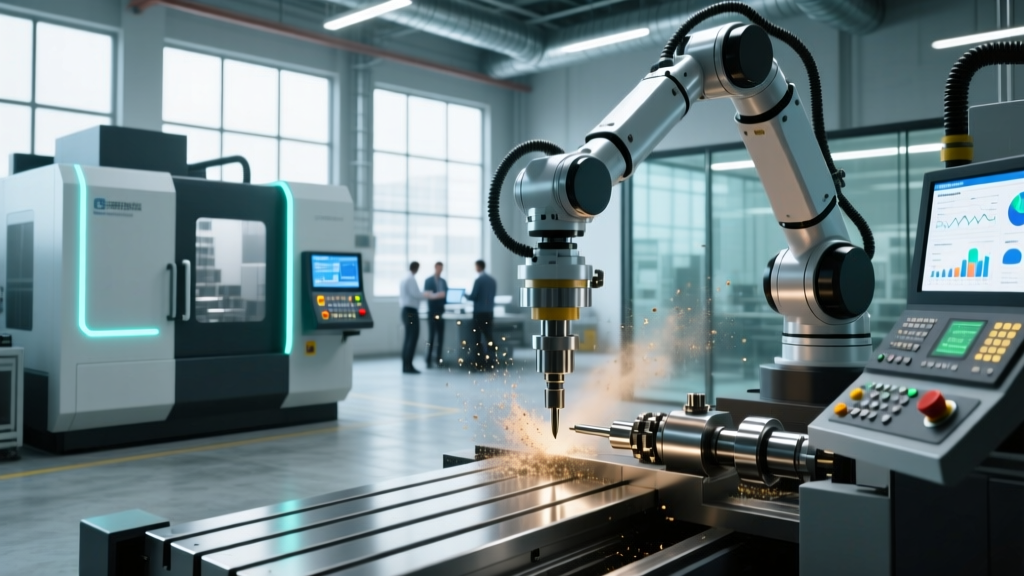
In 2026, the competitive advantage belongs to machine shops that bridge this gap. By leveraging Industry 4.0 connectivity protocols like MTConnect and OPC UA, shops can feed real-time spindle load, axis torque, and vibration data into business-grade ML models. This transforms raw machine telemetry into actionable business intelligence, directly impacting Overall Equipment Effectiveness (OEE) and bottom-line profitability.
Case Study: Precision Aerospace Corp’s Predictive Maintenance Pivot
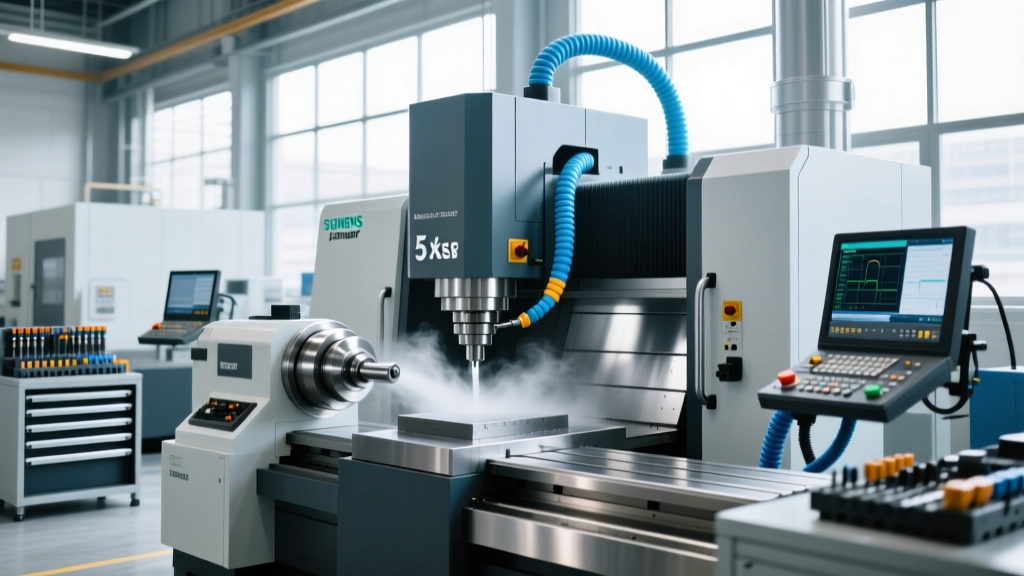
Precision Aerospace Corp (PAC), a mid-sized Tier 2 supplier in Ohio, operates a mixed fleet of 42 CNC machines, including Haas UMC-1000 5-axis mills, Mazak INTEGREX i-400 mill-turn centers, and legacy DMG MORI NLX 2500 lathes. In late 2025, PAC faced a severe margin erosion problem: unplanned downtime on their 5-axis trunnion tables was costing an estimated $18,000 per incident in scrapped Inconel 718 parts and emergency spindle repairs.
PAC initially attempted to use a generic enterprise predictive analytics suite. The project failed within three months because the software could not parse the proprietary FOCAS (Fanuc Open CNC API Specifications) data streams. The turning point occurred when PAC shifted to an industrial-specific ML architecture.
The Architecture Shift
PAC deployed Advantech UNO-2484G edge gateways on every machine, standardizing data extraction via the open-source MTConnect standard. This edge layer normalized the data and pushed it to MachineMetrics, an industrial ML platform designed specifically for discrete manufacturing. By applying anomaly detection algorithms to the Z-axis servo load and spindle vibration signatures, the ML model learned the baseline 'healthy' cutting signature for Inconel roughing operations.
Within 60 days, the system successfully predicted a trunnion table harmonic bearing failure on a Haas UMC-1000 forty-eight hours before catastrophic seizure. The maintenance team replaced the $1,200 bearing during a scheduled weekend shift, avoiding a projected $34,000 spindle crash and part scrap event.
⚠️ The Sensor Saturation Trap: Do not blindly sample CNC data at 1000Hz and push it to the cloud. High-frequency vibration data for tool breakage detection must be processed locally on the edge gateway. Pushing raw 1kHz telemetry to cloud-based machine learning tools for business will result in exorbitant AWS/Azure egress fees and latency spikes that render tool-breakage algorithms useless.Evaluating Machine Learning Tools for Business: Shop-Floor Matrix
Selecting the right platform requires matching your shop's controller diversity with the software's ingestion capabilities. Below is a comparison of leading industrial ML platforms suitable for CNC environments in 2026.
| Platform | Best Use Case | Native Protocol Support | Est. Cost (Per Machine/Mo) |
|---|---|---|---|
| MachineMetrics | Mixed-fleet discrete manufacturing; OEE & predictive maintenance. | MTConnect, FOCAS, OPC UA, EtherNet/IP | $150 - $250 |
| Siemens Insights Hub | Heavy Siemens Sinumerik environments; digital twin integration. | OPC UA, S7 Protocol, MQTT | $200 - $350 |
| Rockwell Plex MES | Full ERP-to-shop-floor traceability; high-volume automotive. | EtherNet/IP, CIP, OPC UA | Bundled in SaaS ERP |
Step-by-Step Integration Framework for Legacy and Smart CNCs
Integrating physical machine tools with enterprise-level ML requires a structured approach to IT/OT convergence. Follow this four-step framework to ensure data integrity.
- Controller Audit & Protocol Mapping: Identify the exact CNC controller generation. Fanuc 31i-B supports native FOCAS over Ethernet, while older Fanuc 18i models may require hardware macro executors or external I/O modules to extract spindle load data. Map these to the NIST smart manufacturing data dictionaries.
- Deploy Edge Hardware: Install industrial-rated edge gateways (e.g., Cisco IR1101 or Advantech UNO series) in the machine's electrical cabinet. Ensure the gateway supports local buffering to prevent data loss during network drops.
- Establish the Data Pipeline: Configure the edge gateway to translate proprietary machine data into MQTT or MTConnect XML/JSON payloads. Route this through a secure VLAN isolated from the corporate office network to prevent latency-inducing broadcast storms.
- Model Training & Baseline Calibration: Allow the ML platform to ingest 'blind' data for 14 to 21 days. This establishes the statistical baseline for normal tool wear and thermal growth before enabling predictive alerts.
Edge vs. Cloud: Solving the Latency Problem in Tool Breakage
A common failure mode when applying machine learning tools for business to the shop floor is misunderstanding latency requirements. Business forecasting (e.g., predicting next month's carbide insert consumption based on current OEE) can tolerate 500ms cloud latency. However, detecting a micro-fracture in a solid carbide end mill during high-speed aluminum milling requires a reaction time of under 15 milliseconds.
To solve this, modern architectures deploy 'tinyML' models directly on the edge gateway. The edge device halts the machine via a hardwired M-code or direct PLC interrupt, while simultaneously sending a compressed anomaly log to the cloud for long-term business analytics. For deeper architectural guidance, the Siemens Insights Hub documentation provides excellent schematics on hybrid edge-cloud topologies for Sinumerik CNCs.
"The biggest mistake shops make is treating CNC connectivity as an IT project rather than a manufacturing engineering project. If your data scientists don't understand the difference between climb milling and conventional milling load signatures, your machine learning models will generate false positives that operators will quickly learn to ignore."
— Dr. Elena Rostova, Director of Advanced Manufacturing Analytics, SME (Society of Manufacturing Engineers)
Calculating the True ROI of Smart Machine Connectivity
To justify the capital expenditure of edge hardware and SaaS ML subscriptions, shop managers must track specific, hard-dollar metrics beyond generic 'OEE improvements'. Focus on these three quantifiable areas:
- Spindle Crash Avoidance: A single crash on a 15,000 RPM HSK-A63 spindle costs between $18,000 and $45,000 in rebuild fees and 3-6 weeks of lead time. Preventing just one crash annually yields a 400% ROI on a $10,000 edge-sensor deployment.
- Insert Life Optimization: Traditional shops change carbide inserts based on conservative piece-count timers, wasting up to 30% of usable tool life. ML-driven acoustic emission monitoring allows shops to run inserts to true failure thresholds, reducing annual tooling spend by 12% to 18%.
- Quoting Accuracy: By feeding historical, ML-verified cycle times and tool wear rates back into the shop's CAM/ERP system, estimators can quote complex 5-axis aerospace parts with a 95% confidence interval, eliminating the 15% 'fudge factor' that causes them to lose bids to leaner competitors.
Actionable Takeaways for Shop Managers
1. Stop buying generic enterprise AI tools until your shop floor data is normalized via MTConnect or OPC UA.
2. Invest in edge-computing gateways capable of sub-20ms processing for critical tool-breakage detection.
3. Start your ML pilot program on your most expensive, bottleneck 5-axis machine, not your manual lathes.
4. Involve your lead machinists in the data-labeling process to ensure the ML models reflect physical cutting realities, not just statistical anomalies.