Linear vs Box Ways: Practical Machine Learning Tools and Techniques
Compare linear and box way CNC systems using practical machine learning tools and techniques for predictive maintenance, vibration analysis, and ROI.
The selection between linear guideways and box ways has historically been a static mechanical calculation: linear rails for high-speed traversal and box ways for heavy-cutting rigidity. However, as smart manufacturing matures in 2026, this mechanical dichotomy is now evaluated through the lens of data. Integrating practical machine learning tools and techniques into CNC condition monitoring allows shops to transcend traditional mechanical limitations, predicting way system degradation, compensating for thermal drift, and optimizing feedrates in real time.
Understanding how to deploy these algorithms requires a deep grasp of the underlying tribology and kinematics of both way systems. This analysis breaks down the mechanical realities of linear versus box ways and details the specific machine learning architectures required to monitor and optimize each architecture.
The Mechanical Baseline: Kinematics and Damping
Before applying sensor fusion and predictive algorithms, engineers must establish the mechanical baseline. The physical behavior of the way system dictates the type of data the ML models must ingest.
| Metric | Linear Guideways (e.g., THK HSR, Rexroth BSCL) | Box Ways (e.g., Turcite-B coated, Hand-Scraped) |
|---|---|---|
| Friction Coefficient (Dynamic) | 0.002 - 0.005 (Rolling contact) | 0.05 - 0.08 (Sliding contact) |
| Damping Ratio | Low (~0.01 to 0.03) | High (~0.15 to 0.25) |
| Max Rapid Traverse | 60 - 120 m/min | 20 - 30 m/min |
| Primary Failure Mode | Ball recirculation fatigue, brinelling, seal ingress | Gib wear, Turcite delamination, stick-slip scoring |
| Stick-Slip Phenomenon | Negligible | Pronounced at low feedrates (< 50 mm/min) |
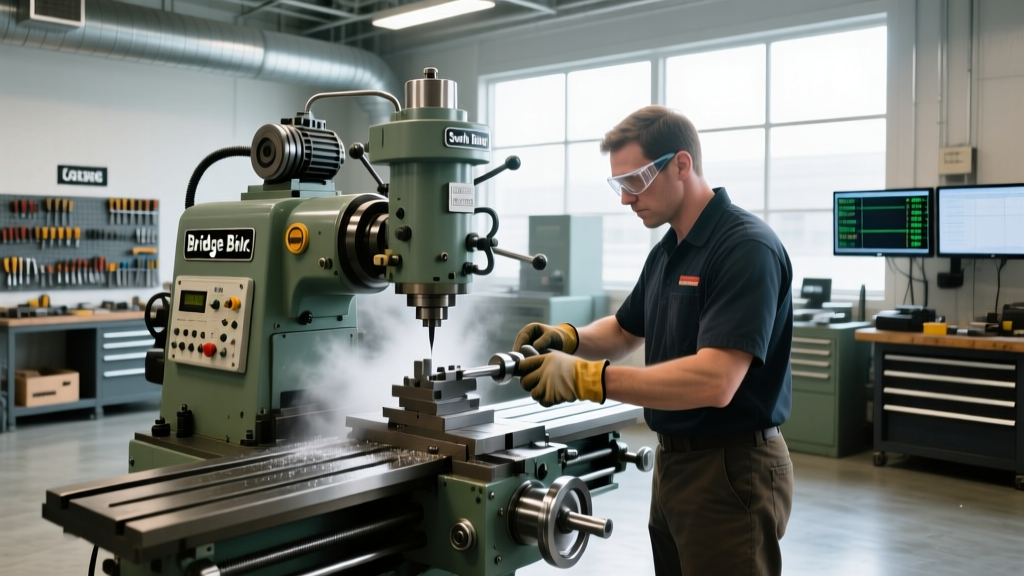
Linear guideways utilize recirculating ball or roller bearings, offering near-zero stick-slip and enabling aggressive acceleration. However, their low damping ratio makes them highly susceptible to high-frequency chatter during interrupted cuts. Box ways rely on large surface areas of sliding contact, often lined with PTFE-based composites like Turcite-B or Rulon. The massive oil film and surface contact area provide exceptional vibration absorption, making them mandatory for heavy roughing in aerospace alloys like Inconel 718, but their sliding friction generates significant heat and requires complex gib adjustments.
Deploying Practical Machine Learning Tools and Techniques
The deployment of practical machine learning tools and techniques in CNC condition monitoring is not a one-size-fits-all process. The physical differences between rolling and sliding contact require entirely different sensor arrays and algorithmic approaches.
Linear Way Monitoring: High-Frequency Acoustics and Envelope Analysis
Because linear rails fail primarily through subsurface fatigue and ball recirculation defects, the resulting vibrational signatures occur at very high frequencies (often above 5 kHz). Standard 1 kHz vibration sensors used for spindle monitoring are blind to these early-stage defects.
- Sensor Specification: Piezoelectric accelerometers with a resonant frequency above 40 kHz (e.g., PCB Piezotronics 352C33) mounted directly on the rail block.
- Signal Processing: High-frequency resonance technique (HFRT) or envelope demodulation. The raw signal is bandpass filtered around the sensor's resonance, rectified, and low-pass filtered to extract the defect frequency.
- ML Algorithm: Convolutional Neural Networks (CNNs) applied to the spectrogram images of the envelope signal. CNNs excel at identifying the spatial patterns of ball pass frequencies (BPFO/BPFI) degrading over time, classifying the defect stage from 'normal wear' to 'spalling' with over 94% accuracy.
Box Way Monitoring: Stick-Slip Prediction and Thermal Drift
Box ways do not suffer from high-frequency bearing defects; their degradation is characterized by changes in friction coefficients, oil film breakdown, and thermal expansion. Monitoring these systems requires low-frequency, high-resolution data ingestion.
- Sensor Specification: High-resolution linear encoders (nanometer scale) combined with distributed PT100 RTD temperature sensors embedded in the casting and way covers.
- Signal Processing: Time-series analysis of axis following error and motor torque current (Iq). A sudden spike in Iq at low feedrates indicates oil film breakdown and impending stick-slip.
- ML Algorithm: Long Short-Term Memory (LSTM) networks. LSTMs are ideal for modeling the temporal dependencies of thermal growth. By training the LSTM on historical temperature gradients and corresponding axis deviation, the system can predict thermal drift 30 minutes into the future, allowing the CNC controller to apply preemptive macro offsets.
The Sensor-to-Algorithm Pipeline
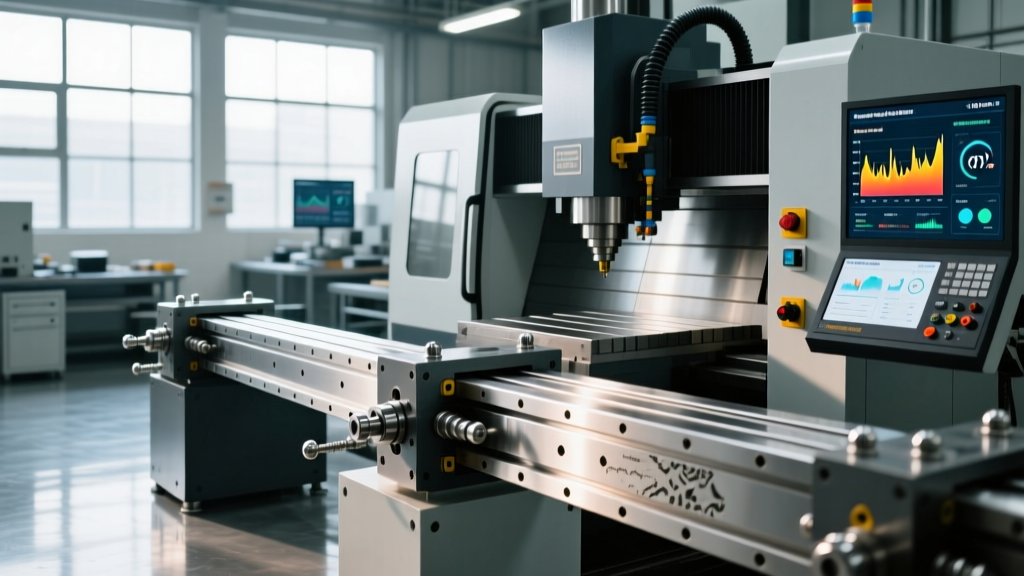
According to frameworks established by the ISO 13374 standard for condition monitoring, a robust ML pipeline requires strict data hierarchy. For way systems, this means edge-computing gateways (like the Siemens IPC127E) must perform the computationally heavy Fast Fourier Transforms (FFTs) locally. Only the extracted feature vectors—such as RMS velocity, kurtosis, and thermal gradients—are transmitted via MQTT to the cloud-based LSTM or Random Forest models. This reduces network payload by 99% and ensures real-time inference at the machine level.
Economic Breakdown: ROI of ML-Driven Way Selection
Implementing these systems requires capital expenditure that must be justified by the avoidance of catastrophic way failure and unplanned downtime. Based on 2026 job shop pricing, the economics of retrofitting a standard 3-axis VMC (e.g., Haas VF-2 or Doosan DNM series) are as follows:
| Cost Category | Linear Way ML Retrofit | Box Way ML Retrofit |
|---|---|---|
| Hardware (Sensors & Edge) | $4,200 (4x High-freq accelerometers, edge gateway) | $2,800 (6x RTDs, torque monitoring modules) |
| Software & Model Training | $12,000 (Custom CNN training on spectrogram data) | $8,500 (LSTM thermal modeling setup) |
| Annual Cloud/Compute | $1,800 | $1,200 |
| Estimated Downtime Saved (Year 1) | $35,000 (Preventing rail seizure during lights-out) | $22,000 (Scrap reduction via thermal compensation) |
The ROI for linear way monitoring is typically realized faster in high-volume, lights-out production environments where a seized rail block can crash a spindle and destroy a tombstone fixture. Conversely, box way ML investments pay off in high-precision, tight-tolerance aerospace machining, where thermal drift causes scrap parts that cost thousands of dollars in raw material alone.
Decision Matrix: Matching Way Systems to ML Capabilities
When specifying a new CNC machine tool or upgrading an existing cell, the choice of way system should be directly correlated to the shop's data infrastructure and the specific practical machine learning tools and techniques they are prepared to deploy. Refer to the NIST Smart Connected Systems Division guidelines for digital twin integration when scaling these models across a fleet.
- Choose Linear Guideways + CNN Acoustic Monitoring IF: Your primary operation involves high-speed aluminum milling, 3C (computer, communication, consumer electronics) part production, or high-volume medical devices. The goal of the ML model here is purely predictive maintenance—detecting ball fatigue before catastrophic seizure.
- Choose Box Ways + LSTM Thermal/Friction Monitoring IF: Your shop machines titanium, Inconel, or hardened steels requiring heavy depth-of-cut (DOC) roughing. The damping of the box way is non-negotiable for tool life, while the ML model's primary function is adaptive control—monitoring stick-slip and compensating for the massive heat generated by both the cut and the sliding friction.
- Hybrid Approach (Linear X/Y, Box Z): Many modern 5-axis trunnion tables and horizontal machining centers utilize linear rails on the X and Y axes for contouring speed, while retaining a box way on the Z-axis for plunge rigidity. This requires a dual-pipeline ML architecture, ingesting high-frequency acoustic data for the X/Y axes and low-frequency torque/thermal data for the Z-axis, fusing them via a cloud-based digital twin as detailed in advanced predictive maintenance frameworks on ScienceDirect.
Ultimately, the mechanical superiority of linear versus box ways is contextual. By applying targeted machine learning algorithms to the specific physical signatures of each system, manufacturers can extract maximum utilization from the hardware, transforming passive castings and rails into active, data-generating assets that drive continuous production.