Retrofitting Manual Mills for Custom Machined Tools: A Case Study
Discover how a mid-sized job shop retrofitted manual Bridgeport and South Bend machines to produce precision machined tools, cutting costs by 60%.
The Job Shop Dilemma: Manual vs. CNC for Low-Volume Machined Tools
For small-to-medium toolrooms and job shops, the demand for custom, high-precision machined tools—such as specialized form cutters, custom broaches, and intricate fixture clamps—often outpaces the capacity of manual equipment. While purchasing a new vertical machining center (VMC) like a Haas VF-2 or DMG Mori CMX 600V offers immediate CNC capabilities, the capital expenditure of $95,000 to $150,000 is difficult to justify for low-volume, high-mix tooling production. According to data from the NIST Manufacturing Extension Partnership (MEP), small manufacturers frequently face a 'productivity gap' where manual processes bottleneck custom tooling orders, yet volume doesn't justify new CNC assets.
CNC retrofitting bridges this gap. By integrating modern closed-loop AC servos, precision ball screws, and advanced motion controllers onto cast-iron manual machines, shops can achieve CNC tolerances at a fraction of the cost. This case study examines a 2026 retrofit project at a mid-sized Midwest tool and die shop that successfully transitioned from manual DRO operations to full CNC production for custom machined tools.
Case Study Profile: Apex Tooling & Die
- Facility Size: 12,000 sq. ft. job shop
- Core Business: Custom stamping dies, fixture tooling, and specialized machined tools
- Target Machines: Bridgeport Series I (2J Head) Mill, South Bend Heavy 10 Lathe
- Project Budget: $28,000 (Mechanical prep + CNC kits)
- Alternative Cost: $135,000 (New entry-level VMC + CNC Lathe)
Evaluating CNC Retrofit Kits: A Controller Matrix
Before tearing down the machines, the shop evaluated three dominant retrofit ecosystems. The choice of controller dictates not only the user interface but the servo tuning capabilities required for rigid tapping and high-speed contouring when producing complex machined tools.
| Controller System | Best Application | Est. Kit Cost (3-Axis) | Servo Architecture | Shop Floor Verdict |
|---|---|---|---|---|
| Centroid M400S | Mills, complex 3D contouring | $6,500 - $7,800 | Closed-Loop AC Servo | Selected for the Bridgeport due to conversational programming and robust Z-axis brake integration. |
| MachMotion | Lathes, multi-axis mills | $8,000 - $11,500 | Closed-Loop AC Servo | Selected for the South Bend lathe; superior spindle encoder integration for rigid threading. |
| FlashCut CNC | Light-duty routing, basic mills | $4,000 - $5,500 | Open/Closed Loop Options | Rejected for this application; lacked the torque density needed for heavy steel cutting. |
Deep Dive: Bridgeport Series I Mill Retrofit
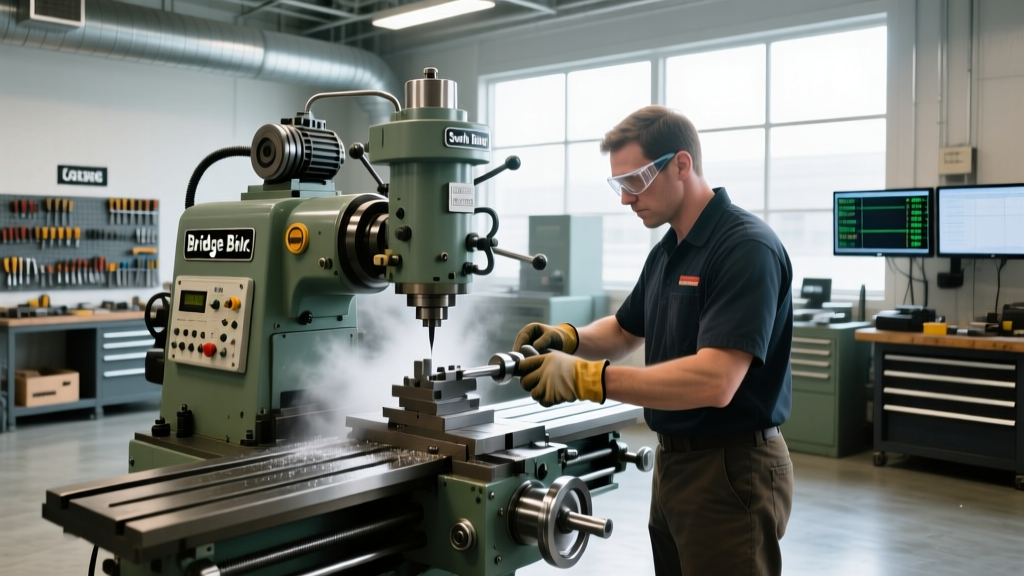
The Bridgeport Series I is a toolroom staple, but its native lead screws and way surfaces are insufficient for the tight tolerances required for precision machined tools. The shop executed a comprehensive mechanical overhaul before mounting the Centroid M400S controller.
Mechanical Prerequisites and Upgrades
- Ball Screw Installation: The original Acme lead screws were replaced with C3-grade precision ground ball screws (Thomson). This reduced backlash from 0.008' to less than 0.0002'. Cost: $1,400 per axis.
- Bearing Upgrades: Standard thrust bearings were swapped for 7200-series angular contact bearings installed in a back-to-back (DB) configuration to handle the axial thrust generated during heavy facing and slotting operations.
- Way Scraping and Turcite: The X and Y axis ways showed 0.004' of wear in the center travel zone. The ways were hand-scraped and lined with Turcite-B to eliminate stick-slip friction, a common cause of circular interpolation errors (quarter-circle mismatch) when machining radii on form tools.
The Z-Axis Brake Gotcha
A critical, often overlooked aspect of retrofitting a Bridgeport is the Z-axis. The heavy milling head relies on the manual quill or the power-feed motor's holding torque. When an AC servo is mounted to the knee, power loss causes the knee to drop, crashing the tool into the workpiece. The shop installed a pneumatic Z-axis brake kit (approx. $450) that mechanically clamps the knee upon E-stop or power failure, a mandatory safety upgrade documented in Society of Manufacturing Engineers (SME) safety guidelines for retrofitted equipment.
Deep Dive: South Bend Heavy 10 Lathe Integration
Producing cylindrical machined tools, such as custom reamers and stepped pilot drills, required CNC turning capabilities. The South Bend Heavy 10 was retrofitted using a MachMotion package tailored for lathes.
Spindle Encoder and CSS Integration
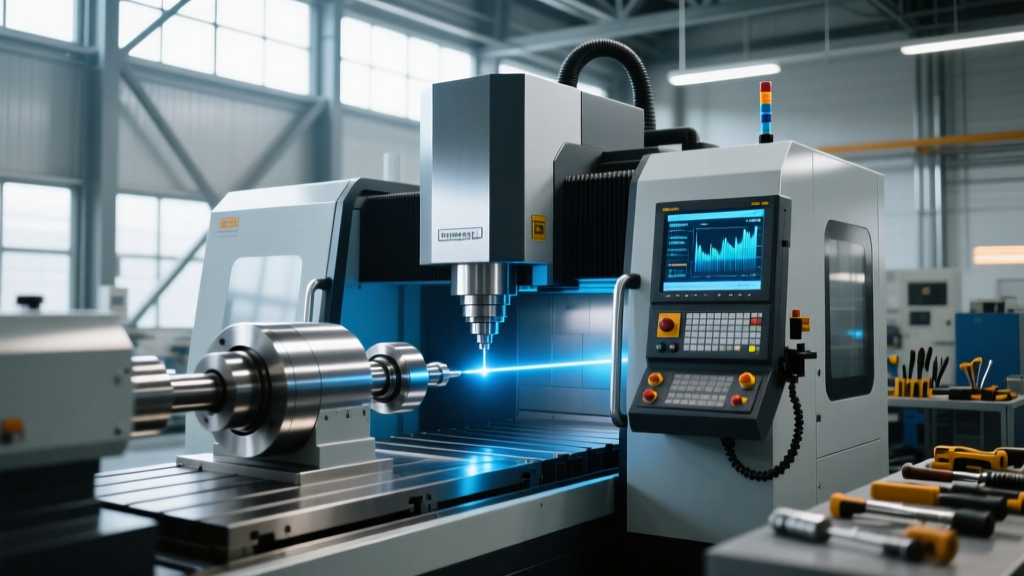
To achieve Constant Surface Speed (CSS) and execute rigid tapping or precise threading, the spindle speed must be tracked in real-time. A 1000-line quadrature encoder was mounted to the spindle nose via a custom-machined aluminum housing and a timing belt. This allowed the MachMotion controller to synchronize the Z-axis feed rate exactly with spindle rotation, enabling the shop to machine complex thread profiles on custom toolholders without the chatter typical of manual thread chasing.
'The ability to program a custom multi-start thread for a specialized pull-stud and machine it in one setup, without changing gears or relying on a thread dial, completely transformed our toolroom output.' — Lead Machinist, Apex Tooling & Die
Production Reality: Manufacturing Custom Machined Tools
Post-retrofit, the shop benchmarked the production of a custom dovetail cutter (O1 tool steel, 58 HRC after heat treat, requiring hard milling with carbide). The results highlighted the operational shift.
| Metric | Manual Mill (with DRO) | Retrofitted CNC Bridgeport | New VMC (Baseline) |
|---|---|---|---|
| Setup Time | 45 minutes | 20 minutes | 15 minutes |
| Machining Cycle Time | 3.5 hours | 55 minutes | 45 minutes |
| Tolerance Held (Profile) | +/- 0.002' | +/- 0.0005' | +/- 0.0003' |
| Surface Finish (Ra) | 64 µin | 32 µin | 16 µin |
| Operator Intervention | Constant | Load/Unload only | Load/Unload only |
While the new VMC still holds a slight edge in cycle time and surface finish due to higher spindle RPMs (10,000+ vs the Bridgeport's 5,000 RPM limit) and superior rigidity, the retrofitted CNC easily held the +/- 0.0005' profile tolerance required for the dovetail cutter's flutes. More importantly, the operator was freed to run manual grinding operations elsewhere in the shop during the 55-minute CNC cycle.
Hidden Costs and Mechanical Failure Modes
Warning: Do Not Digitize a Broken Machine
A common failure mode in retrofit projects is attempting to bolt CNC drives onto mechanically degraded machines. If your manual machine exhibits the following symptoms, mechanical remediation will double your budget:
- Gib Wear: If the X/Y gibs cannot be tightened to eliminate play without causing binding, the ways are scored and require professional scraping or regrinding.
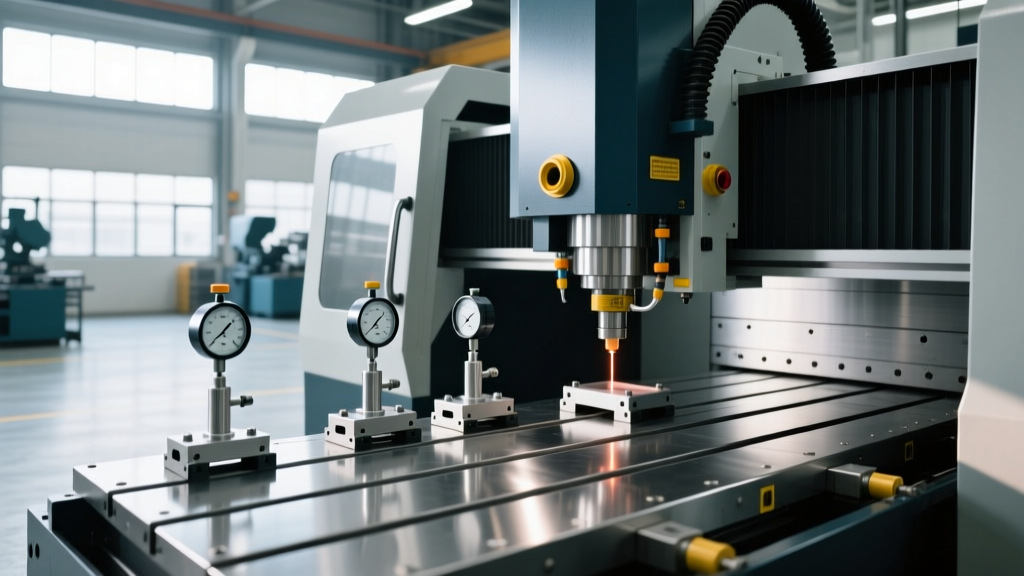
- Spindle Runout: Any TIR (Total Indicator Reading) over 0.0003' at the spindle nose will be amplified during CNC contouring, ruining the cutting edges of the machined tools you are producing.
- Lost Motion: If manual handwheel reversal requires more than 2 degrees of rotation before the table moves, the Acme nuts are destroyed and must be replaced before ball screw conversion.
ROI Breakdown: When Does a Retrofit Beat a New VMC?
According to market analysis by AMT (The Association For Manufacturing Technology), lead times for new entry-level CNC machine tools can still stretch into the late quarters of the year, making retrofits an attractive timeline alternative. Financially, the break-even point heavily favors the retrofit for toolroom applications.
| Financial Metric | CNC Retrofit (Mill + Lathe) | New VMC + CNC Lathe |
|---|---|---|
| Capital Equipment Cost | $28,000 | $165,000 |
| Rigging & Installation | $0 (In-house) | $4,500 |
| Facility Power Upgrades (3-Phase) | $0 (Existing) | $3,200 |
| First Year Maintenance | $500 | $2,500 |
| Depreciation Schedule (MACRS) | 7 Years | 7 Years |
| Est. ROI Timeline | 6 Months | 3.5 Years |
Final Verdict for Toolroom Operations
For high-volume production of commodity parts, a retrofit cannot compete with the speed, tool-changing capacity, and coolant management of a modern VMC. However, for job shops and toolrooms producing custom machined tools, fixture components, and low-volume prototypes, a properly executed CNC retrofit on heavy cast-iron manual machines offers an unmatched return on investment. By allocating $28,000 toward precision ball screws, closed-loop servos, and way remediation, shops can unlock CNC capabilities, eliminate manual bottlenecks, and maintain critical profit margins without taking on crippling equipment debt.