Ben Alpren Machine Tool Value: Tier 1 Comparison Guide
Is a Ben Alpren machine tool worth the investment? We compare its VMC pricing, spindle specs, and ROI against Haas and DN Solutions for job shops.
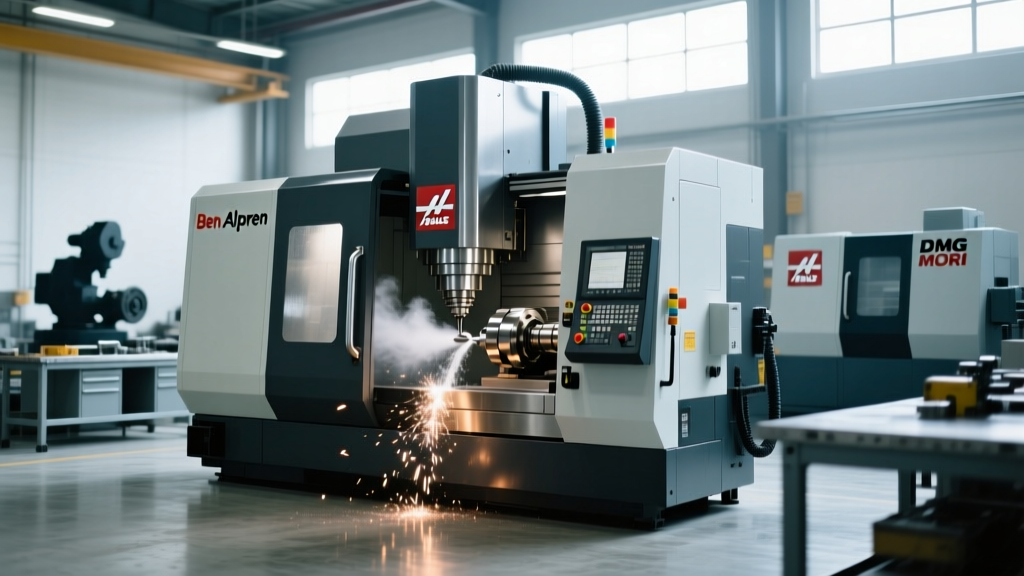
Procuring a vertical machining center (VMC) requires balancing upfront capital expenditure against long-term spindle uptime, positional accuracy, and service network reliability. The Ben Alpren machine tool lineup, particularly its VMC-850 and VMC-1060 vertical mills, occupies the aggressive value-tier segment of the market. Often positioned as a high-spec, low-cost alternative to established Tier-1 brands, Ben Alpren appeals to startup job shops and high-mix production facilities looking to maximize initial ROI.
However, evaluating a value-tier VMC requires looking past the base price tag. This guide deconstructs the Ben Alpren value proposition, comparing its hardware, control integration, and total cost of ownership (TCO) directly against industry benchmarks like the Haas VF-2 and DN Solutions (formerly Doosan) DNM 4500.
Quick Spec Snapshot: Ben Alpren VMC-850
- Work Envelope: 850 x 500 x 500 mm (X/Y/Z)
- Spindle: 10,000 RPM Direct-Drive (Belt-drive optional)
- Tool Changer: 24-Tool Arm Type (Cam-driven)
- Control Options: Fanuc 0i-F Plus, Mitsubishi M80, Siemens Sinumerik 828D
- Way Type: Heavy-duty roller linear guides (Hiwin or THK)
The Ben Alpren Value Proposition: What You Actually Get
Value-tier machine tool builders typically utilize a globalized supply chain, sourcing castings from specialized foundries and integrating tiered component packages. The Ben Alpren VMC-850 leverages Meehanite-grade castings that undergo proper stress-relieving, providing a rigid foundation comparable to mid-tier competitors. Where the cost savings are realized is in the peripheral integration and localized assembly overhead.
According to market data tracked by the Association for Manufacturing Technology (AMT), value-tier VMCs have captured significant market share in the sub-$80,000 category by offering Tier-1 component names (like Fanuc and NSK) at a 20-30% discount. Ben Alpren follows this model, but buyers must scrutinize the specific grade of these components.
Spindle, Bearings, and Ballscrew Realities
The spindle is the heart of any VMC. While Ben Alpren advertises a 10,000 RPM spindle, the critical differentiator is the bearing specification and assembly environment. Tier-1 builders like DMG Mori or Okuma use P4-class super-precision angular contact bearings assembled in cleanrooms. Ben Alpren typically utilizes high-quality but standard-grade NSK or FAG bearings. This is perfectly adequate for general aluminum and mild steel milling, but shops running tight-tolerance (±0.0002”) boring operations or continuous high-speed aerospace aluminum profiling may experience thermal growth and runout degradation 1,500 to 2,000 hours earlier than a Tier-1 equivalent.
Similarly, axis drives on the Ben Alpren VMC-850 use C3-grade ballscrews. While C3 is standard for production VMCs, it exhibits slightly more reverse backlash under heavy thermal loads compared to the C5 or pre-tensioned C3 systems found on the Haas VF Series. Shops must implement strict warm-up cycles to maintain Z-axis repeatability.
Head-to-Head Matrix: VMC-850 vs. VF-2 vs. DNM 4500
To understand where the Ben Alpren machine tool fits in the current landscape, we must compare it against the most common alternatives in the 40-taper, mid-travel VMC category. Pricing reflects estimated 2026 base MSRP before options, rigging, and taxes.
| Feature | Ben Alpren VMC-850 | Haas VF-2 | DN Solutions DNM 4500 |
|---|---|---|---|
| Base Price | $68,500 - $74,000 | $84,000 - $92,000 | $95,000 - $110,000 |
| Travel (X/Y/Z) | 33.5' x 19.7' x 19.7' | 30' x 16' x 20' | 31.5' x 17.7' x 20.5' |
| Spindle Torque | 140 Nm (Peak) | 122 Nm (Vector Drive) | 162 Nm (Direct Drive) |
| Rapid Traverse | 945 ipm (X/Y) | 1,000 ipm (X/Y) | 1,417 ipm (X/Y) |
| Control Ecosystem | Standard Fanuc / Mitsubishi | Proprietary Haas NGC | Fanuc / Fagor / DN |
Total Cost of Ownership (TCO) and the Service Trap
The most significant risk when purchasing a value-tier VMC is not the initial hardware quality, but the post-sale support infrastructure. Tier-1 brands maintain regional depots stocked with proprietary servo drives, spindle cartridges, and cast-iron way covers. Ben Alpren, operating with a leaner distribution model, often relies on third-party technicians or direct overseas shipping for complex warranty claims.
Warning: The Downtime Multiplier
If a proprietary servo amplifier fails on a Tier-1 machine, a local technician typically arrives within 24 hours with a replacement. On a value-tier import, if the specific parameter-matched drive is not in local stock, you may face a 2-to-4-week lead time for air freight. At a conservative shop rate of $150/hour, a single 3-week downtime event costs the shop $15,120 in lost capacity—erasing nearly the entire upfront discount of the Ben Alpren machine.
Mitigating the Service Risk
Shops buying the Ben Alpren VMC-850 should negotiate a 'critical spares package' at the point of sale. This $2,500–$4,000 add-on should include:
- Two spare axis servo amplifiers (pre-parameterized)
- One complete spindle encoder assembly
- Four sets of way-wipers and replacement way-cover bellows
- A physical backup of the machine's SRAM and parameter tapes
Decision Framework: When to Choose Ben Alpren
Choosing between a Ben Alpren machine tool and a Tier-1 alternative is not about finding the 'best' machine; it is about aligning the equipment with your specific operational risk tolerance and production profile.
Buy the Ben Alpren VMC-850 If:
- You are a high-mix, low-volume job shop running 1 shift: The machine will not be pushed to thermal limits, and minor downtime can be absorbed without missing critical OEM delivery deadlines.
- You have in-house maintenance capability: Your shop employs a technician who can read Fanuc electrical schematics, swap servo drives, and re-tension ballscrews without waiting for a factory-certified tech.
- Capital is strictly constrained: You need to put a 40-taper VMC on the floor immediately to win a specific contract, and financing a $95,000 machine destroys your cash flow margins.
Buy Tier-1 (Haas / DN Solutions) If:
- You run 2 or 3 shifts (lights out): High-cycle machining demands premium spindle bearings and rapid, reliable tool changers that won't fault at 2:00 AM.
- You machine tight-tolerance aerospace or medical parts: The thermal stability and volumetric accuracy compensation of Tier-1 castings and C5 ballscrews are non-negotiable.
- You rely on proprietary macro-variables: If your programmers rely heavily on Haas-specific Visual Quick Code (VQC) or advanced probing routines, the standard Fanuc integration on a Ben Alpren will require extensive custom macro writing.
ROI Breakdown: The True Cost of the Discount
Let us run a practical ROI scenario comparing the Ben Alpren VMC-850 ($72,000 average out-the-door) against a similarly equipped Haas VF-2 ($92,000 out-the-door).
Capital Delta: $20,000 in favor of Ben Alpren.
Shop Hourly Rate: $140/hr.
Break-Even Uptime: The Ben Alpren must maintain an uptime within 4% of the Haas over the first 18 months to justify the Haas premium.
If the Haas runs at 94% availability and the Ben Alpren runs at 88% availability (due to slower chip-to-chip times, minor coolant leaks, or waiting on a replacement proximity switch), the Haas will generate an additional $10,080 in billable hours per month. In this scenario, the Tier-1 machine pays off its $20,000 premium in less than 60 days of 2-shift operation. Conversely, if the Ben Alpren is maintained meticulously and run on a single shift, that $20,000 stays directly in your company's working capital.
Final Procurement Advice
The Ben Alpren machine tool lineup offers a legitimate, hardware-rich entry point into 3-axis CNC milling. To maximize the investment, treat the purchase as a system integration project rather than a simple appliance delivery. Insist on laser calibration reports (ISO 230-2) prior to shipment, secure a local third-party service contract, and stock critical electronic spares. By managing the operational variables, job shops can successfully leverage the Ben Alpren VMC-850 to achieve aggressive margins without sacrificing baseline part quality.