CNC Retrofit Safety: Peerless Machine & Tool Corporation Compliance
Ensure OSHA and NFPA 79 compliance when performing CNC retrofits on Peerless Machine & Tool Corporation manual mills and lathes. Expert safety guide.
The Compliance Gap in Manual-to-CNC Retrofits
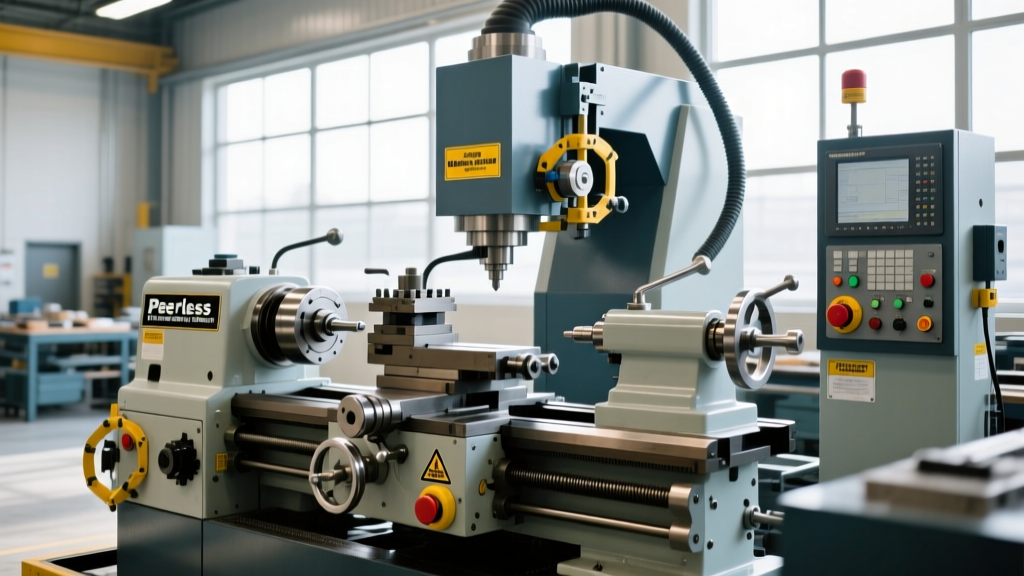
Retrofitting manual machine tools sourced from distributors like Peerless Machine & Tool Corporation into automated CNC systems offers immense productivity gains, but it fundamentally alters the risk profile of the equipment. A manual engine lathe or heavy-duty knee mill relies on operator proximity, manual feed engagement, and physical handwheels for inherent safety. When integrators introduce high-torque AC servos, automated spindle control, and rapid traverse capabilities, the machine transitions from a manually guarded tool to an automated industrial system.
Under OSHA regulations, the entity performing the CNC retrofit assumes the legal responsibilities of the original equipment manufacturer (OEM). This means the retrofitted machine must comply with current safety standards, regardless of the original casting's age. Failing to integrate proper safety architecture on a retrofitted Peerless Machine & Tool Corporation lathe or mill exposes the shop to severe liability and catastrophic operational hazards.
WARNING: Interlock BypassingBypassing mechanical gear-head interlocks or removing physical limit stops to accommodate absolute linear encoders is a severe violation of OSHA 1910.212. Never disable hardware over-travel limits when installing ball screws on manual ways.
NFPA 79 and ISO 13849-1: Control Panel Architecture
The electrical control panel is the nerve center of any CNC retrofit. According to the NFPA 79 Electrical Standard for Industrial Machinery, control circuits must be strictly separated from high-voltage power circuits. When upgrading a manual mill to a 3-axis CNC, the 480V or 240V spindle and servo drives must be physically isolated from the 24VDC logic circuits using grounded metal barriers within the enclosure.
For safety functions like Emergency Stop (E-Stop) and axis limit monitoring, ISO 13849-1 dictates the use of Performance Levels (PL). A standard CNC retrofit requires a minimum of PLd (Category 3 architecture) for the E-stop circuit. This necessitates dual-channel monitoring where a single fault in the wiring or relay does not lead to a loss of the safety function.
Safety Component Specifications & Pricing (2026 Estimates)
Selecting the right safety hardware prevents catastrophic servo runaways and ensures compliance during third-party audits. Below is a matrix of recommended components for heavy-duty retrofits.
| Component Type | Recommended Model | Safety Rating | Est. Cost (2026) |
|---|---|---|---|
| Safety Relay / E-Stop Module | Pilz PNOZ s30 (Dual-channel) | PL e, Cat. 4 | $650 - $800 |
| Solenoid Interlock Switch | Schmersal AZM40 (RFID coded) | PL e, Cat. 4 | $350 - $450 |
| Type 4 Light Curtain (14mm res.) | SICK deTec4 Core | PL e, Cat. 4 | $1,800 - $2,400 |
| Axis Limit Switches | Allen-Bradley 802T (Sealed) | IP67, Cat. 1 | $120 - $180 each |
Mechanical Safeguarding for Retrofitted Equipment
Manual machines retrofitted with CNC ball screws and servos generate significantly higher rapid traverse speeds—often exceeding 400 inches per minute (IPM) on the X and Y axes. This kinetic energy turns loose clothing, chips, and broken tooling into lethal projectiles.
OSHA 1910.212 Mandates for Point-of-Operation Guards
Compliance with OSHA Machine Guarding standards requires that the point of operation be fully enclosed during automated cycles. For CNC lathes originally sold as manual machines by Peerless Machine & Tool Corporation, the original manual chuck guard is insufficient for automated turning.
- Material Selection: Use a minimum of 6mm (0.236 inch) thick polycarbonate (Lexan) for chuck guards. Standard PETG or acrylic will shatter upon impact with a 3-jaw chuck jaw ejected at 2,000 RPM.
- Interlocking: The chuck guard must be wired to an RFID-coded solenoid interlock (like the Schmersal AZM40). The spindle VFD must not receive the run-enable signal unless the guard is fully closed and locked.
- Way Covers: Manual way covers must be replaced with telescoping steel covers or heavy-duty Kevlar-reinforced bellows to prevent chip ingestion into the newly installed precision ball screws.
VFD Integration: Arc Flash and Lockout/Tagout (LOTO)
Upgrading a manual spindle to a Variable Frequency Drive (VFD), such as a Yaskawa A1000 or Hitachi WJ200, introduces severe electrical hazards. VFDs rectify AC line voltage into a DC bus, which can retain lethal voltage (up to 650VDC on a 480V system) for minutes after the main disconnect is turned off.
Expert Insight on LOTO: "Standard Lockout/Tagout procedures fail on CNC retrofits if the integrator does not install a hardwired DC bus voltage indicator on the outside of the VFD panel. Maintenance personnel must visually verify the bus voltage is below 30VDC before opening the drive enclosure, regardless of the main disconnect position." — Industrial Electrical Safety Board Guidelines, 2025
To comply with NFPA 70E and ensure safe LOTO procedures, retrofit control panels must include:
- A lockable main disconnect switch rated for the full short-circuit current of the facility.
- Internal bleeder resistors sized to dissipate the DC bus capacitance within 60 seconds.
- An external, panel-mounted LED voltage indicator wired directly to the DC bus terminals.
Step-by-Step Safety Validation Protocol
Before a retrofitted Peerless Machine & Tool Corporation machine is released to the production floor, the integrator must execute and document the following validation protocol:
- E-Stop Stopping Time Measurement: Use an oscilloscope to measure the time from E-Stop button actuation to the physical cessation of axis movement. Calculate the required safety distance for light curtains using the formula: Ds = (1600 mm/s × Ts) + 850 mm, where Ts is the measured stopping time in seconds.
- Category 3 Fault Injection: Intentionally drop one channel of the dual-channel E-stop circuit. Trigger the E-stop. The machine must halt safely, and the safety relay must latch a fault, preventing a reset until the wiring fault is repaired.
- Interlock Defeat Testing: Attempt to start the spindle with the chuck guard open. Attempt to bypass the guard using a spare RFID tag or a magnet. The control system must reject unauthorized tags and remain in a safe state.
- Servo Runaway Test: With the machine in a safe, unclamped state, intentionally disconnect the encoder feedback cable from one axis drive while commanding a slow feed. The drive must trigger a following-error fault and engage the mechanical holding brake within 50 milliseconds.
Frequently Asked Questions (FAQ)
Can I use standard 3D-printed PLA for custom axis limit switch mounts?
No. PLA and standard ABS degrade under UV exposure from shop lighting and lose structural integrity when exposed to water-soluble coolants. Limit switch mounts must be machined from 6061-T6 aluminum or printed in UL94 V-0 rated Polycarbonate or PEEK to withstand impact and chemical exposure without deforming, which could cause a hard crash.
Does a retrofit require a completely new CE or UL marking?
If the machine is modified significantly—such as adding automated axis movement and a new control panel—the integrator becomes the legal manufacturer. In the US, OSHA requires the panel to be built to UL 508A standards. In the EU, the machine must undergo a full CE conformity assessment, including a new risk assessment and technical file, as the original manual machine's CE mark is invalidated by the automation upgrade.