Workholding Safety: Hales Machine Tool Plymouth MN Compliance Guide
Explore OSHA and ANSI workholding safety standards for vises, chucks, and fixtures, featuring compliance insights from Hales Machine Tool in Plymouth, MN.
The Financial and Physical Cost of Workholding Non-Compliance
In CNC machining, the workholding system is the critical interface between the machine tool and the raw material. While spindle speeds and feed rates often dominate engineering discussions, the safety and compliance of vises, chucks, and custom fixtures dictate whether a shop passes an OSHA audit or faces catastrophic part ejection. As of 2026, OSHA penalties for serious machine guarding and workholding violations exceed $16,000 per instance, with willful violations reaching over $160,000. Beyond financial penalties, a failed workholding setup at 10,000 RPM generates enough kinetic energy to breach polycarbonate enclosures, posing fatal risks to operators.
Navigating these regulations requires more than just buying heavy-duty iron; it requires verifiable compliance documentation, proper guarding integration, and adherence to ANSI B11.8 standards. For Midwestern manufacturing facilities, partnering with established regional distributors such as Hales Machine Tool in Plymouth, MN, provides a distinct compliance advantage. These distributors supply workholding solutions that include traceable metallurgy certifications, CE/OSHA-compliant guarding accessories, and manufacturer-verified RPM limits, ensuring your shop is audit-ready from day one.
2026 OSHA Workholding Violation Data
- Average Serious Violation Fine: $16,131+ (adjusted annually for inflation)
- Most Cited Standard: 29 CFR 1910.212(a)(1) - Machine Guarding
- Primary Failure Mode: Unshielded chuck keys and unverified hydraulic pressure drops
ANSI B11.8 and OSHA 1910.212: The Core Workholding Mandates
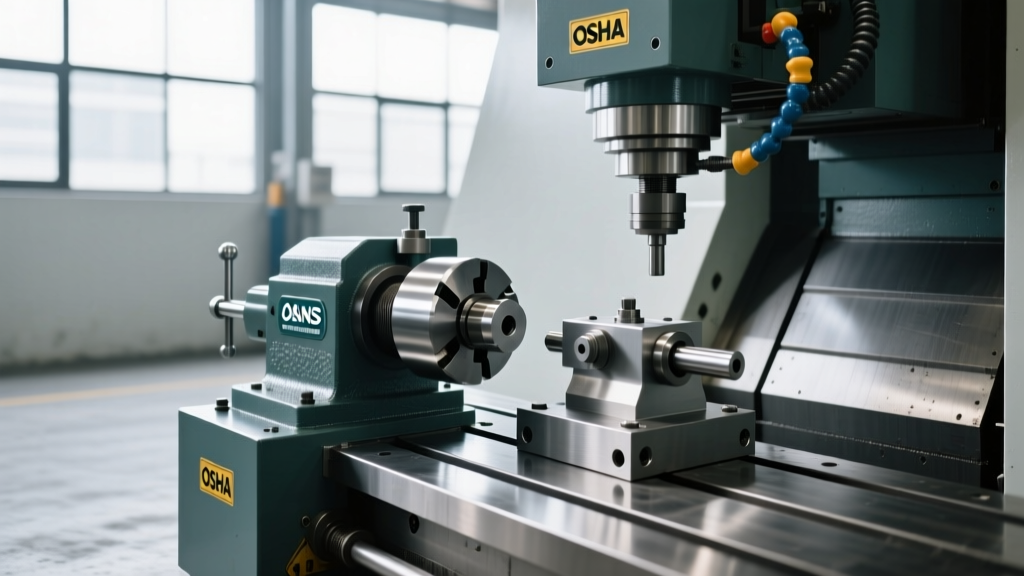
The foundational rule for all workholding equipment in the United States is OSHA 1910.212(a)(1), which mandates that machines must be equipped with safeguards to protect operators from points of operation, ingoing nip points, and rotating parts. For workholding, this translates to three specific requirements:
- Containment: The workholding device must securely retain the part under maximum cutting forces without relying on operator intervention.
- Guarding Integration: Chucks and rotary fixtures must be enclosed or interlocked so the machine cannot cycle if the guard is open.
- Tool Ejection Prevention: Manual tightening tools (like chuck keys or torque wrenches) must feature automatic ejection or physical tethers to prevent them from becoming projectiles.
ANSI B11.8 expands on these rules specifically for drilling, milling, and boring machines. It dictates that hydraulic and pneumatic workholding systems must include pressure monitoring switches that trigger an E-stop if clamping pressure drops below 80% of the required holding force during a cycle.
Vise Safety: Clamping Force, Parallels, and Ejection Risks
Manual and hydraulic milling vises are the most common workholding devices, yet they are frequently misused. A standard 6-inch precision vise, such as the Kurt DX6, generates up to 6,000 lbs of clamping force when torqued to 90 ft-lbs. However, this force is only effective if the part is seated correctly.
The 'Lifting Jaw' Hazard
Older or worn vises suffer from jaw lift—a phenomenon where the movable jaw tilts upward as it closes, pushing the workpiece off the parallels. If an operator attempts to compensate by striking the part with a dead-blow mallet while tightening, the stored kinetic energy in the vise screw can cause the part to eject once cutting forces relieve the friction. Modern compliant vises utilize a downward-pulling mechanism (like the Kurt Anglock system) that pulls the movable jaw down into the vise body with every micron of closure, eliminating lift and ensuring repeatable, safe seating.
| Vise Type | Primary Safety Hazard | Required Compliance Safeguard | Ideal Application |
|---|---|---|---|
| Manual Precision Vise | Operator fatigue leading to under-torquing; part ejection | Calibrated torque wrenches; downward-pulling jaw mechanics | Low-volume milling, toolroom ops |
| Hydraulic Vise | Pressure drop mid-cycle; hydraulic line rupture | Pressure transducer interlocks; burst-rated hoses (5,000+ PSI) | High-volume production, pallet pools |
| Pneumatic Vise | Sudden air pressure loss; lower clamping force limits | Check valves to trap pressure; mechanical locks | Light-duty aluminum machining |
Chuck Compliance: Guarding and Centrifugal Force Limits
Lathe chucks represent one of the highest-risk workholding categories due to extreme rotational speeds. The primary safety concern is not just the chuck body, but the jaws. As RPM increases, centrifugal force acts on the mass of the chuck jaws, pulling them outward and drastically reducing the clamping force on the workpiece.
Calculating Centrifugal Force Loss
According to the National Safety Council's machine guarding guidelines, a standard 3-jaw chuck with heavy steel hard jaws can lose up to 50% of its static clamping force at 3,500 RPM. If the cutting force exceeds the remaining dynamic clamping force, the part will tear free from the chuck. To maintain compliance and safety at high speeds, shops must utilize one of two solutions:
- Centrifugal-Force-Compensating Chucks: Models like the SMW Autoblok COMPACT series utilize internal counterweights that pull the jaw wedges inward as RPM increases, maintaining near-constant clamping force up to 6,000 RPM.
- Lightweight Top Jaws: Replacing heavy steel hard jaws with aluminum or carbon-fiber soft jaws reduces the mass subject to centrifugal pull, allowing higher safe operating speeds.
Interlocking Guards and Chuck Key Ejection
OSHA strictly enforces the use of interlocking chuck guards. A compliant setup requires a physical polycarbonate or steel shield equipped with a safety-rated limit switch (e.g., Schmersal or Allen-Bradley). The switch must be wired to the machine's dual-channel safety relay. If the guard is opened while the spindle is rotating, the relay must cut power to the spindle drive and engage the dynamic brake. Furthermore, manual chuck keys must feature a spring-loaded ejection mechanism that physically prevents the key from remaining inserted in the chuck scroll when released by the operator.
Custom Fixtures: Documenting the Safety Envelope
Custom-engineered fixtures and tombstones bypass the off-the-shelf safety certifications of standard vises, placing the burden of compliance entirely on the end-user. When designing custom workholding, safety must be engineered into the fixture via Finite Element Analysis (FEA) and physical proof-loading.
'A custom fixture is only as safe as its documentation. Without a verified load-test certificate and a defined maximum cutting force envelope, the fixture is a liability during an OSHA inspection.' — Manufacturing Safety Compliance Directive, 2025.
The 1.5x Proof-Load Standard
Before a custom fixture is approved for production, it must undergo a physical proof-load test. Calculate the maximum expected cutting force (using specific cutting force coefficients for your material and toolpath). The fixture must then be subjected to a static hydraulic or mechanical load equal to 1.5 times that maximum cutting force. Deflection must be measured with dial indicators at critical clamping points; if deflection exceeds 0.002 inches under the 1.5x load, the fixture is non-compliant and must be reinforced.
Sourcing Compliant Tooling: The Distributor's Role
Achieving workholding compliance is not solely an internal engineering task; it begins at the point of procurement. Sourcing gray-market or undocumented workholding equipment from overseas marketplaces leaves shops without the necessary safety manuals, RPM derating charts, and material certifications required by safety auditors.
This is where authorized regional partners become invaluable. When facilities source through established networks like Hales Machine Tool Plymouth MN, they receive comprehensive compliance packets. These packets include:
- Dynamic Balancing Certificates: Crucial for high-speed rotary fixtures to prevent spindle bearing degradation and vibration-induced part ejection.
- RPM Derating Charts: Exact graphs showing clamping force loss at specific RPMs for the exact jaw configuration purchased.
- Integration Support: Assistance with wiring hydraulic pressure switches and pneumatic check valves directly into the CNC's M-code safety interlocks.
By treating workholding not just as a method of holding metal, but as a critical safety system governed by strict ANSI and OSHA parameters, machine shops can eliminate ejection risks, pass audits seamlessly, and protect their most valuable asset: their operators.