Machine Tool Metrology: Spindle & Bearing Selection Guide
Select CNC spindles using machine tool metrology. Compare angular contact, hydrostatic, and aerostatic bearings with real runout, stiffness, and cost data.
Selecting a CNC spindle based solely on maximum RPM or peak horsepower is a critical procurement error. In modern precision machining, the true differentiator is the spindle’s metrological baseline—its geometric accuracy, thermal stability, and dynamic stiffness under load. Applying machine tool metrology principles to your equipment selection process ensures the bearing configuration you purchase aligns exactly with your part tolerancing requirements.
This buyer's guide decodes spindle bearing configurations through the lens of metrology, providing exact runout specifications, thermal drift metrics, and acceptance testing protocols required to verify your capital investment.
Bearing Configurations: A Metrological Comparison Matrix
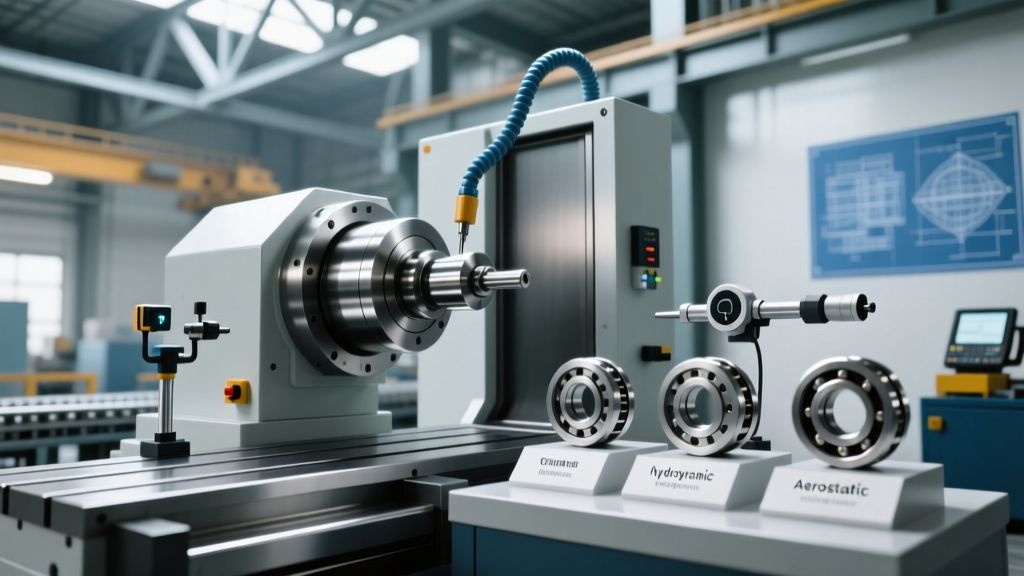
Spindle bearings dictate the error budget of your entire machine tool. The following matrix evaluates the four primary bearing configurations against critical metrology metrics. Use this data to match the spindle to your specific application's tolerance stack-up.
| Bearing Type | Radial TIR (µm) | Axial Stiffness (N/µm) | Max Speed (dmn) | Thermal Drift (µm/hr) | Ideal Application |
|---|---|---|---|---|---|
| Angular Contact (Steel) | 1.5 - 3.0 | 150 - 250 | 800,000 | 3.0 - 5.0 | General milling, heavy roughing |
| Ceramic Hybrid (Si3N4) | 0.8 - 1.5 | 200 - 350 | 1,200,000 | 1.5 - 2.5 | High-speed mold & die, aerospace |
| Hydrostatic (Oil) | < 0.1 | 400 - 800 | 300,000 | < 0.5 | Ultra-precision turning, hard turning |
| Aerostatic (Air) | < 0.05 | 50 - 150 | 2,000,000+ | Negligible | Micro-machining, diamond turning |
Angular Contact Ceramic Hybrid Bearings: The High-Speed Workhorse
For 85% of CNC machining centers, ceramic hybrid angular contact bearings (typically 15° or 25° contact angles) are the default choice. The silicon nitride (Si3N4) balls are 40% lighter than steel, reducing centrifugal expansion at high RPMs and lowering the coefficient of thermal expansion.
When specifying these spindles, pay strict attention to the ISO tolerance class. A standard P4 (ABEC 7) spindle will exhibit up to 2.5µm of radial runout at the tool tip. For tight-tolerance boring or high-speed aluminum milling, you must specify P2 (ABEC 9) class bearings, which guarantee radial runout of less than 1.0µm. Furthermore, specify oil-air lubrication rather than permanent grease packing; oil-air systems maintain a 15-20% higher dmn (bore mm × RPM) capability and actively wick heat away from the raceways, reducing thermal Z-axis growth by up to 30%.
Hydrostatic and Aerostatic Bearings: Fluid Film Ultra-Precision
When your machine tool metrology requirements demand sub-micron accuracy, rolling element bearings are insufficient due to Hertzian contact stresses and cage-induced vibration. Fluid film bearings eliminate mechanical contact entirely.
- Hydrostatic Spindles: These use high-pressure oil (typically 70 to 150 bar) pumped through restrictors into bearing pads. They offer massive damping coefficients and axial stiffness exceeding 500 N/µm, making them immune to chatter during heavy interrupted cuts in hard turning applications. The trade-off is the requirement for a dedicated, temperature-controlled chiller unit (±0.1°C) to prevent the hydraulic fluid from inducing thermal errors into the spindle housing.
- Aerostatic Spindles: Utilizing a thin film of pressurized air (4-6 bar), these spindles generate virtually zero friction and heat. They are mandatory for diamond turning of optics and micro-machining where surface finish requirements are measured in nanometers (Ra < 10nm). However, their low stiffness (often < 100 N/µm) restricts them to very light cutting forces.
Critical Metrology Tests for Spindle Acceptance
Never accept a new spindle or a rebuilt cartridge without verifying its metrological baseline against the manufacturer's claims. According to ISO 230-1 standards for machine tool geometric accuracy, the following tests must be performed during the Factory Acceptance Test (FAT) or upon installation.
- Non-Contact Radial/Axial Runout Mapping: Do not rely on a standard dial indicator. Mount a precision test mandrel and use a capacitance probe (e.g., Lion Precision CPL290) or eddy current sensor to measure runout at 10,000 data points per revolution. This captures high-frequency lobing errors that a mechanical dial indicator will physically dampen and miss.
- Thermal Transient Growth Analysis: Run the spindle at 80% of its maximum rated RPM for 120 minutes. Use a laser interferometer to track Z-axis thermal growth. A high-quality ceramic hybrid spindle should stabilize at less than 15µm of total Z-axis growth. If growth exceeds 30µm, the bearing preload is likely too high, or the cooling jacket is undersized.
- Dynamic Stiffness (Tap Testing): Perform an impact hammer test with an accelerometer attached to the tool holder. Analyze the Frequency Response Function (FRF) to identify the spindle's natural frequencies. Ensure the primary bending mode is above 800 Hz to avoid chatter during aggressive material removal rates (MRR).
Cost vs. Performance: Budgeting for Precision
Understanding the financial implications of spindle metrology helps justify the capital expenditure to stakeholders. Pricing varies drastically based on the precision tier and bearing configuration.
- Standard Cartridge Spindle (P4 Angular Contact): $4,500 – $8,500 for a new unit. Rebuilds cost $2,500 – $4,000. Suitable for job shops running standard tolerances (±12µm).
- High-Speed Ceramic Hybrid Spindle (P2 Class): $12,000 – $22,000. Requires specialized cleanroom rebuilding. Justified for aerospace and medical shops holding ±3µm true position over long production runs.
- Liquid Hydrostatic Spindle System: $28,000 – $45,000+ (including the required chiller and hydraulic power unit). Reserved for dedicated ultra-precision turning cells where replacing the spindle is cheaper than scrapping high-value hard-turned components.
Final Selection Framework
Use this decision matrix to finalize your spindle procurement:
- If your primary metric is heavy MRR and tool life in steel/titanium: Select a robust 25° contact angle steel angular contact bearing with grease lubrication. Prioritize axial stiffness over ultimate RPM.
- If your primary metric is surface finish and tight geometric tolerances in aluminum/graphite: Select a 15° ceramic hybrid bearing with oil-air lubrication. Mandate P2 (ABEC 9) metrology specs in the purchase order.
- If your primary metric is sub-micron form accuracy in optical or hardened materials: Bypass rolling elements entirely. Specify a hydrostatic spindle with integrated temperature-controlled fluid management.
By treating the spindle not just as a motor, but as the foundational metrological reference point of your machine tool, you eliminate downstream scrap, reduce CMM rejection rates, and maximize the return on your machining investment.