Linear vs Box Ways: Configuring Machine Learning Monitoring Tools
Compare linear vs box ways and learn how to configure machine learning monitoring tools for accurate CNC predictive maintenance and vibration analysis.
The effectiveness of predictive maintenance in modern CNC machining hinges entirely on the quality and context of sensor data. When deploying machine learning monitoring tools, a critical variable often overlooked by data scientists and shop floor managers alike is the physical guideway system of the machine tool. Linear guideways and box ways generate fundamentally different friction, vibration, and thermal signatures. Applying a blanket machine learning (ML) algorithm across both way types without adjusting for these physical realities guarantees high false-positive rates and missed failure detections.
This analysis breaks down the mechanical differences between linear and box way systems and provides a technical framework for configuring machine learning monitoring tools to accurately interpret their unique data signatures.
The Physics of Friction: Why Way Systems Alter ML Data Signatures
Machine learning monitoring tools rely on condition monitoring data—primarily vibration, spindle load, and thermal displacement—to predict failures. According to the ISO 13374 standard for condition monitoring and diagnostics, data acquisition must be matched to the mechanical frequency response of the asset. The guideway system dictates this response.
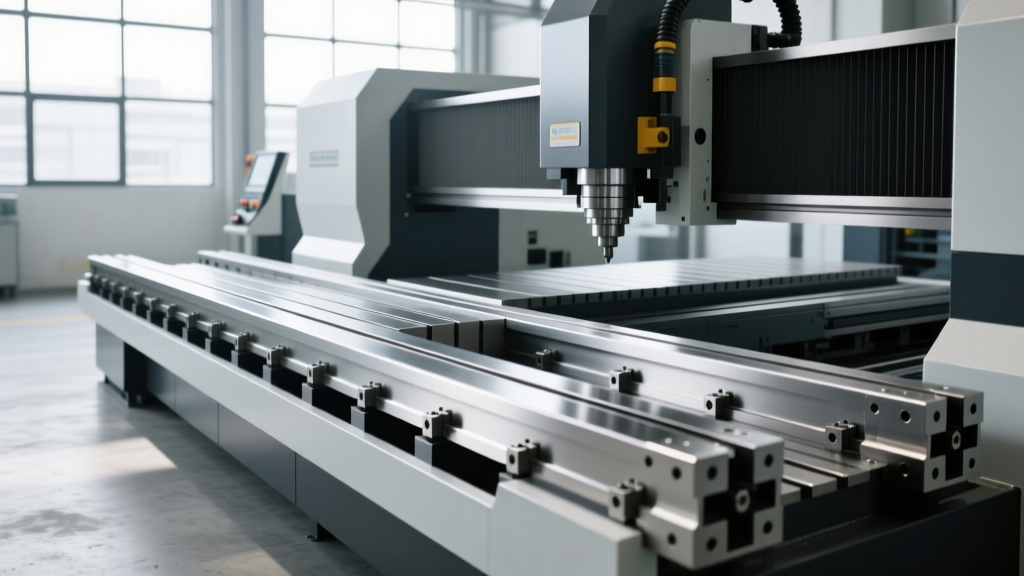
- Linear Guideways: Utilize recirculating ball or roller bearings. Friction is primarily rolling, resulting in high-frequency vibration harmonics and distinct, calculable defect frequencies (e.g., Ball Pass Frequency Outer race - BPFO).
- Box Ways: Utilize sliding friction with polymeric coatings (e.g., Turcite-B, Rulon) or hydrostatic/hydrodynamic oil films. Friction is characterized by low-frequency stick-slip phenomena, macro-level chatter, and significant thermal expansion gradients.
Training an anomaly detection model like an Isolation Forest on linear way vibration data and deploying it on a box way machine will flag normal hydrodynamic oil film variations as catastrophic bearing failures.
Linear Guideways: High-Frequency Harmonics and Edge Computing
Linear ways (such as the THK SHS series or NSK NH series) are dominant in high-speed, light-to-medium cutting CNC mills and lathes. The primary failure modes are recirculation cap fatigue, ball/roller spalling, and lubrication starvation.
Sensor and Sampling Requirements
To capture the defect frequencies of a linear carriage traveling at 60 m/min, machine learning monitoring tools require high-resolution piezoelectric accelerometers (e.g., Kistler 8762A tri-axial sensors) sampling at a minimum of 10 kHz to 25 kHz.
Data Highlight: Linear Way Defect Frequencies
For a standard 35mm linear guideway block with 4-row recirculating balls, a localized defect on the raceway will generate impulse vibrations between 2,000 Hz and 8,000 Hz depending on carriage velocity. ML tools must apply Fast Fourier Transform (FFT) and envelope analysis to extract these high-frequency modulations from the background machining noise.
Optimal ML Algorithms for Linear Ways
For linear systems, Convolutional Neural Networks (CNNs) applied to time-frequency spectrograms are highly effective. By converting high-frequency vibration data into visual spectrograms, CNNs can classify specific fault types (e.g., inner race vs. outer race defects) with over 94% accuracy, provided the training data accounts for variable carriage speeds.
Box Ways: Hydrodynamic Lubrication and Low-Frequency Anomaly Detection
Box ways remain the standard for heavy-duty machining, 5-axis trunnion tables, and large boring mills due to their superior damping characteristics and rigidity. The sliding interface relies on a microscopic oil film or PTFE-based Turcite-B coatings to prevent metal-to-metal contact.
The Stick-Slip Challenge in ML Monitoring
The primary failure mode in box ways is not high-frequency spalling, but rather low-frequency stick-slip friction, way cover interference, and loss of hydrodynamic lubrication. Stick-slip occurs when the static coefficient of friction ($\mu_s$) significantly exceeds the kinetic coefficient ($\mu_k$), causing micro-stutters at low feed rates (typically under 500 mm/min).
Machine learning monitoring tools must be configured to monitor low-frequency bands (1 Hz to 500 Hz). Instead of high-speed accelerometers, shops should utilize low-frequency MEMS accelerometers combined with linear encoder position deviation data and temperature arrays.
Optimal ML Algorithms for Box Ways
Long Short-Term Memory (LSTM) networks and Autoencoders are superior for box way monitoring. Autoencoders can learn the normal non-linear relationship between axis motor current, way temperature, and positional lag. When the way coating degrades or the oil film thins, the motor current required to overcome static friction increases. The autoencoder registers a high reconstruction error, triggering a predictive maintenance alert days before catastrophic galling occurs.
Comparison Matrix: Configuring ML Monitoring Tools by Way Type
The following matrix provides a direct configuration guide for data scientists and reliability engineers setting up machine learning monitoring tools across mixed fleets of CNC equipment.
| Parameter | Linear Guideway Systems | Box Way Systems |
|---|---|---|
| Primary Failure Mode | Recirculation fatigue, ball spalling | Coating wear, oil film collapse, stick-slip |
| Vibration Frequency Band | 1,000 Hz – 15,000 Hz | 1 Hz – 500 Hz |
| Required Sensor Type | Piezoelectric Accelerometers (IEPE) | Low-freq MEMS, Motor Current, Thermocouples |
| Sampling Rate | 10 kHz – 25 kHz | 1 kHz – 2 kHz (plus continuous thermal logging) |
| Best ML Algorithm | CNN on Spectrograms, Random Forest | Autoencoders, LSTM (Time-Series Forecasting) |
| Key Feature Extraction | Kurtosis, Crest Factor, Envelope Spectrum | Static vs. Kinetic current delta, thermal gradient |
Platform Integration in 2026: Siemens, Fanuc, and Edge AI
Modern CNC controllers have evolved from simple G-code interpreters into edge-computing nodes capable of running localized machine learning monitoring tools. Understanding how OEM platforms handle way-specific data is critical for integration.
Siemens Insights Hub and Sinumerik Edge
As detailed in the Siemens Insights Hub ecosystem, the Sinumerik Edge platform allows shops to deploy containerized ML apps directly on the machine. For box way machines (like heavy Waldrich Coburg or Schiess gantry mills), Siemens provides native apps that correlate axis drive torque with positional feedback to detect way friction degradation without requiring external vibration sensors. This current-based monitoring is ideal for the low-frequency stick-slip profile of box ways.
Fanuc FIELD and AI Servo Monitor
Fanuc’s AI Servo Monitor, integrated into the 30i/31i-B5 series controllers, excels at linear way monitoring. It utilizes high-speed sampling of the servo motor current and torque command data to detect the high-frequency torque ripples caused by recirculating ball defects in linear guideways. By leveraging the controller's internal 1 kHz to 4 kHz sampling capabilities, shops can bypass the $3,000+ cost of external piezoelectric sensor arrays for basic linear way health monitoring.
Step-by-Step Deployment Framework for Machine Shops
Deploying machine learning monitoring tools requires a phased approach that respects the mechanical realities of the machine tool fleet. Follow this framework to ensure accurate baselining.
- Fleet Segmentation: Audit your CNC floor. Separate machines into Cohort A (Linear Ways / High Speed) and Cohort B (Box Ways / Heavy Cutting). Do not mix sensor data from these cohorts into a single global ML model.
- Sensor Selection & Mounting: For Cohort A, mount piezoelectric sensors directly on the linear carriage blocks or the spindle nose using rigid stud mounts (magnetic mounts dampen high frequencies above 5 kHz). For Cohort B, prioritize way-cover strain gauges, linear glass scale comparators, and distributed PT100 temperature sensors along the bed.
- Dynamic Baselining: Run the machine through its standard tool change and rapid traverse cycles under no-load conditions for 72 hours to establish the ML baseline. According to research supported by the NIST Advanced Manufacturing Enterprise, accounting for ambient thermal shifts during this 72-hour window reduces false-positive anomaly detection by up to 40% in box way systems.
- Algorithm Tuning: Apply Isolation Forests to Cohort A data to flag high-frequency outliers. Apply Autoencoder reconstruction error thresholds to Cohort B data to flag gradual friction increases. Set Cohort B alert thresholds to trigger on sustained trends over 4-hour windows, rather than instantaneous spikes.
Cost-Benefit Considerations
Outfitting a single 5-axis box way machine with a comprehensive external ML sensor array (edge gateway, low-freq MEMS, thermal arrays) typically costs between $4,500 and $7,000. Conversely, leveraging native controller data (Fanuc AI Servo Monitor) for linear way machines reduces the hardware cost to under $1,000 per node, requiring only software licensing for the edge analytics platform. Align your hardware spend with the physical failure modes dictated by the way system to maximize ROI.