Cabbage Leaf Roll Machine Tool: Linear vs Box Way Systems
Explore linear vs box way systems in cabbage leaf roll machine tool design. Compare load, speed, and IP69K washdown specs for food automation.
The Kinematics of Automated Food Prep Machinery
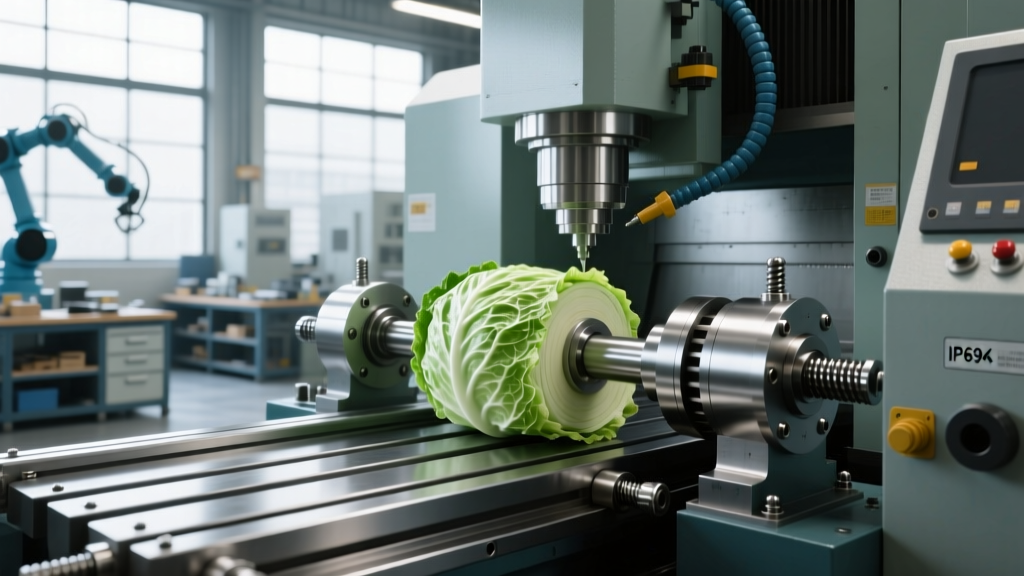
Industrial food co-packers producing stuffed brassica products at rates exceeding 120 units per minute rely on highly specialized automation. At the core of this production line is the cabbage leaf roll machine tool, a multi-axis mechatronic system designed to flatten, fill, and tightly roll cabbage leaves without tearing the delicate vascular structure. While often categorized under food processing equipment, the internal actuation and structural frameworks of these machines are governed by the same rigorous machine tool kinematics found in CNC metalworking. The most critical design decision for OEM engineers building these systems is the selection of the way system: traditional hand-scraped box ways versus modern recirculating linear guide rails.
The choice between these two linear motion technologies dictates the machine’s shock absorption, positioning accuracy, maintenance intervals, and ability to survive harsh IP69K washdown environments. Understanding the tribology and structural dynamics of both systems is mandatory for engineers specifying components for heavy-duty food automation.
System Overview: The 3-Axis Cabbage Roll Actuator- Z-Axis (Press/Flatten): Requires high static load capacity and shock damping to flatten the leaf stem without crushing the blade.
- X-Axis (Conveyance): Demands high-speed traverse rates to move the leaf between the filling and rolling stations.
- Y-Axis (Folding/Rolling): Requires precise, low-speed creep motion to tuck and roll the leaf tightly around the meat or rice matrix.
Box Ways: The Heavy Pressing and Damping Advantage
Box ways rely on sliding contact between two machined cast iron or steel surfaces. In the context of a cabbage leaf roll machine tool, box ways are almost exclusively reserved for the Z-axis pressing station. When a pneumatic-hydraulic ram flattens a raw cabbage leaf, the impact generates significant shock loading. Recirculating ball bearings would transmit this shock directly to the servo motor and machine frame, causing vibration and premature spalling. Box ways absorb this energy through the massive surface area of the sliding interface and the viscoelastic properties of the way liner.
Turcite-B Liners and Hand Scraping
Modern box ways in food machinery are not bare metal-on-metal. They are coated with PTFE-based composite liners like Turcite-B or Rulon. The cast iron base is hand-scraped to achieve 20 to 30 points per square inch (PPSI), creating microscopic oil pockets. The Turcite is then applied to a thickness of roughly 1.5mm and precision-ground. This combination yields a dynamic friction coefficient of approximately 0.05 and, crucially, a static friction coefficient that is nearly identical to the dynamic one. This eliminates ‘stick-slip’ at the ultra-low creep speeds (0.5 mm/s to 2 mm/s) required when the folding mechanism gently tucks the cabbage leaf.
The primary drawback is cost and speed. Hand-scraping and fitting a single box way axis adds between $3,500 and $5,500 in skilled labor to the machine’s build cost. Furthermore, box ways are limited to traverse speeds of under 1.0 m/s, making them unsuitable for the rapid X-axis conveyance required in high-throughput food lines.
Linear Guide Rails: Speed and Precision in Conveyance
For the X and Y axes of the cabbage leaf roll machine tool, profile rail linear guides are the industry standard. Utilizing four rows of recirculating ball bearings running in Gothic arch grooves, linear ways offer a friction coefficient as low as 0.002. According to technical data from Hiwin linear guideways, heavy-duty flange carriages (such as the HG35 or HG45 series) can support dynamic loads exceeding 45 kN while permitting traverse speeds up to 3.0 m/s to 5.0 m/s.
This high-speed capability allows the machine’s shuttle system to rapidly index the flattened leaf from the press station to the volumetric filler and then to the rolling mandrel in a fraction of a second. Linear guides also offer off-the-shelf interchangeability, meaning a failed carriage can be unbolted and replaced in under 15 minutes, minimizing line downtime.
Warning: Seal Failure in Food EnvironmentsStandard linear carriages use urethane end seals that degrade rapidly when exposed to hot water, caustic foam cleaners, and acidic cabbage juice (pH 5.5-6.0). If the seal fails, brassica fibers and rice starch enter the carriage, jamming the recirculating balls. Engineers must specify carriages with reinforced stainless steel scrapers, laminated contact seals, and metal end caps to achieve an acceptable service life in washdown zones.
Technical Comparison Matrix
The following table contrasts the operational parameters of both way systems when applied specifically to automated food preparation machinery.
| Specification | Box Ways (Sliding Contact) | Linear Guide Rails (Recirculating) |
|---|---|---|
| Primary Axis Application | Z-Axis (Leaf Pressing / Heavy Load) | X & Y Axes (Conveyance / Rolling) |
| Dynamic Friction Coefficient | ~0.05 (with Turcite-B & Way Oil) | ~0.002 to 0.003 |
| Shock & Vibration Damping | Excellent (High surface contact area) | Poor (Point contact via steel balls) |
| Max Traverse Speed | < 1.0 m/s | Up to 5.0 m/s |
| Stick-Slip at Low Speed | Negligible | Present (Requires servo filtering) |
| Washdown Survival (IP69K) | High (If way oil is continuously purged) | Moderate (Highly dependent on seal integrity) |
| Estimated Axis Build Cost | $4,500 - $6,500 (Includes scraping labor) | $800 - $1,400 (Off-the-shelf components) |
Tribology and Washdown Constraints
Designing way systems for a cabbage leaf roll machine tool requires strict adherence to sanitary design principles. As outlined by 3-A Sanitary Standards, equipment in the splash zone must resist microbial harborage and withstand high-pressure, high-temperature (HPHT) washdowns. This environment is inherently hostile to precision motion components.
For linear guides, OEMs must transition from standard carbon steel to 440C or 316L stainless steel rails and carriages. While stainless steel prevents rust, it has a lower load capacity and hardness than chrome steel. To compensate, engineers often upsize the carriage (e.g., moving from a size 25 to a size 35) to maintain the required safety factor. Furthermore, the lubricant must be an NSF H1 registered food-grade grease, such as Kluber NH1 CH 2-100, which maintains its viscosity despite daily hot water exposure.
Box ways face a different challenge: way oil contamination. Traditional machine tools use ISO 68 way oils (like Mobil Vactra No. 2) that are not food safe. In a food plant, the box ways must be lubricated with an H1-rated synthetic way oil, such as Cassida RLO 68. The machine must be designed with an automatic, continuous-dispense lube system that slightly over-purges the oil, creating a positive pressure barrier that forces cabbage juice and debris out of the way interface rather than allowing it to seep in.
Servo Tuning: Compensating for Friction Profiles
The mechanical choice of way system directly dictates the PID tuning parameters of the axis servo drives. This is a frequent point of failure in poorly integrated food machinery.
- Tuning Box Ways: Because of the higher static friction breakaway force, the servo’s integral gain (Ki) must be increased to eliminate steady-state error during the leaf-pressing stroke. Engineers often implement a friction compensation lookup table in the drive to inject a specific torque offset the millisecond the axis changes direction, preventing the carriage from ‘sticking’ and tearing the cabbage leaf.
- Tuning Linear Ways: Linear guides have virtually no static friction, but their high rigidity and low damping make them prone to high-frequency resonance. The derivative gain (Kd) must be carefully filtered using low-pass notch filters to prevent the servo from oscillating and creating audible chatter during rapid X-axis indexing.
For deeper insights into managing resonance in high-speed linear motion, the engineering resources provided by SKF linear motion technology offer extensive data on matching carriage preload classes (light, medium, heavy) to the specific harmonic frequencies of the machine frame.
Frequently Asked Technical Questions
Can linear guides be used for the Z-axis press if heavy-duty seals are added?
While heavy-duty seals protect against debris, they do not solve the fundamental lack of damping in recirculating ball bearings. When the Z-axis press impacts the cabbage leaf stem, the shock load is transmitted through the balls to the rail mounting surface, which can cause micro-fractures in the machine casting over time. Box ways remain the superior choice for high-impact vertical pressing operations.
What is the expected maintenance interval for linear carriages in a daily washdown environment?
Even with IP69K-rated stainless steel carriages and reinforced scrapers, the continuous thermal cycling from 85°C washdowns to 4°C production floor temperatures causes seals to expand and contract, eventually breaking the grease barrier. Expect to replace linear carriages on the X-axis every 14 to 18 months. Box ways, provided the H1 way oil is continuously purged, can operate for 7 to 10 years before the Turcite liner requires re-grinding.
How does cabbage juice acidity affect way system materials?
Raw cabbage juice contains sulfur compounds and mild organic acids (pH 5.5-6.0). If this fluid breaches the carriage seals of a standard carbon steel linear guide, it causes rapid hydrogen embrittlement and spalling of the ball bearings. This is why 316L stainless steel or heavily nickel-plated rails are non-negotiable for the X and Y axes operating in the splash zone of the filling station.