Selecting Grob Machine Tools: Spindle & Bearing Configurations
A technical buyer's guide to specifying spindle types, bearing configurations, and interfaces for Grob machine tools in 5-axis and heavy-duty applications.
The Role of Spindle Architecture in Grob Universal Centers
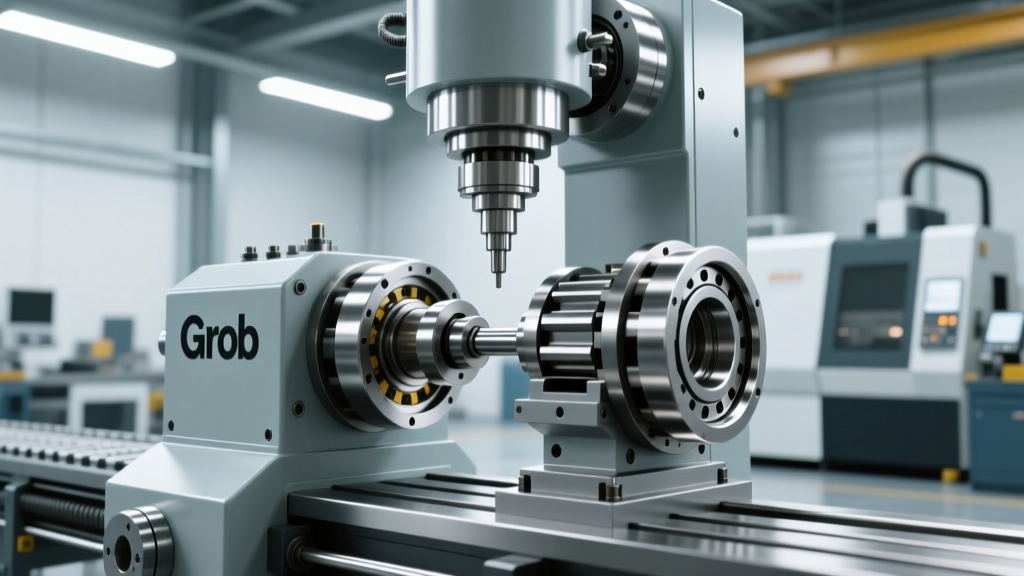
Specifying a Grob universal machining center requires precise alignment between part geometry, material science, and the machine's spindle architecture. Unlike standard vertical machining centers, Grob's G-series (such as the G350 and G550) utilizes a unique horizontal-spindle, tilting-rotary-table design. This kinematic layout places extreme multi-directional loads on the spindle bearings during simultaneous 5-axis contouring and heavy roughing.
When configuring a Grob machine for a specific production cell, the spindle is not a monolithic choice; it is a system of bearing arrangements, preload strategies, and tool interfaces. Selecting the wrong combination results in premature bearing degradation, thermal drift exceeding 20 microns, or catastrophic tool pullout during high-torque titanium milling.
Baseline Spec Matrix: G350 vs. G550 Spindle Platforms- G350 (Compact 5-Axis): Typically configured with HSK-E50 or HSK-A63 interfaces. Max speeds range from 12,000 RPM (heavy duty) to 21,000 RPM (aerospace aluminum). Spindle power peaks around 26 kW.
- G550 (Mid-Size Universal): Standardizes on HSK-A63 or HSK-T100. Torque-dense configurations deliver up to 130 Nm continuous torque at lower RPMs for Inconel and stainless steel, while high-speed variants reach 18,000 RPM.
Decoding Bearing Configurations for 5-Axis Machining
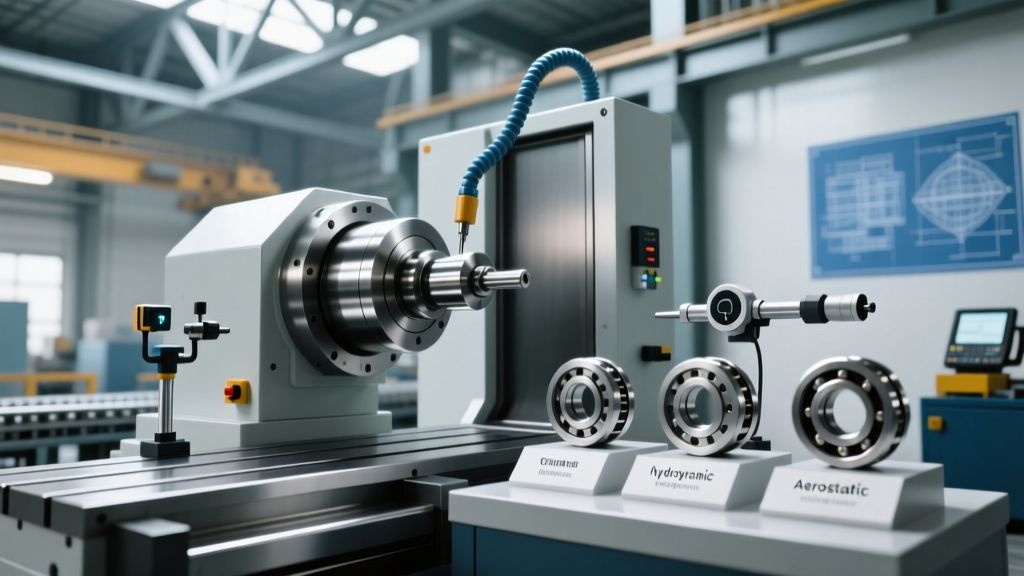
The bearing arrangement dictates the spindle's axial rigidity, radial load capacity, and thermal signature. Grob integrates advanced motor spindles where the rotor is directly mounted on the shaft, eliminating belt-induced vibrations. The bearing selection inside these housings falls into three primary categories.
Hybrid Ceramic Angular Contact Ball Bearings
For high-speed Grob spindles (18,000+ RPM), hybrid angular contact ball bearings are mandatory. These utilize silicon nitride (Si3N4) ceramic balls paired with high-nitrogen steel races (such as Cronidur 30 or similar martensitic steels). Si3N4 balls are 40% lighter than steel, drastically reducing centrifugal forces at high RPMs. This reduction in mass lowers the contact pressure on the outer race, allowing for higher speeds without generating excessive frictional heat. A standard 7014 series hybrid bearing in a Grob high-speed spindle will typically run with a contact angle of 15 to 20 degrees to balance axial thrust capacity with radial stiffness.
Cylindrical Roller Bearings for Radial Rigidity
While angular contact bearings handle axial thrust from drilling and Z-axis milling, the rear and intermediate sections of heavy-duty Grob spindles often incorporate double-row cylindrical roller bearings. These bearings provide immense radial rigidity, which is critical when the G550 performs heavy side-milling with long overhang tools. The rollers distribute the load across a line contact rather than a point contact, allowing the spindle to absorb the radial shock of interrupted cuts in cast iron or forgings without brinelling the races.
Hydrostatic Bearings in Specialized Transfer Lines
Though rare in standard catalog universal centers, Grob's custom transfer lines and specialized heavy-cutting modules occasionally employ hydrostatic spindle bearings. By maintaining a pressurized film of oil (typically at 30 to 50 bar) between the shaft and the bearing surface, hydrostatic bearings offer infinite static stiffness and zero metal-to-metal contact. This configuration is reserved for applications requiring extreme damping, such as deep-hole boring or ultra-precise finishing of hardened dies, where vibration must be entirely eliminated.
| Bearing Type | Max RPM Limit | Radial Rigidity | Axial Rigidity | Primary Grob Application |
|---|---|---|---|---|
| Hybrid Angular Contact (Si3N4) | 18,000 - 24,000 | Moderate | High | Aerospace aluminum, 5-axis contouring |
| Steel Angular Contact | 10,000 - 14,000 | High | Very High | General steel milling, automotive |
| Cylindrical Roller | 8,000 - 12,000 | Extreme | Low (Requires pairing) | Heavy roughing, interrupted cuts |
Spindle Interface Selection: HSK vs. Capto on Grob Platforms
The spindle taper is the mechanical bridge between the bearing system and the cutting edge. Grob predominantly engineers its universal centers around the HSK (Hollow Shank Taper) standard, specifically HSK-A and HSK-E variants. Understanding the nuance between these interfaces is critical for equipment buyers.
- HSK-A63: The workhorse interface for the G550. It features drive slots in the flange that transmit high torque directly from the spindle face to the toolholder. Ideal for heavy roughing in steel and titanium where torque exceeds 100 Nm.
- HSK-E50 / HSK-E63: The 'E' series omits the drive slots and finger notches, resulting in a perfectly symmetrical flange. At 21,000 RPM, the asymmetrical mass of the HSK-A drive slots creates micro-vibrations due to centrifugal unbalance. The HSK-E eliminates this, ensuring superior surface finishes in high-speed aerospace aluminum profiling.
Engineering Warning: Never specify an HSK-A63 spindle for continuous high-speed (>15,000 RPM) aluminum machining. The unbalance generated by the drive slots at high velocities will accelerate bearing wear and degrade surface finish. Always upgrade to HSK-E63 or HSK-E50 for high-speed motor spindles.
Thermal Management and Preload Strategies
Bearing preload—the internal axial force applied to the bearings during assembly—defines the spindle's stiffness. Grob spindles utilize a rigid preload mechanism, typically preloading the front bearing set between 800N and 1200N depending on the duty cycle. However, preload generates friction, and friction generates heat.
To combat thermal growth, modern Grob spindles employ a dual-circuit liquid cooling system. The primary circuit cools the spindle housing (jacket cooling), while the secondary circuit routes coolant directly through the spindle shaft (shaft cooling). Shaft cooling is vital for high-torque applications because it extracts heat directly from the inner bearing races, which run hotter than the outer races due to centrifugal expansion. This advanced thermal management restricts Z-axis thermal growth to less than 15 microns during a standard 4-hour warm-up and heavy-cutting cycle, eliminating the need for continuous probing compensation.
Purchasing Decision Framework: Matching Spindle to Part Geometry
Use this step-by-step framework when negotiating the spindle specification with Grob application engineers:
- Analyze the Material Removal Rate (MRR): If your primary operation involves removing >150 cm³/min of titanium or Inconel, select a low-speed, high-torque spindle (max 12,000 RPM) with steel angular contact bearings and an HSK-A63 or HSK-T100 interface.
- Evaluate Tool Overhang: If 5-axis profiling requires tools extending >250mm from the gauge line, prioritize radial rigidity. Request a spindle configuration that integrates a cylindrical roller bearing in the rear bearing pack to resist radial deflection.
- Assess Surface Finish Requirements: For aerospace structural components requiring 0.8 Ra surface finishes at high feed rates, specify a high-speed motor spindle (18,000+ RPM) with hybrid ceramic bearings, shaft cooling, and an HSK-E interface to eliminate high-speed unbalance.
- Verify Sensor Integration: For 2026 production environments, ensure the spindle includes embedded vibration and temperature sensors near the front bearing pack. This data is critical for predictive maintenance and preventing catastrophic spindle crashes in untended lights-out manufacturing cells.
By treating the spindle as a configurable system of bearings, cooling circuits, and interfaces rather than a simple RPM rating, buyers can maximize the ROI of their Grob machining centers and ensure process stability across the entire lifecycle of the equipment.