Fundamentals of Machining and Machine Tools: Box vs Linear Ways
Explore the fundamentals of machining and machine tools by comparing box ways and linear guides. Technical specs, damping ratios, and friction data.
The Core Mechanics: Sliding Friction vs. Rolling Elements
In the study of machine tool dynamics, the guiding system dictates the ultimate accuracy, surface finish, and chatter resistance of the machine. Drawing from the core principles outlined in the Fundamentals of Machining and Machine Tools, the kinematic pairs that guide axis movement must balance low friction with high dynamic stiffness. As of 2026, the industry remains divided between two primary architectures: traditional sliding box ways and modern recirculating linear guides. Understanding the tribology and Hertzian contact mechanics of both is critical for specifying machine tool structures.
Box ways rely on sliding friction, utilizing a large surface area contact between the moving carriage and the stationary bed. Linear guides, conversely, utilize rolling elements (balls or cylindrical rollers) that recirculate within a carriage block, converting sliding friction into rolling friction. This fundamental difference in mechanics cascades into vastly different performance profiles regarding load capacity, speed, and vibrational damping.
Engineering Callout: The Stick-Slip Phenomenon
In unlubricated or poorly designed sliding systems, the static coefficient of friction ($\mu_s$) is significantly higher than the dynamic coefficient ($\mu_d$). This delta causes 'stick-slip'—a jerky motion at low feed rates that ruins surface finishes and ruins positioning accuracy. Modern box ways eliminate this by utilizing PTFE-based composite linings (like Turcite-B or Rulon), which equalize $\mu_s$ and $\mu_d$ at approximately 0.05, ensuring smooth micro-positioning.
Technical Specifications: Box Way Systems
Box ways are characterized by their massive geometric envelopment. Common configurations include V-flat, square, and dovetail profiles. The sheer surface area in contact provides inherent rigidity, but the true technical advantage lies in damping capacity.
Material Science and Squeeze-Film Damping
When a heavy interrupted cut occurs (such as roughing titanium or Inconel), the cutting tool induces high-frequency vibrations. In a box way system, the lubricant trapped between the sliding surfaces acts as a viscous dashpot. This 'squeeze-film' effect, combined with the internal hysteresis of polymer way liners, yields a damping ratio ($\zeta$) that is typically 5 to 10 times higher than that of rolling element guides.
- Hand Scraping Specifications: High-end box ways are still hand-scraped to achieve 10 to 15 points per square inch (PPI). This creates microscopic oil pockets that maintain hydrodynamic lubrication even at zero velocity.
- Way Liner Materials: Turcite-B and Rulon 142 are industry standards. They exhibit a compressive strength of up to 10,000 psi and operate with a friction coefficient of $\mu = 0.05$ against hardened steel or cast iron.
- Gib Adjustment: Tapered gibs allow for manual preload adjustment to eliminate backlash as the machine ages, a mechanical tuning capability absent in most linear guides.
Technical Specifications: Linear Guide Systems
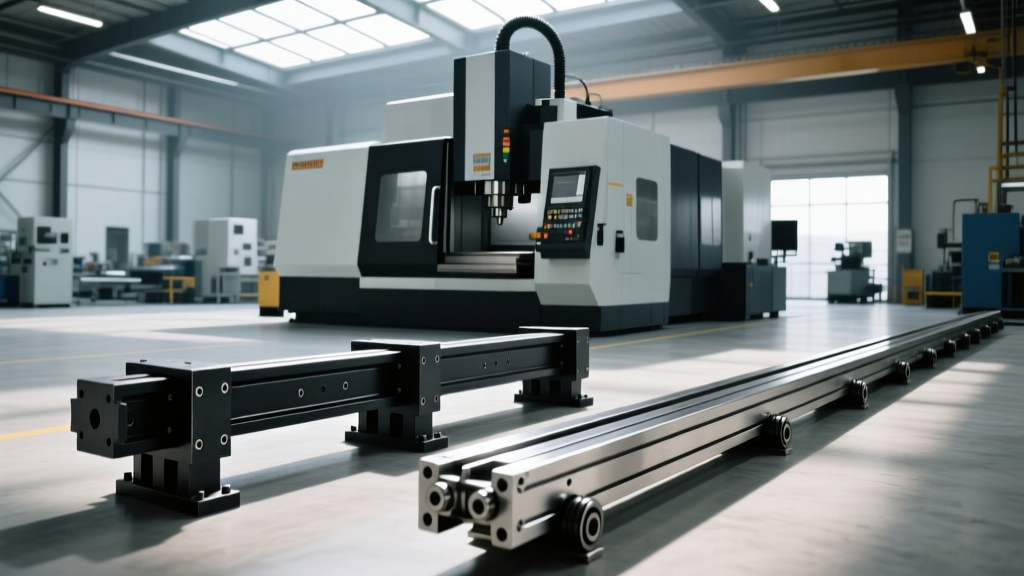
Linear motion guides dominate high-speed machining centers and precision die-sinking EDMs. By utilizing recirculating balls or rollers, they achieve friction coefficients as low as $\mu = 0.001$, enabling rapid traverse rates exceeding 120 m/min.
Hertzian Contact Stress and Preload Classes
The limiting factor in linear guides is the Hertzian contact stress at the microscopic point (ball) or line (roller) contact between the bearing and the raceway. To increase rigidity and eliminate internal clearance, manufacturers apply preload. According to technical data from leading manufacturers like THK Linear Motion Systems, preload is categorized into distinct classes:
- Light Preload (C0/C1): 2% to 3% of the dynamic load rating. Used for general milling and high-speed aluminum machining where minimizing rolling resistance is prioritized.
- Medium Preload (C2): 5% to 6% of dynamic load rating. Standard for precision boring and general mold making.
- Heavy Preload (C3/C4): 8% to 13% of dynamic load rating. Required for heavy-duty turning and grinding applications to prevent carriage lift during aggressive Z-axis cuts.
As of 2026, the integration of ceramic-hybrid bearings (silicon nitride balls) in linear carriages has extended L10 fatigue life by up to 40% in contaminated environments, as the ceramic elements are less susceptible to brinelling from microscopic swarf ingress.
Comparative Data Matrix: Box Ways vs. Linear Guides
The following table synthesizes empirical performance data for standard CNC machine tool applications, comparing traditional lined box ways against modern roller and ball linear guides.
| Parameter | Box Ways (Turcite Lined) | Linear Guides (Roller Type) | Linear Guides (Ball Type) |
|---|---|---|---|
| Friction Coefficient ($\mu$) | 0.05 (Static & Dynamic) | 0.002 - 0.003 | 0.001 - 0.002 |
| Dynamic Damping Ratio | High (Squeeze-film + Polymer) | Low (Metal-to-Metal) | Very Low |
| Max Traverse Speed | 15 - 25 m/min | 60 - 90 m/min | 90 - 120+ m/min |
| Static Rigidity | Excellent (Full surface area) | Very High (Line contact) | Moderate (Point contact) |
| Shock Load Resistance | Superior | Good | Poor (Risk of brinelling) |
| Maintenance Interval | High (Scraping/Gib tuning) | Low (Relube bearings) | Low (Relube bearings) |
Critical Design Note: While roller linear guides offer higher rigidity than ball guides, they are highly sensitive to misalignment. A mounting surface parallelism error of just 5 microns can induce severe internal binding in a preloaded roller carriage, drastically reducing L10 life. Box ways are inherently more forgiving of minor structural casting distortions due to the conformal nature of the scraped polymer liner.
Decision Framework: Specifying the Way System
Choosing between these systems requires mapping the machine's primary operational profile to its kinematic requirements. Referencing advanced manufacturing principles from resources like MIT's Design and Manufacturing coursework, the selection matrix is as follows:
When to Specify Box Ways
- Heavy Interrupted Cuts: Roughing steel forgings, titanium aerospace structural components, or cast iron blocks where chatter mitigation is paramount.
- Heavy-Duty Turning Centers: Large-bore lathes where the Z-axis carriage must absorb massive radial cutting forces without micro-deflection.
- Longevity in Harsh Environments: Machines operating in highly abrasive environments (e.g., grinding or machining composites) where way wipers on linear guides would quickly fail, allowing swarf to destroy recirculating bearings.
When to Specify Linear Guides
- High-Speed Machining (HSM): Aerospace aluminum contouring, where feed rates exceed 40 m/min and low rolling resistance minimizes servo motor lag and heat generation.
- Multi-Axis Simultaneous Contouring: 5-axis mold making where the absence of stick-slip ensures flawless surface finishes at very low, variable feed rates.
- High-Acceleration Pick-and-Place or Laser Cutting: Applications requiring rapid directional changes where the low moving mass of a linear carriage reduces inertial loads on the ball screws or linear motors.
Maintenance and Lifecycle Degradation
The failure modes of these two systems dictate their total cost of ownership. Linear guides suffer from fatigue spalling and brinelling. Once the raceway pits, the carriage must be entirely replaced—a process requiring laser interferometer realignment of the axis. Furthermore, as noted by industrial automation experts at Bosch Rexroth, improper lubrication is the root cause of over 70% of premature linear guide failures, as the microscopic contact zones require precise grease viscosity to maintain the elastohydrodynamic film.
Box ways, conversely, experience adhesive wear and geometric sag over decades. However, because the soft polymer liner wears sacrificially to protect the hardened cast iron bed, a machine tool can be rebuilt in the field. A skilled technician can scrape the mating surfaces, apply new Turcite, and restore the machine to original OEM geometric tolerances, a lifecycle advantage that heavily favors box ways in capital-intensive, multi-decade heavy manufacturing environments.