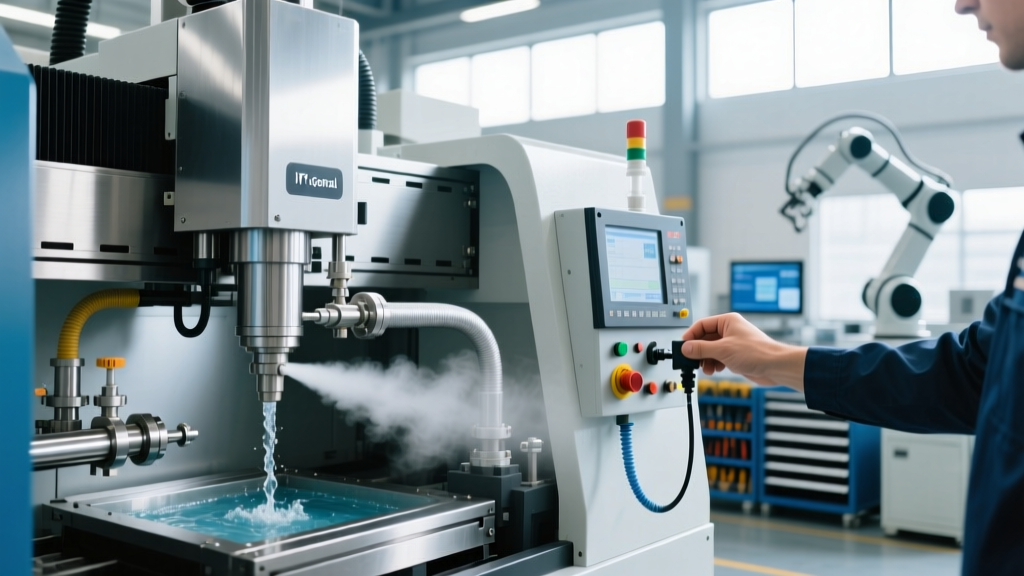
Troubleshooting Smart Machine Tool Coolant: Flood vs Mist MQL
Diagnose and repair flood and MQL mist coolant faults on your smart machine tool. Includes IoT sensor calibration, TSC seal repairs, and flow matrices.
Modern CNC environments rely heavily on integrated IoT sensors to manage thermal dynamics and chip evacuation. When a smart machine tool flags a coolant anomaly, the root cause is rarely just a low tank level. It is usually a mechanical degradation in the delivery system or a calibration drift in the flow sensors. Whether your setup utilizes traditional high-pressure flood coolant or Minimum Quantity Lubrication (MQL) mist, diagnosing the exact failure mode requires bypassing the HMI alarm codes and testing the physical fluid dynamics.
Initial Diagnostic Matrix: Interpreting Smart Sensor Alarms- Alarm: Flow Rate Variance >15%: Indicates cavitation, clogged suction strainer, or degrading pump impeller.
- Alarm: Pressure Drop at Nozzle: Points to a failing through-spindle coolant (TSC) union seal or a collapsed high-pressure hose.
- Alarm: MQL Consumption Spike: Signals a stuck pulse-width modulated (PWM) solenoid or air-to-fluid ratio imbalance.
Flood Coolant System Faults & Repair Protocols
Flood systems on a smart machine tool typically operate between 15 PSI for standard flood and 300 to 1,000 PSI for through-tool applications. The integration of inline flow meters, such as the IFM SM8120, means the control system will halt the cycle if volumetric flow drops below the programmed threshold, usually 2.5 GPM for standard milling operations.
Symptom: Cavitation and Intermittent Flow Sensor Alarms
If your smart machine tool triggers intermittent low-flow alarms despite a full sump, the pump is likely cavitating. Cavitation destroys impeller vanes and introduces micro-bubbles that confuse ultrasonic and electromagnetic flow sensors.
- Inspect the Suction Strainer: Remove the pump intake basket. Fine aluminum or titanium swarf (under 50 microns) bypasses standard 100-mesh drum filters and packs into the pump strainer. Clean with a 40-PSI air blowout, never a wire brush which can deform the mesh.
- Check Fluid Concentration: Low concentration reduces the fluid's specific gravity and lubricity, lowering the cavitation threshold. Use a handheld refractometer. If using a semi-synthetic fluid like Master Fluid Solutions TRIM MicroSol 585XT, multiply the Brix reading by the manufacturer's refractometer factor (typically 1.2 to 1.4) to get the true percentage. Maintain a strict 6.5% to 8.0% concentration.
- Verify Suction Line Integrity: A pinhole leak on the suction side will draw air instead of fluid. Apply a soapy water solution to all PVC or braided hose fittings while the pump is running; bubbles indicate an air ingress point.
Symptom: High-Pressure TSC Union Leaking
Through-spindle coolant (TSC) systems operating at 300+ PSI rely on a rotating carbon seal assembly at the rear of the spindle. When the smart machine tool reports a 'TSC Pressure Fault', the union is often bypassing fluid into the spindle motor housing.
CRITICAL WARNING: Never run a TSC system with dry air to 'clear' the lines. The carbon seal faces require fluid lubrication. Dry running for even 30 seconds will score the seal faces, resulting in a $1,200+ union replacement and potential spindle bearing contamination.Repair Protocol: Disconnect the high-pressure line at the union. Inspect the carbon seal face for radial grooves. If grooves are present, replace the seal cartridge. When reinstalling the retention spring, ensure it is compressed to the exact manufacturer specification (e.g., 15 Nm torque on the retaining nut for standard Haas TSC unions) to maintain the correct face pressure without causing excessive drag on the spindle motor.
MQL (Mist) System Troubleshooting on Smart Machine Tools
Minimum Quantity Lubrication (MQL) replaces flood coolant with a micro-mist of biodegradable ester-based oil, typically consuming 5 to 50 mL per hour. Smart machine tools equipped with MQL use precise PWM solenoids and atomizing nozzles. Because there is no flood to wash away chips, MQL troubleshooting is heavily focused on atomization quality and chip evacuation mechanics.
Symptom: Inconsistent Droplet Atomization (Spitting vs. Mist)
Effective MQL requires droplet sizes between 5 and 20 microns. If the nozzle is 'spitting' macro-droplets, the tool will experience thermal shock, and the smart machine tool's spindle load monitor will detect erratic torque spikes.
- Diagnose the Air-to-Fluid Ratio: MQL systems require a precise volumetric mix, typically 4:1 or 5:1 (air to oil). Check the pneumatic regulator. If shop air pressure drops below 85 PSI during heavy compressor cycling, the atomization fails. Install a dedicated 2-gallon accumulator tank directly upstream of the MQL generator to stabilize pressure.
- Check Fluid Viscosity and Degradation: Plant-based ester fluids (like Accu-Lube LB-2000 or ITW ROCOL Tri-Logic) are hygroscopic. If the reservoir cap is left off, the fluid absorbs ambient moisture, altering its viscosity and surface tension. Drain and replace the reservoir fluid every 6 months, regardless of the volume remaining.
- Clear the Capillary Tubes: The micro-tubes delivering oil to the nozzle can clog with polymerized oil residue. Flush the lines with a specialized MQL line cleaner or isopropyl alcohol, followed by a high-pressure air purge.
Symptom: Smart Sensor Calibration Drift
Advanced MQL units utilize optical or thermal mass flow sensors to verify oil delivery. Over time, oil mist coats the sensor housing, causing false 'No Flow' alarms.
Repair Protocol: Locate the inline flow sensor (often integrated into the UNIST or HPM generator block). Remove the sensor and clean the optical window or thermal probe with a lint-free swab and electronics-grade contact cleaner. Recalibrate the baseline flow rate via the machine's M-code parameters (e.g., adjusting the MQL offset parameter in the Mazak SmoothAi control) to account for the specific gravity of the new fluid batch.
Flood vs. MQL: Decision Matrix for Retrofitting
When upgrading an older CNC to interface with a smart machine tool controller, choosing between retaining flood or retrofitting MQL depends on the specific machining application and facility infrastructure.
| Feature | High-Pressure Flood (Retrofit) | MQL Mist (Retrofit) |
|---|---|---|
| Estimated Retrofit Cost | $8,500 - $14,000 (Pump, chiller, skimmer) | $3,200 - $6,500 (Generator, nozzles, accumulators) |
| Chip Evacuation | Excellent (Deep pocketing, stringy alloys) | Poor (Requires specialized air-blast toolpaths) |
| Thermal Control | High (Absorbs massive heat loads) | Low (Relies on phase-change cooling at the cut) |
| Smart Sensor Integration | Requires inline magnetic flow meters & pressure transducers | Requires optical drop counters & PWM feedback loops |
| Best Application | Inconel, Titanium, heavy roughing, deep hole drilling | Aluminum, cast iron, near-net-shape finishing |
'Proper coolant application is not just about keeping the tool cool; it is about controlling the thermal expansion of the workpiece and ensuring consistent chip formation. A smart machine tool can only optimize the cut if the physical fluid delivery is mechanically sound.' — Sandvik Coromant Machining Technical Guide
Preventative Maintenance Schedule for Coolant Systems
Reactive repairs on coolant systems lead to scrapped parts due to thermal deformation. Implement this strict maintenance cadence to keep smart machine tool sensors reading accurately.
Daily (Operator Level)
- Check sump level and top off with pre-mixed coolant (never add straight water or straight concentrate).
- Verify MQL reservoir level; ensure the cap is sealed tightly to prevent moisture ingress.
- Record refractometer Brix reading and pH level (target pH 8.8 - 9.2).
Weekly (Maintenance Technician)
- Clean the coolant tank skimmer belt or disc. Tramp oil over 2% volume promotes anaerobic bacteria growth, causing the fluid to sour and degrading the smart sensor's ultrasonic readings.
- Inspect MQL nozzle tips for carbon buildup. Soak brass tips in a solvent bath for 15 minutes.
- Backflush the main coolant filter canister.
Bi-Annual (System Overhaul)
- Completely drain, power-wash, and recharge the flood coolant sump. Budget approximately $450 - $800 for synthetic fluid concentrate per 50-gallon sump.
- Replace the TSC union carbon seal cartridge as a preventative measure, regardless of visible wear.
- Calibrate all inline IoT flow sensors against a master mechanical flow meter to ensure the smart machine tool's HMI data matches physical reality.
For comprehensive safety and handling protocols regarding metalworking fluids and mist inhalation, always consult the OSHA Metalworking Fluids Standards and Guidelines. Proper ventilation and machine enclosure sealing are mandatory when operating both flood and MQL systems at high spindle speeds.