LOC Machine Tool Lubrication: Technical Specs and Schedules
Master LOC machine tool lubrication with technical specs, ISO viscosity matrices, and exact maintenance schedules to prevent thermal displacement.
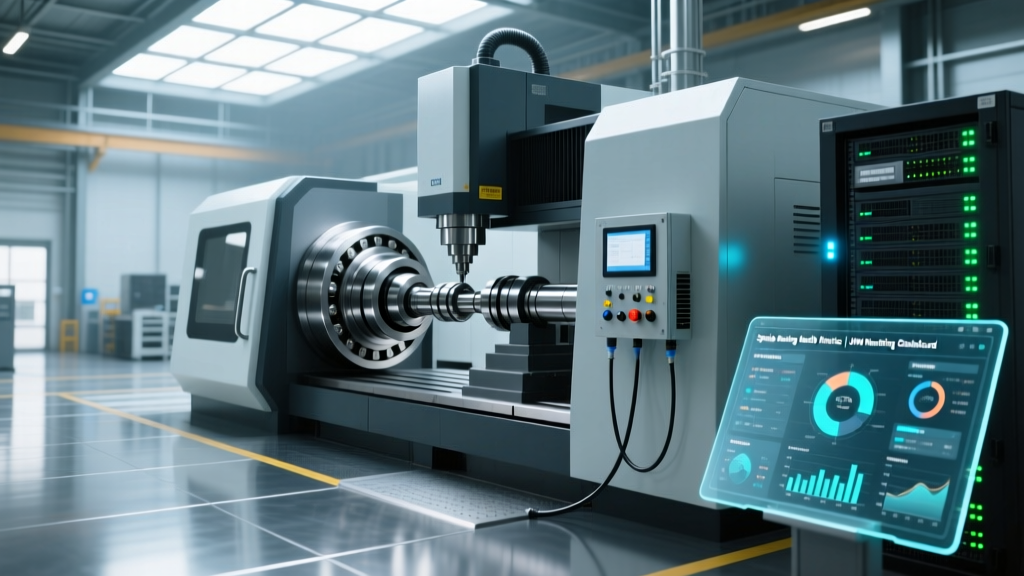
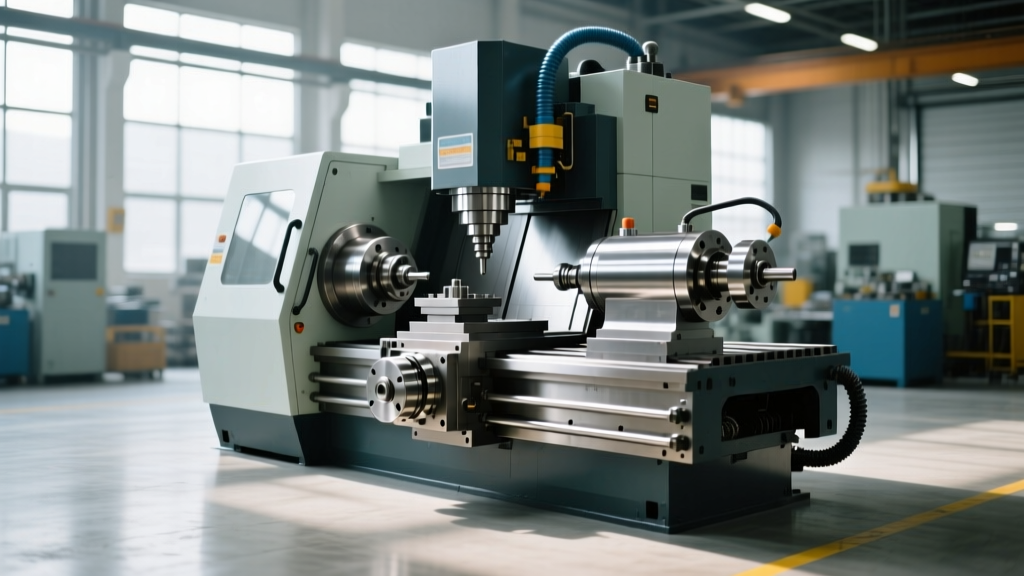
Thermal displacement remains the primary adversary of sub-micron CNC machining. When spindle bearings and gearboxes generate friction, the resulting heat causes asymmetric metal expansion, destroying part tolerances. To combat this, modern manufacturing relies on a Lube Oil Cooler (LOC) machine tool system. Far from a simple fluid reservoir, a 2026-era LOC unit is a closed-loop thermodynamic stabilizer that simultaneously lubricates high-speed bearings and extracts kinetic heat.
Core LOC System Parameters (Standard 5kW Spindle Chiller)• Temperature Stability: ±0.1°C at ambient 20°C
• Flow Rate: 8 to 25 L/min (variable displacement)
• Operating Pressure: 2.5 to 4.5 bar
• Filtration: 10-micron absolute, β10 ≥ 200
• Refrigerant: R-410A or R-32 (low GWP variants)
Thermodynamics and Flow Specifications in LOC Systems
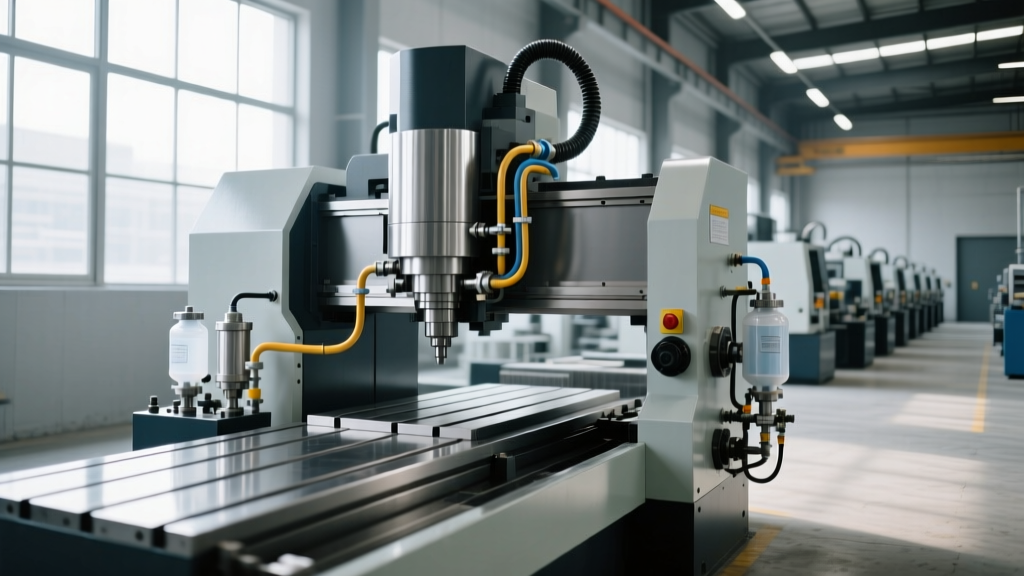
A LOC machine tool setup operates on a dual-circuit principle. The primary circuit pushes ISO-grade oil through the spindle labyrinth seals and gearbox bearings, absorbing convective heat. The secondary circuit utilizes a vapor-compression refrigeration cycle to chill a plate heat exchanger or shell-and-tube condenser, stripping the heat from the oil before it returns to the reservoir.
Current inverter-driven scroll compressors modulate their speed via pulse-width modulation (PWM) signals from the machine's PLC. Instead of cycling on and off—which causes micro-fluctuations in oil temperature—these compressors run continuously at varying speeds. Modern LOC units utilize PT1000 RTD (Resistance Temperature Detector) sensors with a resolution of ±0.01°C, ensuring the oil entering the spindle is matched exactly to the ambient room temperature or a fixed setpoint (typically 22.0°C).
The Danger of Flow Starvation
Flow rate is just as critical as temperature. High-speed ceramic hybrid bearings (e.g., 24,000 RPM HSK-A63 spindles) require an oil-air or liquid oil jet flow of at least 12 L/min to prevent hydrodynamic film collapse. If the LOC pump experiences cavitation due to clogged suction strainers, the oil film thins, leading to metal-on-metal contact and catastrophic bearing seizure within minutes.
ISO VG Viscosity Selection Matrix
Selecting the correct fluid is non-negotiable. Using an incorrect viscosity alters the Reynolds number inside the cooling channels, reducing the heat transfer coefficient and causing localized boiling. According to Machinery Lubrication's ISO Viscosity Guide, matching the ISO VG grade to the spindle's operating speed (dn value) and ambient conditions is mandatory for thermal stability.
| ISO VG Grade | Kinematic Viscosity (40°C) | Target Application | Spindle Speed (dn Value) |
|---|---|---|---|
| VG 10 | 9.0 - 11.0 cSt | Ultra-high-speed spindles, oil-air lube | > 1.5 million |
| VG 32 | 28.8 - 35.2 cSt | Standard CNC milling spindles, gearboxes | 500k - 1.5 million |
| VG 68 | 61.2 - 74.8 cSt | Heavy-duty slideways, low-speed high-torque gears | < 500,000 |
For facilities running multi-axis machining centers with integrated gearboxes, synthetic ester-based VG 32 fluids are highly recommended over mineral oils. Synthetics resist oxidative sludge formation at high thermal loads, extending fluid life by up to 300%.
Precision Maintenance and Flush Schedules
Neglecting the LOC system leads to varnish buildup on the heat exchanger plates, insulating them and destroying cooling efficiency. As detailed in SKF's industrial lubrication systems documentation, proactive maintenance of oil conditioning units prevents up to 70% of premature spindle failures. Below is the exact maintenance matrix for a standard 5kW to 10kW LOC unit.
⚠ Critical Warning: Filter Bypass ValvesMost LOC spin-on filters feature an internal bypass valve set to 3.5 bar. If the filter clogs and the differential pressure exceeds 3.5 bar, the valve opens, sending unfiltered, particle-laden oil directly into the spindle bearings. Never ignore a differential pressure gauge reading in the yellow or red zone.
Daily & Weekly Inspections
- Fluid Level: Verify sight glass is in the upper third. Low fluid introduces air into the pump suction line, causing cavitation.
- Temperature Delta: Check the PLC readout. The supply and return lines should show a ΔT of 2.0°C to 4.0°C under load. A ΔT < 1.0°C indicates the spindle is not generating heat (possible lube failure), while ΔT > 6.0°C indicates the LOC compressor is undersized or failing.
- Acoustic Check: Listen to the gear pump. A high-pitched whine indicates suction starvation; a grinding noise indicates bearing wear in the pump head.
1,000-Hour (or 6-Month) Service
- Filter Replacement: Swap the 10-micron return line filter. Cost: $65 - $120 per element. Do not clean and reuse paper-cellulose elements.
- Suction Strainer: Remove the brass mesh suction strainer from the reservoir and wash with a non-chlorinated solvent. Reinstall with a new O-ring to prevent air ingress.
- Fluid Analysis: Draw a 100ml sample. Test for ISO 4406 cleanliness code (target: 16/14/11 or better) and water content (Karl Fischer titration, target < 50 ppm).
4,000-Hour (or 24-Month) Overhaul
- Complete Fluid Flush: Drain the reservoir. Use a low-viscosity flushing oil (VG 10) circulated at high velocity for 4 hours to strip varnish from the lines. Drain and refill with fresh synthetic VG 32. Cost: $250 - $400 for fluid and flushing agents.
- Heat Exchanger Descaling: If the refrigerant-to-oil ΔP has increased by 15%, the plate heat exchanger is fouled. Flush the oil side with a specialized solvent to dissolve carbon deposits.
- Pump Coupling Inspection: Check the elastomer spider coupling between the electric motor and the gear pump. Replace if cracked or compressed beyond 2mm.
Diagnostic Decision Tree for Thermal Drift Errors
When a CNC machine throws a thermal displacement alarm or parts begin measuring out of tolerance after 4 hours of runtime, the LOC system is the primary suspect. Use this diagnostic framework to isolate the failure mode:
- Is the LOC compressor running continuously without reaching the setpoint?
- Yes: Check refrigerant charge. A low charge causes the evaporator to starve. Look for oil stains on the Schrader valves. Recharge to manufacturer spec (typically 1.2kg to 2.5kg of R-410A).
- No (compressor is short-cycling): The high-pressure safety switch is tripping. Clean the condenser fins on the rear of the LOC unit. Shop dust and oil mist frequently clog these fins, preventing heat rejection.
- Is the oil temperature stable, but the spindle is still overheating?
- Yes: The LOC is functioning, but the spindle internal coolant jacket is blocked. Disconnect the supply and return hoses at the spindle manifold and blow compressed air (regulated to 2 bar) through the jacket to dislodge trapped debris or congealed grease.
- Is the oil temperature fluctuating by more than ±0.5°C?
- Yes: The PT1000 sensor is likely failing, or the solid-state relay (SSR) controlling the compressor clutch is sticking. Test the sensor resistance with a multimeter (should be ~1000 ohms at 0°C). Replace the SSR if output voltage is erratic.
"In 5-axis aerospace milling, a 1°C thermal drift in the spindle housing can translate to 15 microns of Z-axis growth at the tool tip. The LOC system isn't just cooling the oil; it is actively holding the geometric truth of the machine." — Lead Applications Engineer, Precision Spindle Dynamics.
Component Replacement Economics
When components fail, understanding the replacement economics prevents unnecessary full-unit teardowns. A complete 5kW LOC replacement from OEMs like Showa Denki or Hahn+Kolb ranges from $6,500 to $9,200. However, rebuilding the unit in-house is highly viable. A replacement variable-speed gear pump head costs between $850 and $1,400. Inverter boards for the compressor motor typically run $450 to $700. By maintaining a strict 4,000-hour flush schedule, shops routinely extend the operational life of the primary LOC compressor well past 40,000 hours, yielding a massive ROI on the initial capital equipment cost.
Mastering the technical specifications and maintenance rhythms of your LOC machine tool system transforms it from a hidden utility into a competitive advantage, ensuring your spindles run cooler, faster, and with absolute dimensional repeatability.