Spindle Bearing Configs: IoT Edge & Java Virtual Machine Monitoring Tool
Guide to selecting CNC spindle bearing configurations and integrating IoT edge gateways with a java virtual machine monitoring tool for smart shops.
The Convergence of Precision Mechanics and Edge Computing
Selecting the correct spindle bearing configuration for a CNC machining center is no longer strictly a mechanical decision. In modern smart manufacturing environments, the physical spindle assembly is inextricably linked to the digital telemetry it generates. High-precision spindles equipped with embedded piezoelectric vibration sensors and thermal probes produce massive streams of high-frequency data. Processing this data at the edge—before it reaches the cloud or local SCADA systems—requires robust industrial PCs (IPCs) running complex middleware.
For equipment buyers and maintenance engineers, this means evaluating a spindle system requires a dual-lens approach: assessing the mechanical load capacities of the bearing configurations alongside the computational architecture required to monitor them. Because much of the industrial IoT (IIoT) edge middleware relies on Java-based stream processors (such as Eclipse Kura or Apache Kafka edge nodes), ensuring system stability requires deploying a dedicated java virtual machine monitoring tool to prevent garbage collection pauses from masking catastrophic bearing failures.
Mechanical Core: Spindle Bearing Configurations for 2026 Architectures
The heart of any machining spindle is its bearing arrangement. The choice of bearing dictates the spindle's maximum RPM, radial and axial rigidity, thermal generation, and ultimately, the surface finish of the machined part. When specifying a new spindle or planning a rebuild, buyers must choose between three primary configurations based on the machine's intended duty cycle.
1. Angular Contact (AC) Ball Bearings
Angular contact bearings are the standard for high-speed milling and turning spindles. They are designed to handle combined radial and axial loads. The contact angle—typically 15° (designation C) or 25° (designation AC)—determines the axial rigidity. A 15° angle favors higher speeds and lower heat generation, while a 25° angle provides superior axial stiffness for heavy cutting forces. Modern configurations frequently utilize hybrid ceramic designs, where the rolling elements are made of silicon nitride (Si3N4). Ceramic balls are 40% lighter than steel, reducing centrifugal forces at high RPMs, and they provide electrical insulation that prevents electrical discharge machining (EDM) fluting caused by stray VFD currents.
2. Cylindrical Roller (CR) Bearings
For heavy-duty machining, such as roughing operations on titanium or Inconel, radial rigidity is paramount. Cylindrical roller bearings (typically NN or NNU series with a tapered bore for precision preload adjustment) offer massive radial load capacities. However, they cannot support axial loads. Therefore, CR bearings are almost always paired with double-direction angular contact thrust ball bearings to manage the Z-axis cutting forces.
3. Hydrostatic and Hydrodynamic Bearings
Reserved for ultra-precision grinding machines (e.g., Studer or Okamoto grinders), fluid-film bearings offer zero mechanical friction and infinite radial stiffness when pressurized. They eliminate the metal-to-metal contact inherent in rolling-element bearings, yielding sub-micron rotational accuracy. The trade-off is the requirement for a dedicated, highly filtered hydraulic power unit, which adds significant footprint and maintenance overhead.
Spindle Configuration Specification Matrix
| Bearing Type | Designation Example | Max Speed Factor (dmn) | Primary Load Capacity | Ideal Application |
|---|---|---|---|---|
| Hybrid Ceramic AC (15°) | FAG HC7014-E-T-P4S | 2,200,000+ | Moderate Radial / High Axial | High-speed aerospace aluminum milling |
| Steel AC (25°) | NSK 7020CTYNDBLP4 | 1,400,000 | High Radial / Very High Axial | General purpose CNC turning/milling |
| Cylindrical Roller (NN) | Schaeffler NN3020-AS-K-M-SP | 800,000 | Extreme Radial / Zero Axial | Heavy roughing, large bore boring |
| Hydrostatic Journal | Custom OEM Assembly | N/A (RPM limited by fluid shear) | Infinite Radial (Pressurized) | Ultra-precision cylindrical grinding |
The Telemetry Bottleneck: High-Frequency Sensor Data
When you purchase a smart spindle assembly—such as those integrated with Kistler piezoelectric sensors—you are acquiring a mechanical component that acts as a high-bandwidth data generator. A single triaxial accelerometer sampling at 100kHz to detect early-stage bearing raceway spalling generates roughly 1.2 megabytes of raw data per second.
Sending this raw telemetry to a centralized cloud server is economically and technically unfeasible due to latency and bandwidth costs. Instead, modern shops deploy Edge IPCs (like the Siemens SIMATIC IPC series or Beckhoff C6030) mounted directly inside or adjacent to the machine enclosure. These edge devices run local analytics models to detect anomalies, only transmitting summary alerts or compressed FFT (Fast Fourier Transform) spectrums to the central historian.
Edge Gateway Middleware and the Java Virtual Machine Monitoring Tool
The software stack running on these Edge IPCs frequently relies on Java-based frameworks. Platforms like Eclipse Kura, Apache Kafka (via edge gateways), or custom Spring Boot microservices are industry standards for ingesting, buffering, and routing MQTT and OPC-UA sensor data. However, Java's automatic memory management introduces a critical vulnerability in high-speed manufacturing environments: Garbage Collection (GC) pauses.
If a Java application ingesting 100kHz vibration data experiences a 'Stop-The-World' GC pause lasting just 50 milliseconds, it will drop 5,000 data samples. In the context of spindle health monitoring, a dropped packet during a high-frequency harmonic resonance event could mean the difference between the edge system triggering an emergency E-stop and the spindle suffering a catastrophic $45,000 crash.
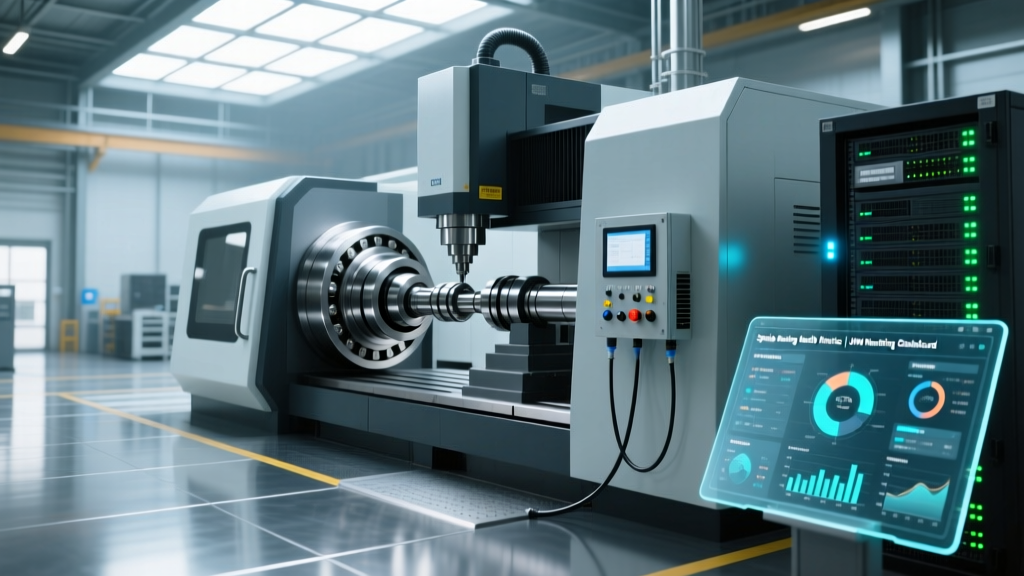
Critical IT/OT Integration Warning: When commissioning a smart spindle monitoring system, standard OS-level task managers are insufficient. You must deploy a dedicated java virtual machine monitoring tool (such as Datadog's JVM metrics suite, JVisualVM, or AppDynamics) on the edge gateway. This allows engineers to monitor heap memory allocation rates, tune the ZGC (Z Garbage Collector) or Shenandoah parameters for sub-millisecond pause times, and ensure the middleware does not bottleneck the physical sensor data.By utilizing a comprehensive JVM metrics dashboard, maintenance teams can correlate spikes in Java heap memory usage with specific spindle operational states, ensuring the software layer never compromises the mechanical safety layer.
Buyer’s Decision Framework: Matching Bearings to IT Architecture
Selecting the right spindle requires aligning the mechanical bearing configuration with the appropriate edge computing hardware and software monitoring stack. Use the following framework when evaluating vendor proposals:
- Scenario A: High-Speed Finishing (15,000+ RPM)
Mechanical: Hybrid Ceramic Angular Contact (15°).
Sensor Requirement: High-frequency piezoelectric accelerometers (50kHz+ sampling).
Edge IT Requirement: High-performance IPC (Intel Core i7/i9 or equivalent), running Kafka edge nodes. Mandatory deployment of a java virtual machine monitoring tool to tune G1GC pause times and prevent buffer overruns during high-speed data ingestion. - Scenario B: Heavy Duty Roughing (Low RPM, High Torque)
Mechanical: Cylindrical Roller paired with Thrust Bearings.
Sensor Requirement: Low-frequency strain gauges and acoustic emission (AE) sensors for tool breakage detection.
Edge IT Requirement: Standard industrial PLC or low-power edge gateway (ARM-based). Basic MQTT brokers (C/C++ based) are often sufficient, reducing the strict necessity for JVM monitoring unless higher-level enterprise middleware is mandated. - Scenario C: Ultra-Precision Grinding
Mechanical: Hydrostatic Bearings.
Sensor Requirement: Fluid pressure transducers, thermal probes, and nanometer-resolution displacement sensors.
Edge IT Requirement: Real-time OS (RTOS) or specialized deterministic edge controllers (e.g., Beckhoff TwinCAT) rather than standard Java-based IPCs, as fluid-film stability requires microsecond-level deterministic control loops.
Total Cost of Ownership: Mechanical vs. Digital Integration
When budgeting for a smart spindle upgrade or a new 5-axis machining center in 2026, buyers must look beyond the mechanical bill of materials. A set of super-precision Schaeffler FAG angular contact bearings (e.g., B7014 series) typically costs between $1,400 and $2,200 per set. However, the labor and machine downtime for a professional spindle rebuild in a cleanroom environment will add $3,500 to $6,000 to the total mechanical cost.
On the digital side, outfitting the machine with an industrial edge IPC capable of handling the telemetry costs roughly $2,800 to $4,500. The licensing for enterprise-grade IoT platforms and the associated java virtual machine monitoring tool subscriptions can add $1,200 to $3,000 annually per machine node. While the digital integration adds 20% to 30% to the initial spindle system capital expenditure, the ROI is realized by shifting from time-based spindle rebuilds (e.g., every 8,000 hours) to strictly condition-based maintenance. Catching a failing bearing cage via edge-computed vibration FFT analysis before it scores the spindle housing can save $15,000+ in secondary mechanical damage and weeks of lead-time downtime.
Final Procurement Directive
Do not evaluate spindle bearings in a vacuum. Request that your machine tool builder or spindle rebuild vendor provide the exact data output specifications (sampling rate, protocol, and bandwidth requirements) of their integrated sensors. Simultaneously, consult with your IT/OT integration team to ensure the edge gateway architecture is provisioned correctly, and that a java virtual machine monitoring tool is integrated into the deployment pipeline to safeguard the continuous flow of critical machine health data.