Safe CNC Retrofit Options: The Consolidated Machine and Tool Guide
Explore CNC retrofit options for manual lathes and mills through the lens of safety compliance, featuring Consolidated Machine and Tool standards.
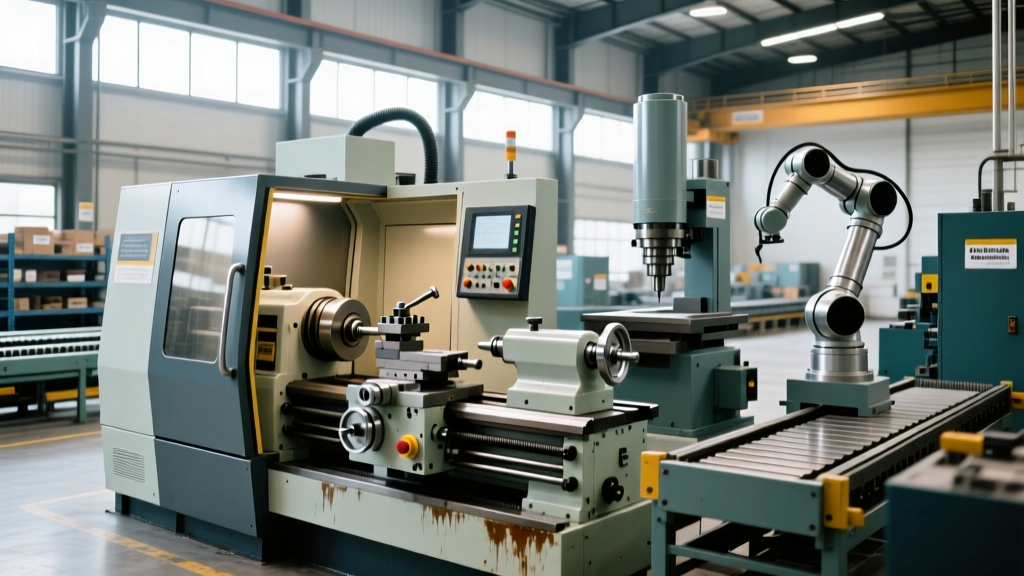
Retrofitting a manual Bridgeport mill, South Bend lathe, or surface grinder with CNC controls bridges the gap between legacy cast-iron rigidity and modern machining precision. However, stripping a manual machine of its human-operated levers and replacing them with automated servo or stepper drives introduces severe kinetic hazards. When evaluating CNC retrofit options, machine shops must look beyond axis resolution and spindle speed. Adopting the rigorous safety compliance benchmarks championed by industry leaders like Consolidated Machine and Tool is essential to avoid catastrophic failures and regulatory penalties.
As of 2026, OSHA enforcement regarding automated machinery retrofits has intensified. A machine that was legally compliant as a manual tool in 1985 becomes a completely different legal entity once automated. This guide details the technical and regulatory requirements for executing a safe, compliant CNC retrofit.
⚠️ Compliance Warning: Under OSHA 29 CFR 1910.212, the employer is legally responsible for ensuring that retrofitted machinery meets current guarding and control reliability standards. Simply bolting on a hobbyist CNC kit without integrating hardwired safety interlocks is a citable offense.The Compliance Gap in Legacy Retrofits
Manual machines were designed with the assumption that a human operator was physically manipulating the handwheels, providing an inherent "hands-on" safety loop. When you introduce a CNC controller, the operator steps away from the immediate cutting zone, relying on the machine's software to manage limits and faults.
The most common failure mode in budget retrofits is relying on software-based E-stops. If the PC crashes, the USB interface locks up, or the breakout board shorts out, a software E-stop command will fail to execute. True compliance requires a dual-channel, hardwired safety circuit that physically removes power from the motor drives, independent of the CNC software's state.
Evaluating CNC Retrofit Controllers for Safety I/O
Not all CNC controllers are created equal when it comes to safety integration. When sourcing a kit, you must evaluate the native Input/Output (I/O) architecture for safety compliance. Below is a comparison of popular retrofit options based on their safety capabilities.
| Controller Platform | Native Safety I/O | E-Stop Integration Method | Approx. Base Cost (2026) | Compliance Rating |
|---|---|---|---|---|
| Centroid Acorn 5 | 8 Opto-isolated Inputs | Hardware relay cuts drive enable; software monitors state. | $1,295 | High (with external relay) |
| Fagor 8055i | Industrial PLC I/O | Native Safe Torque Off (STO) integration via drive protocols. | $4,800+ | Excellent (CE/UL ready) |
| Mach4 + Ethernet SmoothStepper | Dependent on 3rd party breakout board | Requires external safety relay to physically cut stepper/servo enable pins. | $650 (Software + Hardware) | Moderate (Requires custom wiring) |
| LinuxCNC (Mesa 7i76E) | Hardware FPGA I/O | ClassicLadder PLC logic can manage safety relays and watchdogs. | $450 (Hardware) | High (if programmed correctly) |
Hardwiring Safety: NFPA 79 and OSHA Mandates
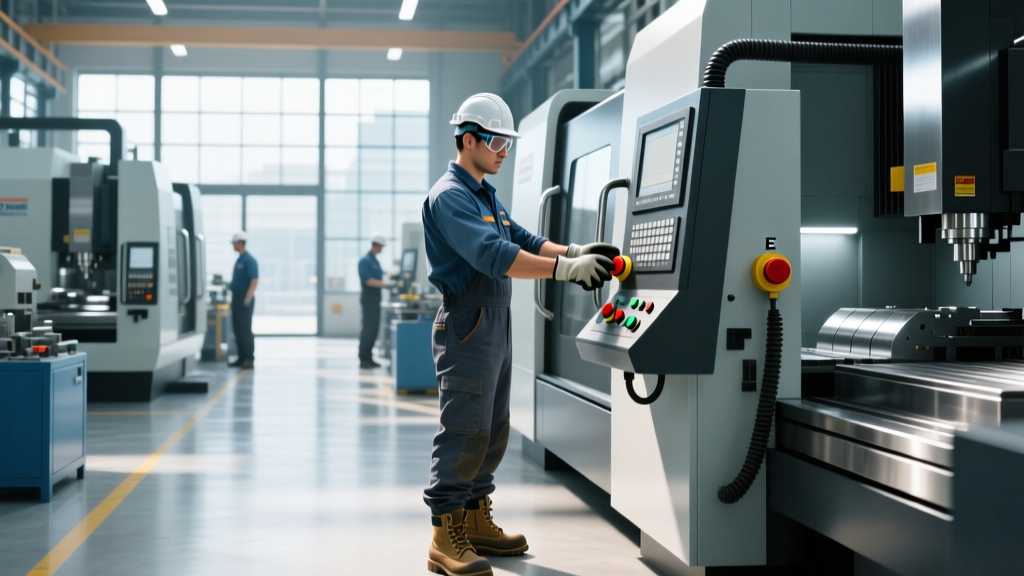
The electrical standard for industrial machinery, NFPA 79, dictates how E-stop circuits must be designed. You cannot simply wire a push-button switch to a 5V logic pin on a breakout board and call it an E-stop. You must use a dedicated, dual-channel safety relay.
Step-by-Step E-Stop Circuit Design
- Install Dual-Channel E-Stop Buttons: Use industrial-grade, twist-to-release E-stop buttons (e.g., Schneider Electric Harmony XB5) with two distinct Normally Closed (NC) contact blocks.
- Wire to a Safety Relay: Route both NC channels into a Category 3 / Performance Level D (PLd) safety relay, such as the Pilz PNOZ X2.8P or Allen-Bradley MSR127RP (approx. $250 - $350 per unit).
- Interrupt the Drive Enable: The safety relay's output contacts must be wired in series with the 24VDC "Enable" or "Servo On" pins on your servo/stepper drives. When the E-stop is pressed, the relay physically drops the 24V signal, triggering the drive's internal Safe Torque Off (STO) or coast-to-stop function.
- Monitor the Relay State: Wire a spare Normally Open (NO) auxiliary contact from the safety relay to an opto-isolated input on your CNC controller. This tells the software that an E-stop has occurred, allowing the GUI to update and halt the G-code interpreter safely.
Many retrofitters wire the E-stop to cut main AC power to the machine. On heavy CNC lathes with large spindle motors, cutting power causes the spindle to "coast" for several minutes due to rotational inertia. NFPA 79 requires controlled stopping. Use drives with dynamic braking or STO functions that engage internal braking resistors before removing control power.
Physical Guarding and Interlock Integration
According to OSHA Machine Guarding Guidelines, automated machines must be enclosed to prevent operators from reaching into the point of operation during the machining cycle. A retrofitted manual mill requires upgraded physical guarding.
- Polycarbonate Shields: Install minimum 3mm (1/8-inch) thick polycarbonate shields. Acrylic is strictly prohibited as it shatters into sharp shrapnel upon impact with broken tooling.
- Magnetic Safety Interlocks: Use coded magnetic safety switches (e.g., Schmersal BNS 260 or Omron D-Coded F39) on sliding doors. These must be wired into the safety relay circuit. If the door opens during a cycle, the safety relay trips, halting axis movement and spindle rotation.
- Defeat-Proof Design: The interlocks must be tamper-resistant. Standard limit switches with roller levers can be defeated with a piece of tape or a zip-tie, which is an immediate OSHA violation. Coded magnetic or RFID switches prevent simple defeat mechanisms.
Risk Assessment Framework (ISO 12100)
Before purchasing any retrofit components, conduct a formal risk assessment based on ISO 12100. Evaluate the machine across four vectors:
"A retrofit is not just an electrical upgrade; it is a fundamental change to the machine's risk profile. If you automate the Z-axis on a manual knee mill, you must account for the gravity-drop hazard if the servo loses holding torque. Mechanical brakes or counterbalance cylinders become mandatory safety devices, not just optional accessories."
— Machinery Safety Engineering Principles
The Risk Reduction Matrix
| Hazard Source | Risk Level (Pre-Retrofit) | Risk Level (Post-Retrofit) | Mandatory Mitigation Strategy |
|---|---|---|---|
| Spindle Entanglement | Medium (Manual proximity) | High (Automated, unattended) | Fixed polycarbonate guarding with interlocked access doors. |
| Axis Over-travel / Crash | Low (Human reaction time) | Critical (G-code error at rapid traverse) | Hardware limit switches wired to drive enable; software limits as secondary backup. |
| Chip Ejection / Coolant Spray | Low (Operator positioning) | High (Automated high-pressure coolant) | Full enclosure with splash-proof seals; mist collection integration. |
Cost Breakdown: Compliance vs. Liability
Machine shop owners often attempt to save money by skipping dedicated safety hardware during a retrofit. Below is a realistic 2026 pricing breakdown demonstrating that proper safety integration is a fractional increase compared to the base retrofit cost, but provides infinite ROI in liability protection.
- Base CNC Retrofit Kit (e.g., 3-axis Centroid Acorn): $1,295
- Servo Motors & Drives (3x 750W AC Servos): $1,800
- Proper Safety Relay (Pilz / Allen-Bradley): $285
- Coded Magnetic Door Interlocks (2x): $340
- Industrial E-Stop Stations (3x): $180
- Polycarbonate Guarding & Hardware: $450
Total Compliant Retrofit Cost: ~$4,350
Total "Hobbyist" Non-Compliant Cost: ~$3,095
The $1,255 delta between a hobbyist wiring job and a fully OSHA-compliant, Consolidated Machine and Tool standard-aligned installation is negligible when weighed against the average $15,000+ OSHA fine for unguarded automated machinery, not to mention the potential for severe operator injury.
Final Commissioning and Documentation
Once the retrofit is complete, compliance requires documentation. You must generate a new electrical schematic reflecting the safety relay circuit, update the machine's nameplate to reflect its new automated status, and create an operator manual detailing the E-stop testing procedures. Test the E-stop and door interlocks at the beginning of every shift, logging the results. By treating your manual-to-CNC retrofit as a formal industrial engineering project rather than a weekend hobby build, you ensure your shop remains safe, productive, and fully compliant.