Operator Training for E-Stops in the Manufacture of Machine Tools
Master operator training for safety interlocks and emergency stops. Learn best practices aligned with modern standards in the manufacture of machine tools.
The Gap Between OEM Design and Shop Floor Reality
When evaluating the manufacture of machine tools, original equipment manufacturers (OEMs) invest heavily in safety architecture. Engineers integrate dual-channel safety PLCs, such as the Allen-Bradley GuardLogix or Pilz PNOZ series, to ensure that every guard door, light curtain, and emergency stop (E-stop) button functions with absolute reliability. However, a critical disconnect frequently occurs between the engineering intent during the manufacture of machine tools and the actual behavior of operators on the shop floor.
Operator training often reduces safety interlocks to a simple "do not open" rule and E-stops to a big red button. This superficial understanding leads to dangerous workarounds, improper machine recovery, and unnecessary mechanical stress. Effective operator training must bridge this gap by teaching machinists not just what the safety devices do, but how they interact with the machine’s drive systems and why specific recovery protocols exist.
Training Core Objective
Operators must understand that safety interlocks are not merely administrative barriers; they are hardwired logic gates that dictate the power state of the machine’s servo drives and spindle motors. Defeating an interlock bypasses the safety PLC, exposing the operator to unshielded kinetic energy.
Decoding Stop Categories: Beyond the Red Button
A common training failure is teaching operators to use the E-stop button as a standard machine-off switch. This practice causes severe mechanical and electrical stress. According to ISO 13850, emergency stop functions are categorized by how they handle the removal of power. Operators must be trained to recognize the difference between these categories to select the correct stopping method for their specific situation.
| Stop Category | ISO 13850 Definition | Machine Tool Application | Operator Action |
|---|---|---|---|
| Category 0 | Uncontrolled stop (immediate power removal via hardware) | E-Stop button, main disconnect switch | Hit ONLY in life-threatening emergencies. Causes abrupt servo dropout and spindle coasting. |
| Category 1 | Controlled stop (decelerate via software, then remove power) | Spindle braking, axis servo halt routines | Used for standard cycle aborts. Power is cut only after motion completely ceases. |
| Category 2 | Controlled stop (decelerate, but drive power is maintained) | Feed hold, cycle pause, single-block stop | Used for tool inspection or clearing chips. Drives remain energized to hold axis position against gravity. |
Training operators to use the CNC control’s "Feed Hold" (Category 2) or "Cycle Stop" (Category 1) for routine interruptions preserves the lifespan of the machine’s contactors and prevents axis drift, reserving the Category 0 E-stop strictly for genuine emergencies.
Interlock Technologies and the Psychology of Defeat
During the manufacture of machine tools, OEMs select specific interlock technologies based on the risk assessment of the access point. Operators must be trained on the vulnerabilities of older systems and the robust nature of modern alternatives to understand why "tricking" the machine is becoming technologically impossible and highly dangerous.
Magnetic vs. RFID Coded Switches
Legacy machine tools often utilize simple magnetic reed switches for guard doors. A common, fatal shop-floor violation involves taping a spare magnet to the outside of the guard to trick the sensor into thinking the door is closed while the operator reaches inside to clear a chip jam.
Modern CNC lathes and machining centers now employ RFID-coded safety switches, such as the Pilz PSENcode series. These switches do not rely on magnetic fields; instead, they read a unique, encrypted digital signature from the actuator. If an operator attempts to defeat the interlock with a standard magnet or a piece of metal, the safety PLC will not recognize the signature and will maintain the Category 0 power removal state. Training must explicitly demonstrate this technology so operators realize that physical defeat vectors have been engineered out of the system.
Trapped Key Interlock Systems
For high-inertia machines like large vertical turning lathes or horizontal boring mills where the spindle takes minutes to coast to a halt, manufacturers integrate trapped key systems. The operator cannot physically remove the key to open the guard door until the spindle speed sensor confirms 0 RPM. Operators must be trained never to force the key mechanism, as doing so shears the internal pins and requires a complete lock replacement costing upwards of $1,200, alongside significant machine downtime.
OSHA Compliance Note: Under OSHA standard 1910.212(a)(1), one or more methods of machine guarding shall be provided to protect the operator and other employees in the machine area from hazards. Bypassing interlocks is a direct violation that shifts liability from the machine manufacturer to the shop floor supervisor and the individual operator. For comprehensive guidelines on machine guarding requirements, refer to the OSHA Machine Guarding overview.
The 4-Step E-Stop Recovery Protocol
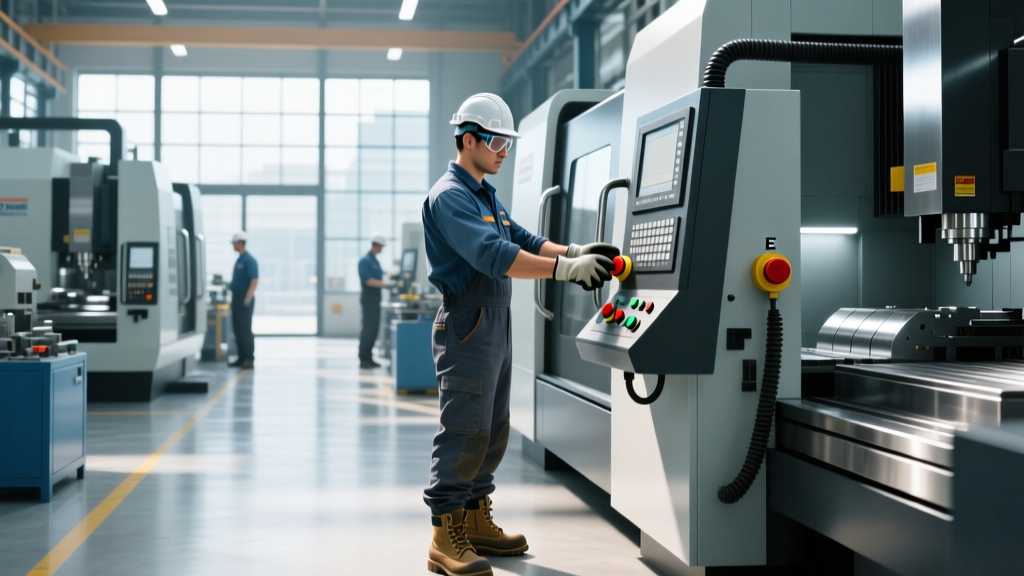
When an E-stop is activated, the machine’s safety circuit drops out, severing power to the motor contactors. Simply twisting the button to release it and pressing "Cycle Start" is a recipe for a machine crash or a severe injury. Operators must be drilled on the following recovery sequence:
- Identify and Resolve the Root Cause: Before releasing the E-stop button, the operator must physically verify why it was pressed. Was a tool breaking? Did a workpiece shift? Is a colleague in the machine envelope? Releasing the button while a hazard persists defeats the purpose of the safety architecture.
- Clear the Envelope and Close Guards: Ensure all personnel are outside the restricted envelope. Close all guard doors completely until the interlock actuator engages. If a door interlock is damaged, the machine must be locked out, not operated.
- Release and Reset the Safety Circuit: Twist the E-stop button to release the mechanical latch. Navigate to the CNC control’s safety diagnostics page and press the "Safety Reset" or "Fault Reset" softkey. This signals the safety PLC to re-energize the servo drives and spindle contactors.
- Re-establish Machine Coordinates: A Category 0 stop often results in the loss of absolute encoder positions if the machine relies on incremental encoders with battery backups. The operator must perform a manual reference point return (zero return) on all axes before resuming the program to prevent a rapid-traverse crash.
Daily Operator Verification Checklist
Safety systems are only effective if they are functional. While the manufacture of machine tools ensures high initial reliability, shop floor contaminants like coolant mist and fine metal swarf can degrade sensors over time. Operators must perform a 3-minute verification at the start of every shift.
Shift-Start Safety Verification Routine
- E-Stop Mechanical Check: Press the primary E-stop. Attempt to start the spindle via the control panel. The control should display a safety fault and refuse to start. Release and reset.
- Door Interlock Latency Test: Start the spindle at 500 RPM in MDI mode. Open the primary guard door. The spindle must begin braking immediately. Measure the time to full stop; if it exceeds the OEM specification (typically under 2.5 seconds for standard mills), the braking resistor or interlock wiring requires maintenance.
- Light Curtain Alignment (If equipped): Pass the standard test piece (usually a 14mm or 30mm diameter rod provided by the OEM) through the entire vertical plane of the light curtain. The machine must trigger an immediate stop at every point without blind spots.
- Emergency Stop Signage: Verify that the E-stop buttons are free of coolant buildup, grease, and physical obstructions that could prevent a rapid palm strike.
Fostering a Proactive Safety Culture
Ultimately, the safety features integrated during the manufacture of machine tools are only as effective as the humans operating them. Training should not be a one-time onboarding event but an ongoing dialogue. Supervisors must encourage operators to report "near misses" involving interlocks without fear of reprimand. If an operator notices that a specific guard door interlock is sticking and requiring excessive force to close, they must report it for maintenance immediately rather than resorting to a workaround.
By understanding the electrical logic, mechanical realities, and strict protocols governing E-stops and interlocks, operators transition from passive machine tenders to active safety managers. This depth of knowledge protects human life, preserves expensive machine tool assets, and ensures total compliance with modern manufacturing standards. For further reading on occupational safety in manufacturing environments, the NIOSH Machine Guarding resource center provides extensive data on hazard mitigation strategies.