Flood vs Mist Cooling: The Perfection Machine and Tool Standard
Explore 2026 coolant innovations comparing flood vs mist (MQL) systems. Learn the Perfection Machine and Tool standard for CNC retrofitting and fluid management.
The Economics of Thermal Management in 2026
Fluid management is no longer a secondary operational concern; it is a primary driver of CNC machining profitability. As shops strive to achieve the operational benchmark often referred to as the Perfection Machine and Tool standard—characterized by zero-waste fluid practices and maximum tool life—the debate between traditional flood coolant and Minimum Quantity Lubrication (MQL) mist systems has evolved. In 2026, the choice is not binary but highly application-specific, driven by advanced IoT sensors, new alloy compositions, and strict environmental compliance.
According to EPA guidelines on metalworking fluid (MWF) disposal, the hidden costs of flood coolant extend far beyond the initial purchase price. Disposal, tramp oil separation, and facility HVAC requirements for mist extraction can inflate total fluid lifecycle costs by up to 300%. Conversely, modern MQL systems have moved past the limitations of early 2010s aerosol delivery, utilizing precision piezoelectric valves to target the shear zone with microscopic accuracy.
2026 MWF Cost & Consumption Baseline:- Flood Coolant Disposal: $1.50 - $3.50 per gallon (hazardous waste rates)
- MQL Fluid Cost: $40 - $65 per gallon (consumed at 5-50 mL/hour)
- Tool Life Variance: MQL increases tool life by 20-40% in aluminum; Flood is mandatory for heavy-duty Inconel roughing.
The Core Physics: Vapor Barriers and Thermal Shock
To select the right system, machinists must understand the thermodynamics of the cutting zone. When machining at high surface speeds, the friction generates a localized vapor barrier. Traditional low-pressure flood coolant (under 150 PSI) often bounces off this barrier, failing to reach the tool-workpiece interface.
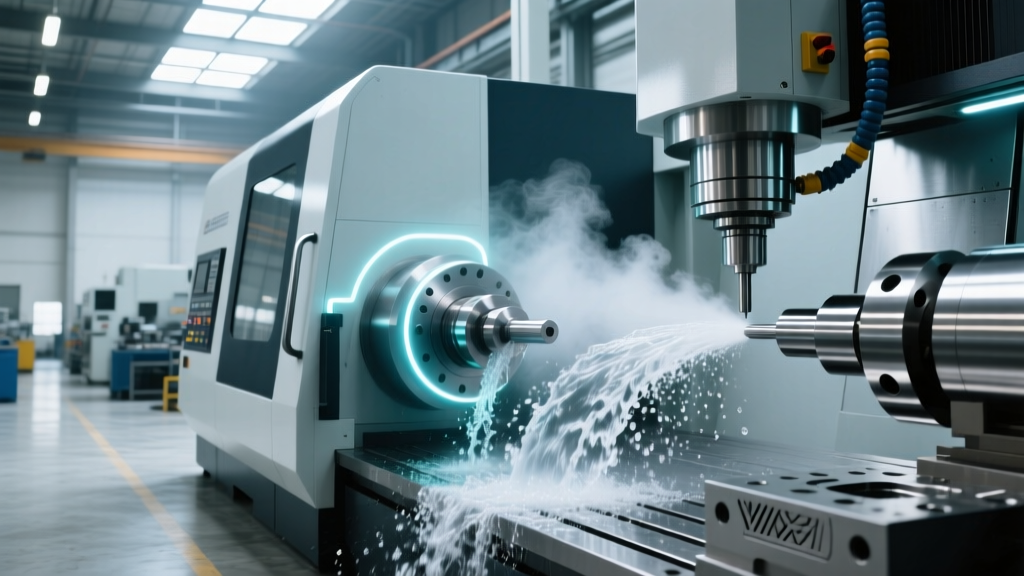
High-Pressure Coolant (HPC) systems, operating between 1,000 and 4,000 PSI, penetrate this vapor shield. This is critical when machining titanium Ti-6Al-4V or Inconel 718, where thermal shock is required to break the chip into manageable segments, preventing the long, stringy chips that weld to carbide flutes. However, applying HPC to softer materials like 6061 aluminum or free-machining brass causes unnecessary thermal cycling, accelerating micro-chipping on the cutting edge.
This is where MQL excels. By delivering a precise aerosol of biodegradable ester-based oil (typically 10 to 30 mL per hour) directly to the shear zone, MQL eliminates thermal shock. The fluid vaporizes instantly upon contact, absorbing heat via phase change while providing boundary lubrication that reduces the coefficient of friction. Sandvik Coromant's research on cutting fluids confirms that boundary lubrication via MQL significantly reduces built-up edge (BUE) in sticky, ductile materials.
Decision Matrix: Material and Operation Routing
Adopting the Perfection Machine and Tool methodology requires routing specific operations to their optimal cooling medium. Use the following framework to audit your shop floor:
| Material | Operation | Optimal System | Delivery Specs | Edge Case / Warning |
|---|---|---|---|---|
| Inconel 718 | Heavy Roughing | High-Pressure Flood | 1,500+ PSI, Through-Tool | MQL will fail; chips will weld and snap inserts. |
| Ti-6Al-4V | Finish Milling | Smart Flood / MQL | External MQL (30 mL/hr) or 300 PSI Flood | Ensure mist extraction captures titanium dust (fire hazard). |
| 6061 / 7075 Al | High-Speed Routing | MQL (Mist) | 10-15 mL/hr, Air pressure 60 PSI | Flood causes thermal shock and micro-chipping of polished flutes. |
| 304 Stainless | Deep Hole Drilling | Through-Tool Flood | 1,000 PSI minimum | MQL cannot evacuate chips from deep blind cavities. |
| Cast Iron (G2) | Face Milling | Dry / Compressed Air | N/A (Air blast only) | Liquid coolant creates abrasive 'sludge' that destroys way covers. |
Smart Coolant Delivery: IoT and Adaptive Nozzles
The most significant innovation in 2026 is the integration of adaptive coolant delivery. Legacy MQL systems relied on manual needle valves, requiring operators to guess the optimal flow rate. Modern setups utilize closed-loop IoT sensors that monitor spindle load and acoustic emissions in real-time.
Systems like the Unist Uni-Roller or advanced Accu-Lube digital controllers now interface directly with the CNC's PLC via EtherCAT. If the spindle load spikes during a cornering maneuver in a hardened steel die, the system automatically increases the MQL pulse frequency from 50 Hz to 120 Hz for exactly 1.4 seconds, preventing thermal damage without flooding the enclosure. This level of granular control is a hallmark of top-tier precision facilities.
Retrofitting Legacy CNCs for MQL
Upgrading a standard 2018-era Haas VF-2 or DMG Mori NLX to MQL standards requires addressing both fluid delivery and chip evacuation. Follow this strict retrofit sequence:
- Spindle Union Upgrade: External MQL nozzles are insufficient for 5-axis work due to nozzle shadowing. Install a Deublin through-spindle air/oil union to deliver MQL directly through the tool holder.
- Fluid Selection: Use a high-flashpoint, low-viscosity ester oil (e.g., Accu-Lube LB-2000). Avoid petroleum-based oils which leave sticky residues on linear scales and way covers.
- Enclosure Sealing & Extraction: MQL creates a fine aerosol. You must install a high-static-pressure mist collector (e.g., Filtermist or Losma) rated for at least 800 CFM to comply with OSHA's permissible exposure limits (PEL) for airborne MWFs.
- Chip Conveyor Calibration: Flood coolant naturally washes chips away. With MQL, chips remain dry and can jam standard hinge-belt conveyors. Retrofit with a scraper-type conveyor or install programmable air-blast nozzles inside the enclosure to direct chips to the trough.
Maintenance Realities: Concentration and Tramp Oil
For shops that must retain flood coolant for heavy roughing, the Perfection Machine and Tool standard mandates rigorous fluid chemistry management. A neglected sump destroys tool life and causes operator dermatitis.
Critical Maintenance Metrics for Flood Systems:- Concentration: Maintain 6-8% for synthetic fluids, 8-10% for semi-synthetic. Always multiply your refractometer reading by the fluid's specific multiplier (often 1.5x to 2.0x).
- pH Levels: Keep between 8.8 and 9.4. A drop below 8.5 indicates bacterial growth and requires immediate biocide treatment.
- Tramp Oil Skimming: Run an Abanaki belt skimmer continuously during non-cutting hours (nights/weekends) to remove way lube before it emulsifies into the coolant.
Common Failure Modes and Edge Cases
Even with advanced systems, shops encounter specific failure modes when transitioning cooling strategies:
- MQL Nozzle Clogging: Using compressed air that is not filtered to 0.01 microns introduces moisture and particulate into the MQL lines, emulsifying the ester oil inside the delivery tubes and causing catastrophic blockages.
- Thermal Expansion in Finishing: Switching from flood to MQL on a legacy machine without compensating for the lack of thermal mass can cause the casting to expand differently, throwing off bore tolerances by up to 0.0004 inches over a 4-hour cycle.
- Residue on Fixtures: Poorly formulated MQL fluids leave a varnish-like residue on tombstones and hydraulic clamps, eventually causing fixture actuation failures. Always perform a 72-hour evaporation test on a glass slide before committing to a new MQL fluid brand.
Mastering the transition between flood and mist cooling requires abandoning the 'one-size-fits-all' mentality. By aligning your fluid delivery mechanics with the specific thermodynamic requirements of your workpiece materials, your shop can drastically reduce disposal liabilities while achieving the surface finishes and tool longevity demanded by modern aerospace and medical manufacturing sectors.