Spindle Costs & Machine Tool Table Dimensions Measurement Units
Analyze 2026 costs for spindle bearing configurations and the hidden budget impacts of machine tool table dimensions measurement units in CNC retrofits.
The Hidden Financial Risks of Machine Tool Envelope and Spindle Mismatches
When budgeting for a CNC machine tool procurement, retrofit, or major spindle rebuild, shop owners and manufacturing engineers typically focus on the spindle's RPM and torque curves. However, a frequently overlooked variable that can derail a project's ROI is the interplay between the spindle's dynamic capabilities and the physical reality of the machine's work envelope. Specifically, machine tool table dimensions measurement units—the physical T-slot spacing, travel limits, and the metric or imperial standards governing them—dictate workholding compatibility, fixture costs, and metrology integration.
Upgrading to a high-speed ceramic hybrid spindle is a wasted capital expenditure if the table's measurement units and dimensional standards require expensive custom adapter plates for your existing workholding. This analysis breaks down the 2026 cost realities of spindle bearing configurations and the hidden budget traps associated with table dimension measurement standards.
The Metric-Imperial Trap: Table Dimensions and Measurement Units
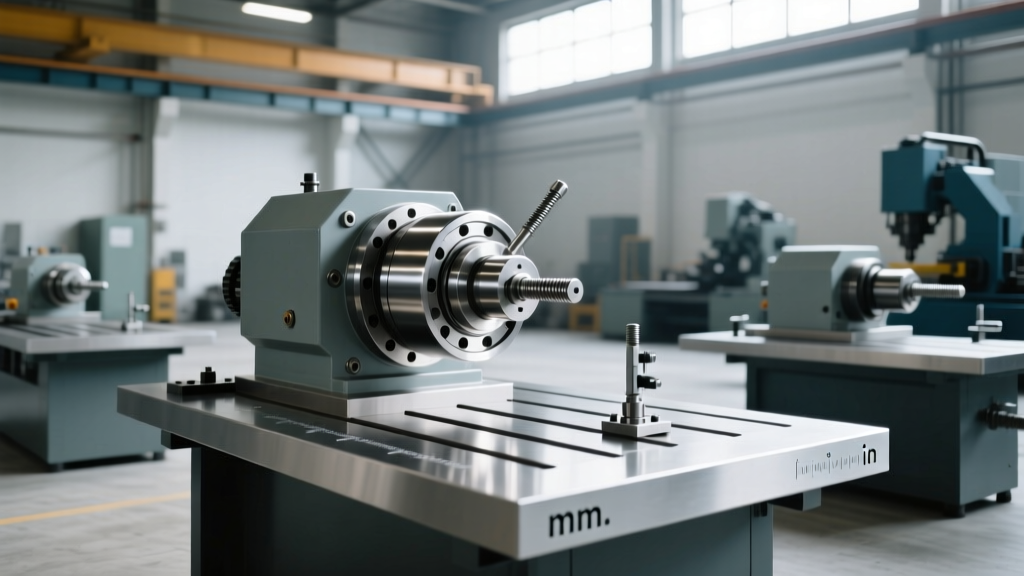
The phrase machine tool table dimensions measurement units refers to two distinct but related cost factors: the physical dimensions of the table (T-slot width and spacing) and the underlying measurement system (metric millimeters vs. imperial inches) used by the machine's linear scales and ball screws.
T-Slot Standards and Workholding Adaptation Costs
European and Japanese machining centers (e.g., DMG Mori, Makino, Okuma) predominantly utilize metric T-slots governed by DIN 650 standards (commonly 14mm, 18mm, or 22mm). American legacy machines (e.g., Bridgeport, older Haas models) rely on ANSI/ASME B5.1 imperial standards (5/8"-11, 3/4"-16, or 1"-8).
If a North American job shop purchases a used Japanese vertical machining center (VMC) with an 18mm T-slot table to take advantage of a high-rigidity spindle, their existing inventory of imperial Kurt DX6 vises and standard 5/8" step blocks will not fit.
- Custom Stepped T-Nuts: Machining or sourcing custom 18mm-to-3/4" adapter T-nuts costs between $120 and $250 per set of four.
- Adapter Sub-Plates: To avoid swapping T-nuts for every setup, shops often machine custom 1-inch thick aluminum or steel sub-plates with metric slots on the bottom and imperial slots on the top. A 40" x 20" custom ground sub-plate costs $2,800 to $4,500, effectively reducing the machine's Z-axis clearance by an inch and altering the spindle's dynamic deflection characteristics.
Linear Scale and Ball Screw Unit Conversions
Beyond physical slots, the native measurement units of the machine's feedback systems impact budget planning. If a machine features metric pitch ball screws (e.g., 10mm pitch) and metric glass linear scales (e.g., Heidenhain LS series), but the shop's CAM software, CMM inspection equipment, and operator workflows are strictly imperial, the reliance on G-code G20/G21 conversion commands introduces rounding errors.
Over long toolpaths, converting millimeters to inches at the controller level can result in a 0.0002" to 0.0005" tolerance stack-up, which is unacceptable for aerospace or medical machining. Retrofitting absolute linear scales to output native imperial signals, or replacing the ball screws with imperial-pitch equivalents to match a high-precision spindle upgrade, adds $3,500 to $6,000 per axis to the retrofit budget.
Spindle Bearing Configurations: Capital vs. Maintenance Expenditure
The spindle is the heart of the machine tool. The bearing configuration dictates not only the initial purchase price but the mean time between failures (MTBF) and the cost of inevitable rebuilds. According to SKF's super precision bearing engineering data, the choice between steel, ceramic, and hydrostatic bearings radically alters the total cost of ownership.
Standard Steel Angular Contact Bearings (ABEC-7 / ABEC-9)
Standard grease-packed or oil-air lubricated steel angular contact ball bearings (e.g., SKF 7014 CD/P4A) are the workhorses of general-purpose VMCs. They offer high axial rigidity for heavy face milling but are limited by thermal expansion at high RPMs.
- Initial Spindle Cost: $12,000 - $18,000
- Rebuild Cost (2026 Market Rates): $4,500 - $7,000 (including cleanroom labor, new bearings, and dynamic balancing).
- MTBF: 8,000 to 12,000 hours under standard cutting loads.
Ceramic Hybrid Bearings (Silicon Nitride Si3N4)
Ceramic hybrid spindles utilize silicon nitride balls with steel inner and outer races. Because ceramic balls are 40% lighter and possess a lower coefficient of thermal expansion, these spindles can run 30% to 50% faster than all-steel equivalents without suffering from centrifugal force-induced preload loss. This is the preferred configuration for high-speed aluminum aerospace structuring.
- Initial Spindle Cost: $22,000 - $35,000
- Rebuild Cost: $11,000 - $16,000. Ceramic bearings themselves are roughly 2.5x the cost of precision steel bearings.
- MTBF: 15,000 to 25,000 hours. The longer lifespan often offsets the higher initial capital expenditure in 24/7 production environments.
Hydrostatic Bearing Systems
Hydrostatic spindles use a pressurized film of oil to suspend the rotating shaft, meaning there is zero metal-to-metal contact. This provides near-infinite radial stiffness and exceptional vibration damping, making them mandatory for hard-milling, mold-and-die finishing, and precision jig boring. As noted in Sandvik Coromant's milling dynamics research, extreme damping is required to prevent chatter when utilizing long-overhang tooling in deep cavity milling.
- Initial Spindle Cost: $65,000 - $120,000+
- Maintenance Cost: Spindle bearings rarely wear out. Maintenance costs are shifted to the hydraulic pump unit, chiller systems, and oil filtration (approx. $2,000 annually). However, if a crash occurs and the shaft scores the bearing journal, the entire spindle cartridge often requires replacement, costing upwards of $45,000.
When pairing a high-speed ceramic hybrid spindle with a machine table that utilizes metric measurement units (e.g., metric linear scales), ensure your CNC controller supports real-time thermal growth compensation. High-speed spindles generate significant Z-axis thermal growth. If the controller's compensation parameters are miscalibrated due to metric-to-imperial rounding errors in the macro variables, you will scrap expensive parts. Budget an additional $3,500 for a Renishaw or Blum laser tool setting and thermal calibration cycle integration.
2026 Cost Matrix: Spindle Rebuilds and Table Adaptations
The following matrix illustrates the compounded costs when upgrading a spindle while simultaneously addressing machine tool table dimensions measurement units mismatches on a standard 40-taper VMC.
| Budget Line Item | Standard Steel Spindle (Imperial Table) | Ceramic Hybrid Spindle (Metric Table Adaptation) | Hydrostatic Spindle (Full Metric Integration) |
|---|---|---|---|
| Spindle Cartridge / Rebuild | $6,500 | $14,500 | $85,000 (New Cartridge) |
| Custom T-Slot Adapter Sub-Plate | $0 (Native Fit) | $3,800 | $4,200 (Ground to 0.0001") |
| Linear Scale Unit Conversion | $0 | $4,500 (3-Axis) | $8,500 (Absolute Scales) |
| Thermal Compensation Calibration | $1,200 | $3,500 | $5,000 |
| Total Estimated Project Cost | $7,700 | $26,300 | $102,700 |
Strategic Budgeting Framework for Machine Tool Procurement
To prevent budget overruns, engineering managers must evaluate the spindle and the table as a single, interdependent system. Follow this decision framework before signing a purchase order or authorizing a retrofit:
- Audit the Workholding Inventory: Before buying a machine with metric table dimensions, calculate the exact cost of replacing or adapting your current vise and fixture inventory. If adaptation costs exceed 15% of the machine's purchase price, negotiate a custom imperial table as a factory option or source a different machine.
- Match Spindle RPM to Table Rigidity: Do not install a 24,000 RPM ceramic hybrid spindle on a machine with a worn, out-of-spec table. The high-frequency vibrations of high-speed machining will accelerate the degradation of loose T-slots and worn way covers, negating the precision benefits of the ceramic bearings.
- Standardize Metrology Early: Decide on the native measurement unit (metric vs. imperial) for the entire shop floor. Forcing a metric machine to operate in an imperial environment via G-code conversion is a hidden tax on programming time and inspection accuracy. Budget for native CAM post-processors and matching linear scales during the initial capital expenditure phase.
By treating machine tool table dimensions measurement units with the same financial scrutiny as spindle bearing configurations, manufacturing facilities can eliminate hidden adaptation costs, ensure metrological integrity, and achieve a predictable, rapid return on their machining investments.