Troubleshooting Flood vs Mist Cooling for Machine Tool Steel
Diagnose and fix coolant delivery issues in flood and mist systems. Learn optimal pressures, concentrations, and repairs for machine tool steel applications.
In the machining industry, the phrase machine tool steel carries a dual burden: it refers both to the high-alloy workpieces being cut (like D2, M2, and H13 tool steels) and the structural steel and cast-iron components of the CNC machine itself (beds, linear guides, and way covers). Managing coolant delivery across these two domains is one of the most frequent sources of shop-floor downtime. Flood cooling and Minimum Quantity Lubrication (MQL/mist) systems operate on entirely different fluid dynamics, and treating them interchangeably leads to catastrophic tool wear, thermal shock, and severe corrosion on the machine's structural steel.
This guide provides a diagnostic framework for troubleshooting coolant delivery failures, optimizing fluid concentrations, and repairing delivery hardware specifically for high-hardness tool steel applications.
WARNING: Thermal Shock in Interrupted CutsWhen machining high-carbon, high-chromium machine tool steel (e.g., D2 at 60 HRC), applying standard flood coolant during an interrupted cut (like milling a slotted die) will cause rapid thermal cycling. This leads to micro-cracking on the carbide insert edges. For interrupted cuts on hardened tool steel, switch to a high-pressure directed air blast or a precisely targeted MQL mist to maintain stable cutting zone temperatures without quenching the insert.
The Thermal Dynamics of Tool Steel Machining
Tool steels are notoriously poor conductors of heat. When turning or milling M2 high-speed steel or H13 hot-work steel, up to 80% of the generated heat remains trapped in the chip. If the coolant system fails to penetrate the tool-chip interface, the heat transfers into the workpiece, causing dimensional distortion, or into the cutting tool, causing rapid crater wear.
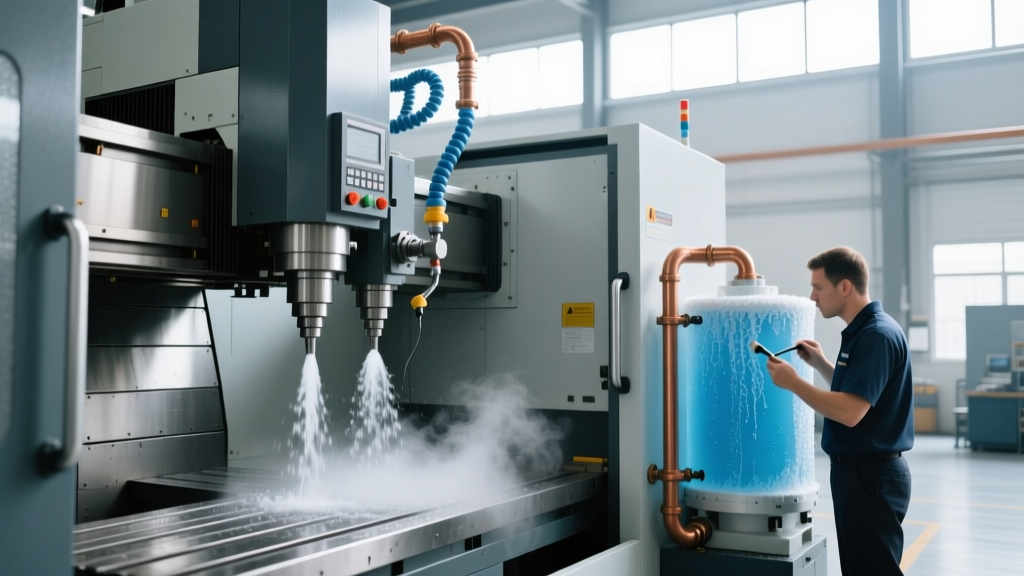
Flood systems rely on volume and velocity to cool the part and flush chips, while mist (MQL) systems rely on the latent heat of vaporization. A fluid droplet absorbing heat as it turns to gas removes significantly more thermal energy per milliliter than a liquid stream simply washing over a surface. Understanding which system your machine utilizes is the first step in diagnosing a thermal failure.
Flood Coolant Systems: Troubleshooting Flow, Pressure, and Chemistry
Flood systems are the default for heavy material removal on machine tool steel workpieces. However, they are highly susceptible to mechanical degradation and chemical imbalances that compromise their ability to protect both the cutting edge and the machine's steel bed.
Symptom-Cause-Fix Diagnostic Matrix
| Symptom | Root Cause | Corrective Action |
|---|---|---|
| Poor chip evacuation in deep cavities; chips welding to D2 steel workpiece. | Insufficient nozzle velocity; standard 40 PSI centrifugal pumps cannot break the vapor barrier at the cutting zone. | Retrofit with a high-pressure coolant pump (1,000–3,000 PSI) and use pinpoint carbide-tipped nozzles to penetrate the vapor shield. |
| Flash rust appearing on the machine tool steel bed and way covers within 24 hours. | Coolant pH has dropped below 8.0, or tramp oil has depleted the corrosion inhibitors. | Test pH daily (target 8.8–9.4). Install a centrifugal tramp oil skimmer and add a localized rust preventative additive if pH correction fails. |
| Cutting tool edge chipping prematurely; fluid appears milky and foul-smelling. | Bacterial infection consuming the emulsifiers, causing the fluid to split and lose lubricity. | Shock-treat the sump with a biocide. Check the refractometer concentration (target 8–10% Brix for heavy tool steel cutting) and ensure the fluid is not sitting stagnant over weekends. |
| Pump cavitation (loud rattling noise) and erratic coolant flow. | Clogged suction filter or fluid level too low, causing the pump to draw air. | Clean the primary sump screen. Check for fine tool steel swarf bypassing the conveyor and clogging the intake manifold. |
Calibrating for Tool Steel Concentrations
Machining abrasive machine tool steel requires higher lubricity than machining aluminum or mild steel. Operators frequently under-dose the sump, leading to poor surface finishes and accelerated tool wear.
- Draw a sample from the active cutting zone, not the stagnant sump corner.
- Measure Brix using a handheld optical refractometer.
- Apply the correction factor. If using a semi-synthetic fluid with a refractometer correction factor of 1.5, a reading of 6.0 Brix means your actual concentration is 9.0% (6.0 x 1.5). Maintain this actual concentration between 8% and 10% for heavy tool steel milling.
Mist (MQL) Systems: Diagnosing Atomization Failures
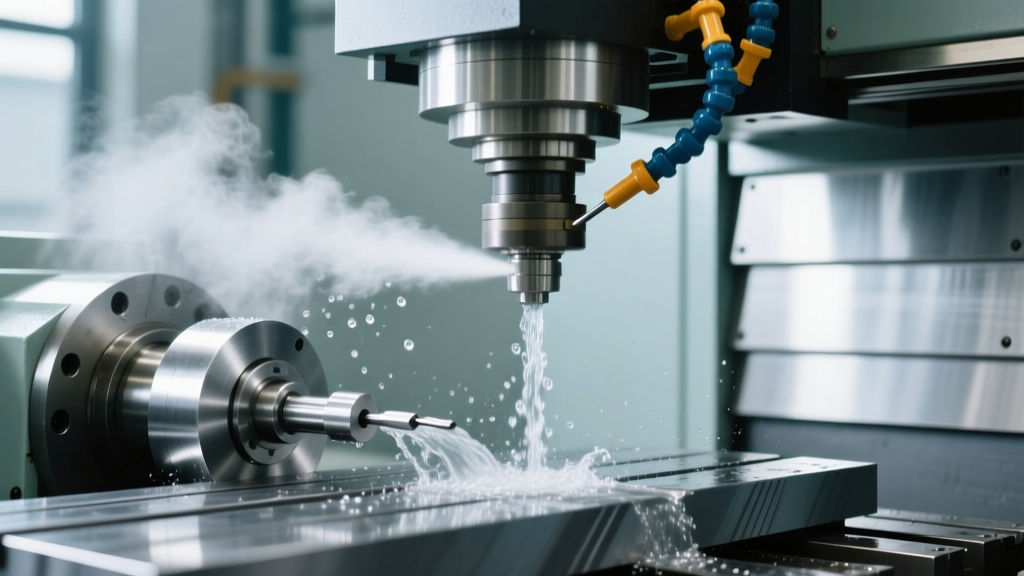
Minimum Quantity Lubrication (MQL) is increasingly adopted for machining machine tool steel due to the elimination of fluid disposal costs and the prevention of thermal shock. However, MQL systems are highly sensitive to air pressure fluctuations and nozzle geometry.
Data Highlight: MQL Droplet MetricsFor effective penetration into the cutting zone of hardened steel, MQL droplets must measure between 5 and 20 microns. Droplets larger than 30 microns behave like flood coolant (bouncing off the workpiece), while droplets smaller than 3 microns evaporate before reaching the tool edge.
Troubleshooting MQL Delivery Issues
Symptom: The tool is overheating, and the workpiece shows severe burn marks, but the MQL reservoir is barely depleting.
Diagnosis: The air-to-fluid ratio is skewed, or the coaxial nozzle is clogged with polymerized oil.
Step-by-Step Repair Flow:
- Verify Air Pressure: MQL systems require a stable, clean, and dry air supply. Check the machine's pneumatic regulator; it should be set between 4 and 6 bar (60–90 PSI). Fluctuations in shop air pressure will destroy the atomization siphon effect.
- Check Fluid Viscosity: MQL fluids are typically plant-based esters. If the shop temperature drops below 60°F (15°C), the ester thickens, preventing the micro-dosing pump from drawing fluid. Install a trace-heater on the fluid reservoir.
- Purge the Nozzle: Ester oils oxidize and form a hard varnish when exposed to the heat of the cutting zone and left sitting in the nozzle. Disconnect the nozzle and flush it with a specialized solvent or isopropyl alcohol to clear the micro-orifices.
Protecting the Machine Tool Steel Structure
While much focus is placed on the workpiece, the machine tool steel—the precision-ground beds, ball screws, and way covers—requires stringent coolant management. According to guidelines on metalworking fluid maintenance from the National Institute for Occupational Safety and Health (NIOSH), degraded fluids not only pose respiratory risks to operators but become highly acidic, actively eating away at the machine's structural steel.
When mist systems are improperly tuned, larger droplets escape the cutting zone and settle on the machine's linear guides. If the MQL fluid lacks adequate corrosion inhibitors, or if flood coolant is allowed to stagnate under way covers, localized galvanic corrosion will pit the steel surfaces, destroying machine geometry.
Preventative Maintenance Protocol:
- Wipe down exposed machine tool steel surfaces with a pH-neutral cleaner weekly.
- Inspect way cover bellows for coolant pooling; drill 3mm weep holes at the lowest flex points if pooling occurs.
- For flood systems, ensure the machine's internal wash-down cycle runs for at least 3 minutes post-machining to clear acidic swarf from hidden steel crevices.
Decision Framework: When to Retrofit from Flood to MQL
Shop managers frequently ask whether they should convert their legacy flood-cooled CNCs to MQL for machining machine tool steel. Use this framework to decide:
| Criteria | Stick with Flood Cooling | Retrofit to MQL / Mist |
|---|---|---|
| Machining Operation | Deep hole drilling, heavy roughing, internal threading. | Face milling, contouring, sawing, and light finishing. |
| Material Hardness | Above 55 HRC (Requires high-pressure to break chips). | Below 50 HRC or pre-hardened mold steels (P20, H13). |
| Chip Volume | High volume; requires fluid velocity to clear the enclosure. | Low to medium volume; chips can be cleared with air blasts. |
| Estimated Retrofit Cost | $0 (Maintain existing sump and pumps). | $4,500–$8,500 per machine (Includes external MQL unit, rotary union, and nozzle plumbing). |
For further compliance and safety standards regarding aerosolized cutting fluids and machine enclosure ventilation, refer to the Occupational Safety and Health Administration (OSHA) Metalworking Fluids guidelines. Proper extraction and mist collection are non-negotiable when running MQL on high-speed tool steel applications to maintain a safe shop environment and prevent oily buildup on the machine's electrical cabinets.