Cincinnati Machine Tool History: Troubleshooting Legacy Mill Rigidity
Explore Cincinnati machine tool history through rigidity analysis. Troubleshoot vibration, spindle chatter, and way wear in legacy Sabre and Arrow mills.
Cincinnati Machine Tool History: The Foundation of Rigidity
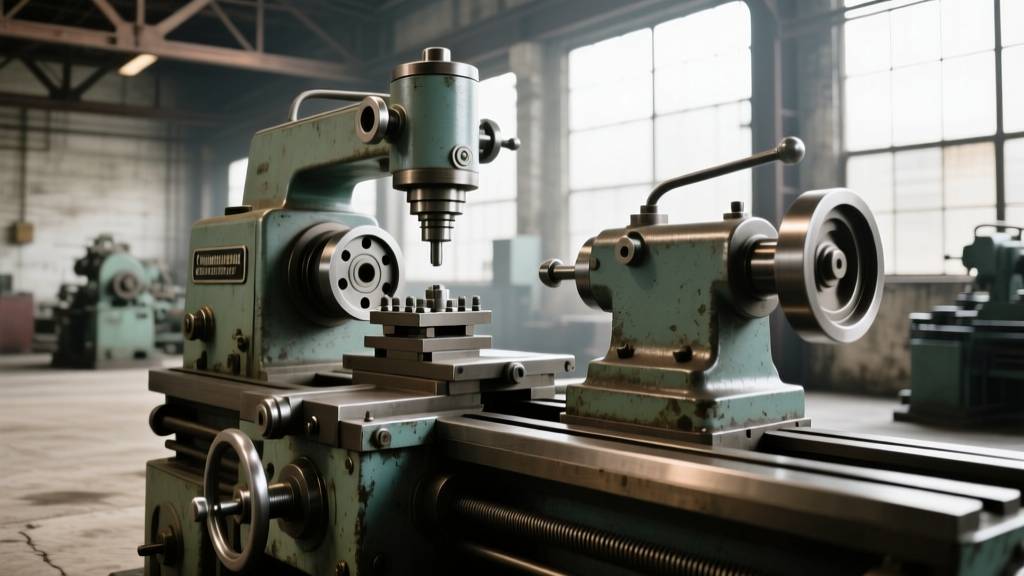
When evaluating Cincinnati machine tool history, the defining characteristic of the brand's mid-to-late 20th-century dominance was an uncompromising commitment to mass. Models like the Omnimill, and later the CNC Sabre and Arrow series, were engineered with massive Meehanite cast iron bases and columns. Unlike modern weldment-based machines that rely on polymer concrete fills to dampen harmonics, legacy Cincinnati mills absorb cutting forces through sheer structural volume and wide stance geometries.
As we navigate the manufacturing landscape in 2026, many machine shops are actively rebuilding these legacy Cincinnati mills. The alternative—waiting 12 to 18 months for new heavy-duty vertical machining centers (VMCs) from overseas—makes the restoration of a 1990s Sabre 500 or Arrow 1000 a highly economical choice. However, decades of thermal cycling, crash damage, and deferred maintenance severely compromise their original rigidity. Troubleshooting vibration in these specific machines requires an understanding of their unique mechanical architecture.
Expert Insight: A legacy Cincinnati Sabre 750 in good mechanical condition will still out-rigidify a brand-new 2026 import VMC of the same table size by roughly 18-22% in static stiffness testing, provided the spindle bearings and way systems are restored to factory preload specifications.Vibration Diagnostic Decision Tree
Before tearing down components, you must isolate the frequency signature of the vibration. Use a portable FFT (Fast Fourier Transform) vibration analyzer or an accelerometer mounted to the spindle housing and table. Match your findings to this diagnostic framework:
- High Frequency (100 Hz - 400+ Hz): Spindle bearing degradation, toolholder imbalance, or retention knob distortion. Usually manifests as high-pitch chatter marks on the workpiece.
- Mid Frequency (30 Hz - 100 Hz): Ballscrew whip, servo motor tuning oscillation, or loose column-to-base gibs. Manifests as rhythmic surface waviness.
- Low Frequency (2 Hz - 30 Hz): Way system stick-slip, foundation settling, or degraded Bijur lubrication metering. Causes poor surface finish during slow contouring and circular interpolation errors.
Spindle and Drawbar Degradation in Sabre & Arrow Models
The most common source of high-frequency chatter in legacy Cincinnati CNC mills is not the spindle bearings themselves, but the tool retention system. The Sabre and Arrow series utilized a pneumatic/hydraulic drawbar mechanism relying on a stack of Belleville (conical) springs to generate clamping force.
Belleville Spring Stack Fatigue
Over 20+ years of tool changes, Belleville springs lose their elastic memory and flatten. A factory-new Cincinnati 50-taper spindle requires approximately 2,500 lbf (pounds-force) of drawbar pull. In a degraded machine, this force frequently drops below 1,400 lbf. At this threshold, heavy radial cuts (like slotting with a 2-inch indexable cutter) will cause the toolholder to micro-slip in the taper, generating severe harmonic chatter.
Actionable Repair: Purchase a calibrated drawbar force gauge (e.g., from OTT-Jakob or a local spindle service provider). If your pull force is below 2,200 lbf, the spring stack must be replaced. Expect to pay between $800 and $1,200 for a matched OEM-equivalent Belleville spring stack, plus 4 hours of labor. Never attempt to re-shim the existing springs to regain force; this will overstress the pneumatic release cylinder.
Retention Knob Mismatch Distortion
Critical Warning: Cincinnati Milacron 50-taper spindles require a specific retention knob thread and pilot diameter. Mixing 45-degree and 90-degree pull studs across different toolholders will cause the drawbar to apply asymmetric force, physically distorting the toolholder shank and pushing it out of the spindle taper. This guarantees vibration at RPMs above 3,000.Way System Stick-Slip and Turcite Delamination
Cincinnati transitioned from bare cast-iron-on-steel ways to using Turcite-B (a PTFE-based composite) way liners in their CNC production to eliminate stick-slip and reduce friction. Troubleshooting low-frequency vibration requires inspecting this interface.
Diagnosing Stick-Slip
If your machine exhibits a jerky, stuttering motion during circular interpolation or low feed rates (under 5 IPM), the way system is suffering from stick-slip. This is rarely a mechanical wear issue; it is almost always a lubrication failure.
Legacy Cincinnatis rely on Bijur single-line resistance lubrication systems. The metering units (typically Type C or Type M valves) clog over time with degraded way oil varnish. If the X-axis metering valve is clogged, the axis will starve for oil, causing the static friction coefficient to spike above the kinetic friction coefficient.
Actionable Repair: Do not just swap the oil. Flush the entire Bijur system. Replace all metering units on the affected axis (cost: ~$45 per valve). Refill the reservoir with a dedicated way oil containing tackifiers and anti-stick-slip additives, such as Mobil Vactra No. 2. Verify oil flow by cracking the bleed screws on the way covers and cycling the lube pump manually until fresh oil purges the air pockets.
Vibration Frequency Signatures & Corrective Actions
| Vibration Frequency | Primary Suspect Component | Diagnostic Test | Estimated 2026 Repair Cost |
|---|---|---|---|
| 1X Spindle RPM | Spindle imbalance / Toolholder | Swap toolholder; check pull-stud runout | $150 - $400 (New toolholder) |
| High Freq (Non-synchronous) | ABEC-7 Spindle Bearings | Stethoscope on housing; check for heat (>140°F) | $4,500 - $8,500 (Full rebuild) |
| 30 - 60 Hz | X/Y Axis Gibs / Column Nod | Dial indicator on column during heavy Y-cut | $800 - $1,500 (Gib adjustment/scraping) |
| 2 - 10 Hz (Oscillation) | Ballscrew Backlash / Servo Hunt | Reverse bump test with dial indicator | $2,500+ (Ballscrew replacement) |
| Variable Low Freq | Way Stick-Slip / Lube Starvation | Indicator on table during 1 IPM feed | $300 - $600 (Bijur rebuild & flush) |
Foundation Settling and Column Orthogonality
According to foundational metrology principles outlined by NIST's Manufacturing Engineering division, a machine tool's structural loop is only as rigid as its foundation. Cincinnati Arrow and Sabre models feature a heavy, cantilevered column design. If the concrete foundation settles unevenly, the column twists, altering the orthogonality between the spindle centerline and the X-Y plane.
This twist pre-loads the Y-axis cross gibs. When the Y-axis moves, the binding gibs create a mid-frequency stick-slip vibration that cannot be tuned out via the Acramatic control parameters.
Re-Leveling Protocol
To restore geometric rigidity, you must re-level the machine using a precision master level (minimum resolution of 0.0005 inches per foot).
- Isolate the machine from ambient shop vibrations (turn off nearby punch presses and air compressors).
- Place the precision level on the bare cast iron table (clean off all oil and debris).
- Adjust the leveling pads in a cross-pattern sequence. Do not adjust two adjacent pads simultaneously, as this will induce a cross-twist in the base casting.
- After leveling, sweep the spindle taper with a test arbor. If the table is level but the spindle is out of square by more than 0.0002 in 12 inches, the column-to-base joint has shifted. This requires loosening the main column bolts, shimming the joint, and re-torquing to factory specs (often exceeding 800 ft-lbs).
Summary: Prioritizing Your Rebuild
Restoring a legacy Cincinnati mill is a highly rewarding endeavor that yields exceptional heavy-duty cutting performance. To systematically eliminate vibration, follow this exact triage order: First, verify the foundation and geometric leveling. Second, flush the Bijur lubrication system and replace way metering valves. Third, test and replace the Belleville drawbar springs. Finally, if high-frequency chatter persists, invest in a professional spindle rebuild. By respecting the original engineering intent of these massive castings, you can keep these historical workhorses holding tight tolerances for decades to come.
For further reading on modern milling troubleshooting and chatter mitigation, refer to the Sandvik Coromant milling knowledge base, which provides excellent baseline data on cutting tool harmonics that apply universally across both legacy and modern machine platforms.