Evaluating US Machine & Tool Quality for CNC Retrofits
Explore how legacy US machine & tool quality holds up in 2026 CNC retrofits. Real-world case studies, costs, and retrofit kits for Bridgeport and South Bend.
The Metallurgical Baseline: Why Mid-Century Castings Dominate
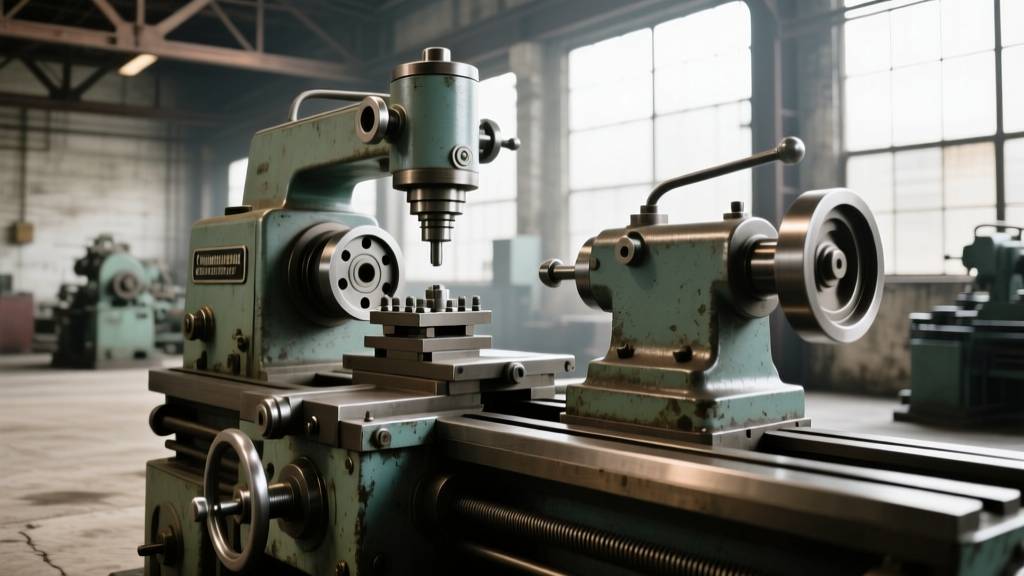
When modern job shops evaluate US machine and tool quality, the conversation inevitably turns to the massive, stress-relieved cast iron bases produced by American manufacturers between 1950 and 1985. In 2026, the cost of a new, domestically built 3-axis CNC machining center easily exceeds $120,000. Conversely, importing a budget CNC introduces structural compromises: welded steel bases and lightweight castings that lack the vibration-damping characteristics required for heavy material removal.
This economic and metallurgical reality has triggered a massive resurgence in CNC retrofitting. By pairing the unmatched damping coefficient of legacy American iron with modern digital servos and glass scales, machine shops are achieving micron-level accuracy at a fraction of the cost of new equipment.
Data Highlight: Damping Capacity
Class 40 cast iron, standard in 1970s American mills, possesses a damping capacity up to 10 times higher than fabricated welded steel bases found in modern import machines. This directly translates to extended tool life and superior surface finishes during aggressive trochoidal milling.
Case Study 1: Bridgeport Series I Boss Retrofit
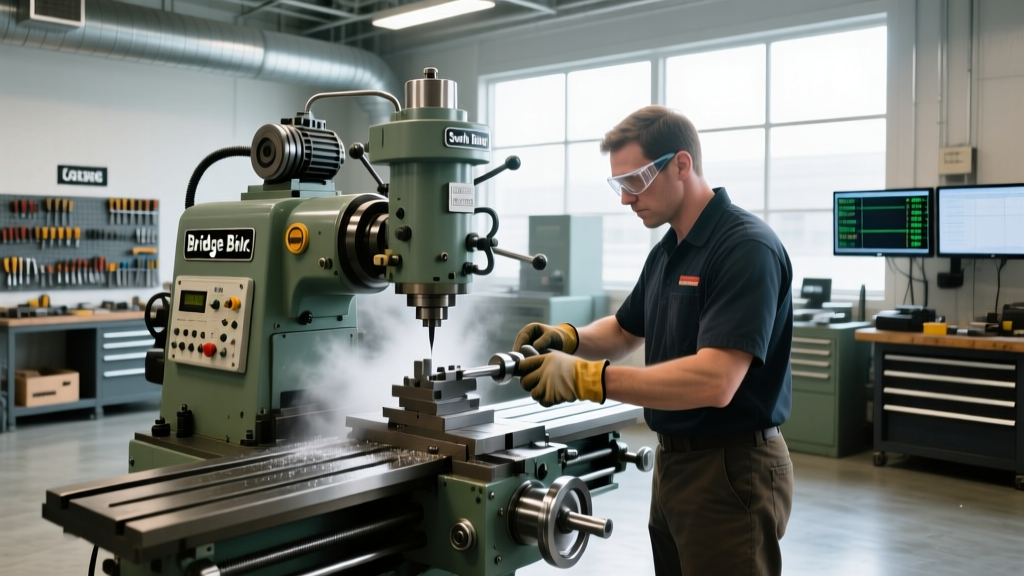
The Bridgeport Series I is the quintessential manual mill. However, its manual lead screws and R8 spindle limit its CNC potential. A prominent 2026 case study involves a mid-sized Ohio job shop that retrofitted three 1982 Bridgeport Boss 5 models using the Centroid M400S CNC control kit.
Technical Execution and Component Selection
- Control System: Centroid M400S (4-axis capability, conversational programming).
- Drive Motors: Upgraded from original stepper motors to 750W AC Servo motors with absolute encoders, eliminating the need for homing switches and providing 3,000 RPM rapid traverse capabilities.
- Way Rehabilitation: The original Turcite-B way liners were degraded. The shop milled the saddle and applied new Rulon 142 way tape, hand-scraped to 15 points per square inch to ensure oil film retention.
- Spindle Upgrade: Retained the R8 spindle but integrated a pneumatic drawbar system to automate tool changes, reducing cycle times by 18%.
Cost and Time Breakdown
| Component / Phase | Estimated Cost (USD) | Labor Hours |
|---|---|---|
| Centroid M400S Kit & AC Servos | $5,200 | 0 (Included in install) |
| Rulon Way Tape & Scraping Tools | $450 | 24 |
| Pneumatic Drawbar Integration | $850 | 8 |
| Wiring, Limit Switches, & Calibration | $600 | 16 |
| Total Per Machine | $7,100 | 48 Hours |
Case Study 2: South Bend Heavy 10 Lathe to CNC Conversion
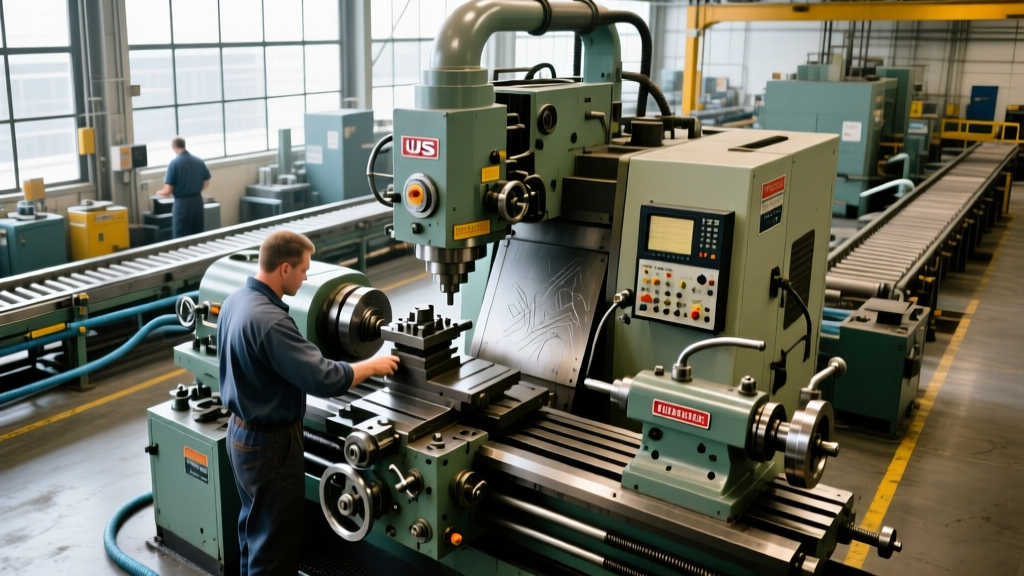
While mills are common retrofit candidates, manual lathes present unique kinematic challenges. A precision aerospace supplier in Washington converted a 1968 South Bend Heavy 10 lathe to a 2-axis CNC turning center to handle low-volume, high-mix titanium threading.
Overcoming the Acme Lead Screw Limitation
Manual lathes utilize Acme lead screws, which suffer from inherent backlash (often 0.010" to 0.020" on worn machines) and high friction. CNC interpolation requires zero-backlash ball screws. The engineering team completely removed the original cross-slide and compound rest, replacing them with a custom-machined aluminum ball screw mount housing a THK 2510 ground ball screw (25mm diameter, 10mm lead).
"The true measure of US machine and tool quality isn't just the casting; it's the spindle bearings. The original New Departure bearings in this 1968 South Bend still held less than 0.0002" of TIR after 50 years. You simply cannot buy that level of baseline precision in a new import lathe under $40,000."
— Lead Manufacturing Engineer, WA Aerospace Subcontractor
Spindle Encoder Integration for Rigid Tapping
To enable CNC rigid tapping and precision threading, a 1024 PPR (Pulses Per Revolution) incremental encoder was mounted to the rear of the spindle shaft via a custom timing belt pulley. This provided the FlashCut CNC controller with the exact spindle position feedback required to synchronize the Z-axis ball screw movement with the spindle rotation, achieving thread accuracies within ±0.0005".
Decision Matrix: Retrofit vs. New Import vs. New Domestic
Shop owners must weigh the capital expenditure against the required tolerances. According to data tracked by AMT (The Association For Manufacturing Technology), the market share for retrofitted legacy equipment in Tier 3 supply chains has grown 14% since 2023 due to supply chain lead times on new domestic machines.
| Criteria | Legacy US Retrofit (e.g., Bridgeport) | New Import CNC (e.g., Tormach, Haas Mini) | New US Domestic CNC (e.g., Fryer, Fadal) |
|---|---|---|---|
| Capital Cost | $6,000 - $9,000 | $15,000 - $45,000 | $85,000 - $150,000+ |
| Structural Damping | Excellent (Heavy Cast Iron) | Fair to Good (Light Cast/Welded) | Excellent (Heavy Cast Iron) |
| Rapid Traverse | 150 - 300 IPM | 500 - 800 IPM | 800 - 1,200+ IPM |
| Way Protection | Poor (Often exposed, requires manual covers) | Good (Telescoping sheet metal) | Excellent (Fully enclosed telescoping) |
| Tool Changer | Rare / Manual / Pneumatic Drawbar | Standard (10-24 tool ATC) | Standard (20-40 tool ATC) |
Critical Failure Points in Manual-to-CNC Conversions
Retrofits fail when integrators ignore the physical degradation of the host machine. The NIST Manufacturing Engineering Laboratory frequently highlights the importance of baseline metrology before applying digital compensation. Avoid these common pitfalls:
⚠️ Warning: The Way Wear Trap
Manual machines wear in the center of the X and Y axes where 90% of the operator's work occurs. If you install ball screws and CNC controls on a dished way, the machine will physically dip in the Z-axis as it travels to the center of the table. Software backlash compensation cannot fix geometric way wear. You must mill the table and apply Moglice or Turcite, or accept severe Z-axis contouring errors.
1. Electromagnetic Interference (EMI) on Limit Switches
Legacy machine bases act as giant antennas. When VFDs (Variable Frequency Drives) or AC servo amplifiers fire, they induce voltage spikes in unshielded limit switch wiring, causing the CNC control to trigger false E-Stops. Solution: Use only double-shielded, twisted-pair cables for all 24V DC limit switch circuits, and route them in separate conduits from 110V/220V AC power lines.
2. R8 Spindle Deflection in CNC Milling
The R8 taper relies on a drawbar for retention and lacks the radial rigidity of a CAT 40 or BT30 taper. Under heavy CNC side-milling loads, R8 tooling will deflect, causing chatter and poor tolerances. Solution: Limit radial depth of cut (RDOC) to 50% of tool diameter on R8 retrofits, or machine the spindle nose to accept a TTS (Tormach Tooling System) retention knob for improved repeatability.
Calibration Standards and Final Verification
Once the mechanical and electrical retrofit is complete, the machine must be verified against established metrology standards. Industry best practices, often referenced by the Society of Manufacturing Engineers (SME), dictate the use of laser interferometry for ball screw pitch error compensation.
Using a Renishaw XL-80 laser system, the integrator maps the positional error of the ball screw across the entire travel. This data is uploaded into the CNC controller's pitch error compensation table, effectively turning a $5,000 mechanical retrofit into a machine capable of holding ±0.0004" positional tolerance over 24 inches of travel.
Summary: Is the Retrofit Worth It?
The Final Verdict
Retrofitting is not a shortcut; it is a strategic capital allocation. If your shop requires high-speed production, 24/7 lights-out machining, and automated tool changing, buy a new machine. However, if your application involves high-mix/low-volume prototyping, toolroom work, or heavy roughing where structural damping is paramount, leveraging legacy US machine and tool quality via a modern CNC retrofit yields an unmatched return on investment in 2026.