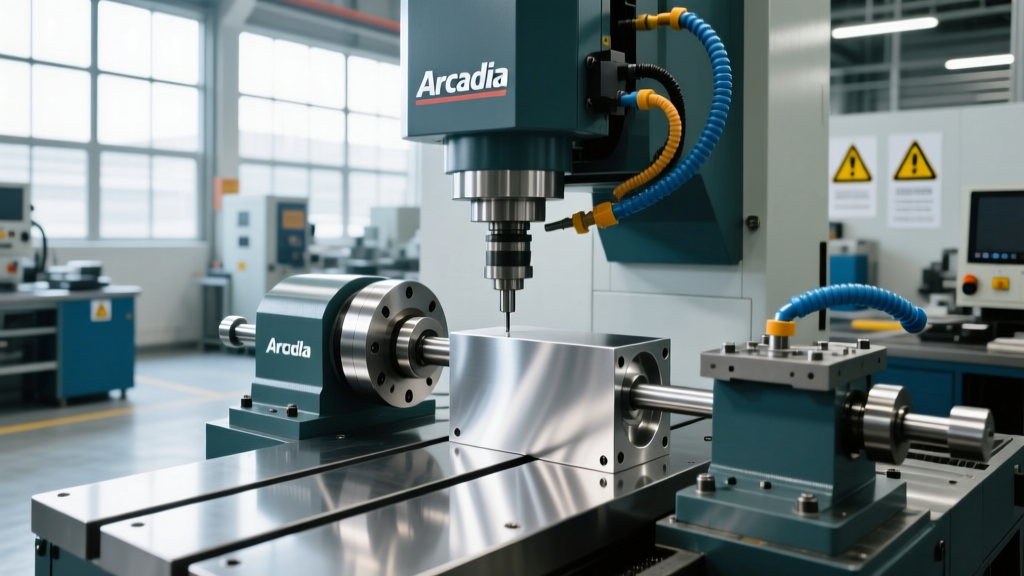
Arcadia Machine and Tool Workholding: Safety & Compliance Guide
Explore workholding safety standards and compliance for CNC vises, chucks, and fixtures, featuring Arcadia Machine and Tool machining protocols.
The High-Stress Machining Context: Arcadia Machine and Tool
When evaluating workholding safety standards, few historical benchmarks illustrate the necessity of extreme clamping compliance better than the legacy of Arcadia Machine and Tool. Famous for manufacturing high-performance, all-stainless firearms like the Hardballer and Backup, Arcadia Machine and Tool routinely machined unforgiving alloys such as 416 stainless steel and 17-4 PH. These materials demand aggressive cutting parameters and generate immense lateral cutting forces. If a workholding system fails under these specific loads, the result is not merely a scrapped part—it is a catastrophic projectile hazard inside the CNC enclosure.
Modern machine shops taking on similar high-stress, high-precision contracts must adhere to rigorous safety protocols. Compliance is not just about guarding the operator from the spindle; it is about ensuring the workholding system itself cannot become the source of a kinetic failure. This guide breaks down the exact safety standards, compliance frameworks, and mechanical limits for CNC vises, power chucks, and custom fixtures in 2026.
Baseline Compliance: OSHA and ANSI B11 Standards
Workholding safety is governed primarily by OSHA 1910.212 General Machine Guarding requirements and the ANSI B11 series of machinery safety standards. While machine guards protect the operator from the cutting zone, the workholding system must be engineered to prevent the workpiece from breaching those guards.
The Kinetic Energy Hazard
A 5-pound stainless steel chuck rotating at 3,000 RPM possesses immense kinetic energy. If the clamping force is overcome by cutting forces or centrifugal derating, the workpiece becomes a projectile. OSHA mandates that workholding devices must be rated for the maximum operational speed of the machine and the maximum cutting forces anticipated during the cycle. Relying on the static clamping force rating of a chuck without calculating dynamic derating is a direct violation of safe operating procedures outlined in the CCOHS Machine Guarding Guidelines.
⚠️ CRITICAL SAFETY WARNING: Unshielded Chuck JawsOSHA inspectors frequently cite shops running power chucks without proper rotational guarding. Even if the chuck is rated for 4,000 RPM, operating it without a closed interlocked enclosure violates ANSI B11.0. Never bypass door interlocks to monitor chuck jaw clearance during high-speed turning operations.
CNC Vise Safety: Torque, Hydraulics, and Failure Modes
Manual and hydraulic CNC vises are the backbone of milling workholding. However, operator error and hydraulic degradation introduce severe compliance risks.
Manual Vise Torque Discrepancies
Consider a standard high-precision milling vise, such as a 6-inch Kurt-style DX640. To achieve its rated 40,000 lbs of clamping force, the operator must apply exactly 90 ft-lbs of torque to the handle. The internal multiplier mechanism (often 6:1) relies on this specific input.
- The Failure Mode: Operators using standard 10-inch T-handle wrenches rarely exceed 40 to 50 ft-lbs of actual torque. This results in a clamping force of less than 20,000 lbs.
- The Consequence: When machining hard materials like 17-4 PH stainless (a staple of Arcadia Machine and Tool style production), a heavy roughing pass with a 3/4-inch carbide endmill can easily generate 2,500+ lbs of lateral cutting force. If the static friction coefficient between the part and the jaw is overcome, the part shifts, ruining the tool and potentially shattering the carbide insert into the operator's zone.
- The Compliance Fix: Mandate the use of calibrated torque multipliers or switch to hydraulic/pneumatic clamping systems that eliminate human torque variability.
Hydraulic Fixture Pressure Drop
For high-volume production, hydraulic fixtures are standard. The primary safety risk is a sudden loss of hydraulic pressure due to pump failure, hose rupture, or internal valve leakage.
💡 ENGINEERING TIP: Accumulator IntegrationTo comply with modern safety audits, hydraulic fixture circuits must include a nitrogen-charged accumulator and a pressure-compensating flow control valve. If the primary pump fails, the accumulator must be sized to maintain a minimum of 1,500 PSI at the clamping cylinders for at least 45 seconds, allowing the CNC control to detect the pressure drop via a transducer and execute an emergency spindle stop before the part ejects.
Power Chuck Centrifugal Derating: The Hidden Hazard
The most misunderstood safety parameter in CNC turning is centrifugal force derating. As a power chuck spins, the centrifugal force acting on the chuck jaws pulls them outward, directly counteracting the hydraulic clamping force pushing them inward. This phenomenon is governed by DIN 6386 standards.
Below is a real-world derating matrix for a standard 8-inch wedge-bar power chuck utilizing standard steel top jaws weighing 1.8 lbs each.
| Spindle Speed (RPM) | Static Grip Force (lbs) | Dynamic Grip Force (lbs) | Force Loss (%) |
|---|---|---|---|
| 0 (Static) | 45,000 | 45,000 | 0% |
| 1,500 | 45,000 | 41,200 | 8.4% |
| 2,500 | 45,000 | 34,500 | 23.3% |
| 3,500 | 45,000 | 25,100 | 44.2% |
| 4,500 | 45,000 | 12,800 | 71.5% |
As demonstrated, running an 8-inch chuck at 4,500 RPM results in a 71.5% loss of gripping force. If the CAM programmer calculated the cutting feed rate based on the static 45,000 lbs grip force, the part will inevitably slip or eject at high RPMs.
Mitigation Strategies for Chuck Derating
- Lightweight Top Jaws: Switch from solid steel top jaws to aluminum or carbon-fiber reinforced composite jaws. Reducing the jaw weight from 1.8 lbs to 0.6 lbs cuts the centrifugal force penalty by 66%.
- Counter-Centrifugal Chucks: For operations consistently above 3,000 RPM, invest in counter-centrifugal wedge-bar chucks. These utilize internal counterweights that pull the jaws inward as RPM increases, effectively neutralizing the derating effect up to the chuck's maximum rated speed.
- Speed-Gated Interlocks: Program the CNC macro to verify the hydraulic drawbar pressure sensor reading before allowing the spindle to exceed 2,000 RPM.
Custom Fixture Compliance and Machine Interlocks
When machining complex geometries that require custom tombstones or dedicated fixtures, the safety standard shifts from off-the-shelf ratings to engineered system validation. According to the OSHA Machine Safeguarding Concepts documentation, any custom workholding must be integrated into the machine's safety control circuit.
Pneumatic vs. Hydraulic Fixture Interlocks
Pneumatic fixtures are popular for their speed and cleanliness, but air is compressible. If a cutter breaks and jams against the part, a pneumatic cylinder can compress, allowing the part to shift slightly and causing a secondary crash. Hydraulic systems, utilizing incompressible fluid, lock the part rigidly in place.
For compliance, custom fixtures must utilize pressure-sequence valves. The CNC M-code that initiates the spindle start must be physically blocked by a PLC relay unless the fixture pressure transducer confirms that the clamping pressure has reached the engineered minimum threshold (e.g., 2,200 PSI) for a minimum of 1.5 seconds, ensuring all hydraulic lines are fully charged and seated.
2026 Workholding Safety Audit Checklist
Shop managers and safety officers should conduct quarterly audits of all workholding equipment using the following actionable checklist. This ensures ongoing compliance and prevents the degradation of safety margins over time.
- ☐ Chuck Tear-Down & Lubrication: Power chucks must be completely disassembled, cleaned, and re-lubricated with molybdenum disulfide (MoS2) based chuck grease every 400 operating hours. Dried grease increases internal friction, reducing drawbar-to-jaw force transfer by up to 25%.
- ☐ Vise Way Cleaning: Inspect the angular drive ways on manual CNC vises. Chip packing in the ways prevents the movable jaw from seating fully downward, causing the jaw to lift under heavy cutting loads.
- ☐ Drawtube Thread Inspection: Inspect the threads connecting the hydraulic cylinder drawtube to the chuck mounting nut. Stripped or cross-threaded connections will fail catastrophically under high drawbar loads.
- ☐ Soft Jaw Bore Validation: Aluminum or steel soft jaws must be re-bored if they have been removed from the chuck. Reusing soft jaws that were bored in a different clamping state introduces runout and reduces the surface contact area, severely compromising grip strength.
- ☐ Accumulator Pre-Charge Check: Verify the nitrogen pre-charge on hydraulic fixture accumulators using a calibrated gauge. A depleted pre-charge renders the accumulator useless during a primary pump failure.
By treating workholding not just as a setup requirement, but as a critical safety system governed by strict mechanical and regulatory limits, machine shops can prevent catastrophic failures. Whether you are running high-volume automotive turning or replicating the demanding stainless steel tolerances pioneered by Arcadia Machine and Tool, rigorous adherence to these compliance standards ensures both operator safety and manufacturing integrity.