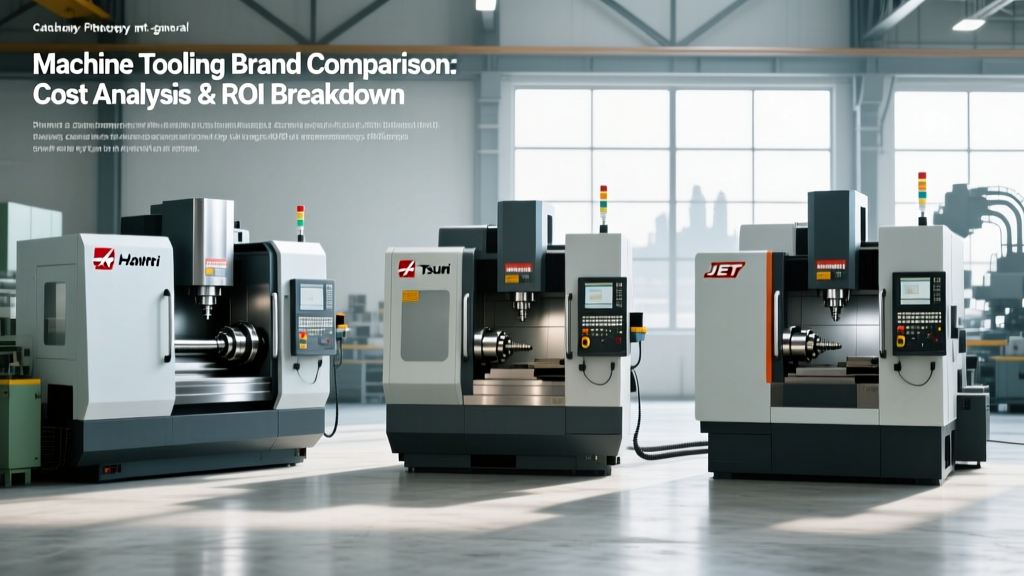
Machine Tooling Brand Comparison: Cost Analysis & ROI Breakdown
Compare premium and economy machine tooling brands with our cost analysis. Discover hidden costs, ROI metrics, and budget planning strategies for your shop.
Procurement managers and shop owners frequently evaluate machine tooling based on the initial invoice price per insert or end mill. This approach, known as the 'price-per-edge' fallacy, routinely inflates total manufacturing costs by 15% to 30%. In the current manufacturing landscape, where CNC spindle time averages $120 to $180 per hour and raw material scrap costs are at a premium, the true cost of cutting tools is measured strictly in Cost Per Part (CPP) and overall spindle utilization.
This analysis breaks down the value proposition across premium, mid-tier, and economy machine tooling brands, providing a quantitative framework to optimize your 2026 tooling budget.
The Brand Tier Matrix: Premium vs. Mid-Tier vs. Economy
The global machine tooling market is broadly segmented into three tiers based on R&D investment, substrate quality, and coating technologies. Understanding where each brand fits is the first step in strategic budget allocation.
| Tier | Representative Brands | Avg. Indexable Insert Cost | Best Application Scenario | Expected Tool Life Multiplier |
|---|---|---|---|---|
| Tier 1 (Premium) | Sandvik Coromant, Kennametal, Iscar | $16.00 - $28.00 | High-temp alloys (Inconel, Titanium), high-volume production, tight tolerances. | 3.0x - 4.5x baseline |
| Tier 2 (Mid-Tier) | Seco Tools, Walter AG, Sumitomo | $11.00 - $18.00 | Standard steels, cast irons, medium-volume batch machining. | 1.8x - 2.5x baseline |
| Tier 3 (Economy) | YG-1, TaeguTec, Korloy | $5.00 - $10.00 | Non-critical roughing, aluminum milling, low-margin job shop work, prototyping. | 1.0x (Baseline) |
According to Sandvik Coromant's machining fundamentals, premium grades utilize advanced PVD/CVD coatings and highly engineered substrate gradients that resist thermal cracking and crater wear. Economy brands typically rely on homogeneous carbide substrates with standard TiAlN coatings, which degrade rapidly under the high thermal loads generated by modern high-speed machining (HSM) parameters.
Real-World Scenario: Ti-6Al-4V Milling Cost Breakdown
To illustrate the financial impact of brand selection, consider a 5-axis CNC milling operation machining aerospace-grade Ti-6Al-4V. The machine burden rate is $150/hour ($2.50/minute). The part cycle time for the specific roughing operation is 10 minutes. Tool change time (including spindle stop, arm swap, and tool length verification) is 4 minutes.
Tier 1 Premium Tool (e.g., Kennametal HARVI or equivalent)
- Insert/Tool Cost: $22.00
- Tool Life: 40 minutes (Yields 4 complete parts per edge)
- Tooling CPP: $22.00 / 4 parts = $5.50
- Cutting Time CPP: 10 mins × $2.50 = $25.00
- Tool Change CPP: (4 mins / 4 parts) × $2.50 = $2.50
- Total Cost Per Part: $33.00
Tier 3 Economy Tool (Generic Import Brand)
- Insert/Tool Cost: $8.00
- Tool Life: 10 minutes (Fails at the end of 1 part; running it longer risks scrapping the $400 raw titanium forging)
- Tooling CPP: $8.00 / 1 part = $8.00
- Cutting Time CPP: 10 mins × $2.50 = $25.00
- Tool Change CPP: (4 mins / 1 part) × $2.50 = $10.00
- Total Cost Per Part: $43.00
The Verdict: Despite the Tier 1 tool costing 175% more upfront, it reduces the total Cost Per Part by $10.00 (a 23% savings). Over a 5,000-part production run, the premium tooling yields $50,000 in net savings while simultaneously freeing up 333 hours of spindle time previously lost to tool changes.
The Total Cost of Ownership (TCO) Framework
When planning your annual machine tooling budget, shift your procurement KPIs away from 'purchase price variance' and adopt a TCO model. The Society of Manufacturing Engineers (SME) consistently highlights that direct tooling costs represent only 3% to 5% of total manufacturing costs, whereas machine time and labor account for over 70%.
Strategic Budget Allocation Rule of Thumb
Allocate 70% of your tooling budget to Tier 1 brands for operations where tool failure results in catastrophic part scrap (e.g., deep cavity milling, finishing aerospace alloys, threading).
Allocate 30% to Tier 2 or Tier 3 brands for non-critical roughing passes, facing operations on standard 1018 steel, or machining soft materials like 6061 aluminum where thermal wear is negligible and edge chipping is the primary failure mode.
Hidden Costs of Economy Tooling
When evaluating cheaper machine tooling brands, procurement teams often miss the secondary costs that erode margins:
- Scrap and Rework: Economy inserts suffer from unpredictable flank wear. An unexpected tool failure during a finishing pass on a $2,000 Inconel turbine casing destroys the part and the profit margin for the next 50 parts.
- Operator Intervention: Cheter tools require operators to manually monitor cutting sounds and chip colors, preventing lights-out (unattended) machining. If an operator must babysit a CNC lathe, your effective labor cost per part skyrockets.
- Inventory Bloat: Because economy tool life is inconsistent, shops over-order to prevent stockouts, tying up working capital in idle carbide inventory.
Specialized Tooling: Solid Carbide vs. Indexable
Brand value analysis also applies to solid carbide end mills, particularly in mold and die or medical machining. Resources like the Harvey Tool technical resource center demonstrate that specialized geometries (such as variable helix and variable pitch designs) drastically reduce harmonic chatter.
In high-hardness steels (45-60 HRC), a $140 premium solid carbide end mill from a top-tier brand will consistently outlast a $45 economy alternative by a factor of five. More importantly, the premium tool maintains its cutting diameter within 0.0002 inches, eliminating the need for secondary semi-finishing passes. When budget planning for mold base machining, always factor in the cost of the secondary EDM or benching operations required to fix chatter marks left by inferior tooling.
2026 Procurement Strategy: Navigating Carbide Pricing
Tungsten and cobalt commodity prices remain volatile. To insulate your shop from sudden price hikes in machine tooling, implement the following procurement strategies:
- Standardize Insert Geometries: Reduce your active SKU count. Instead of stocking 15 different styles of CNMG inserts across three brands, standardize on two high-performance geometries from a single Tier 1 supplier. This unlocks volume rebate tiers and ensures you always have backup edges in the crib.
- Implement Tool Vending Machines: Pair your premium tooling investment with automated dispensing systems (e.g., AutoCrib or Seco Point). Data shows that uncontrolled tool cribs result in 15% of inventory being lost, hoarded, or expired. Vending enforces accountability and tracks CPP data automatically.
- Negotiate Cost-Per-Part Contracts: For high-volume production lines, approach Tier 1 suppliers for a 'tooling management' contract. The supplier guarantees a specific CPP, and they absorb the cost of tool life variations and process optimization. This shifts the financial risk of tooling performance from your balance sheet to theirs.
Optimizing your machine tooling budget requires abandoning the illusion of cheap inserts. By rigorously calculating Cost Per Part, standardizing premium grades for critical operations, and leveraging automated inventory control, manufacturing facilities can significantly reduce total operational costs while increasing spindle uptime and part quality.