Next-Gen Milling Machine Tools: 2026 Smart Tech & Coating Trends
Discover how 2026 innovations in sensor-integrated toolholders and nano-coatings are transforming milling machine tools for aerospace and medical CNC shops.
The definition of milling machine tools has fundamentally shifted in 2026. They are no longer passive carbide cutters waiting to wear out; they are active, data-generating nodes within a closed-loop manufacturing ecosystem. For CNC shops machining high-value alloys like Ti-6Al-4V or Inconel 718, the integration of piezoelectric sensors directly into the toolholder and the advent of nano-composite PVD coatings have redefined the boundaries of tool life and surface finish integrity.
Sensor-Integrated Toolholders: Moving Beyond the Spindle
Historically, vibration and acoustic emission sensors were mounted on the machine spindle or the casting. In 2026, the most advanced milling machine tools utilize sensor-embedded toolholders (such as HSK-A63 and CAT50 smart holders) that place the measurement hardware less than 15 millimeters from the cutting edge.
These smart holders utilize miniature piezoelectric accelerometers sampling at frequencies up to 50 kHz. This high-resolution data capture allows the CNC controller to detect micro-chatter—specifically regenerative chatter in the 2,000 to 4,000 Hz range—before it manifests as visible witness marks on the workpiece. When integrated with National Institute of Standards and Technology (NIST) Smart Manufacturing frameworks, this localized sensor data feeds directly into edge-computing modules on the shop floor, triggering automatic feed-rate overrides in under 40 milliseconds.
Pro Tip: Sensor CalibrationWhen deploying smart toolholders, always perform a baseline 'air cut' calibration at the exact RPM you intend to use. The centrifugal force at 12,000 RPM alters the piezoelectric sensor's baseline voltage by up to 4%. Failing to account for this rotational offset will result in false-positive chatter alarms during heavy roughing passes.
Nano-Composite Coatings: Breaking the 1,200°C Barrier
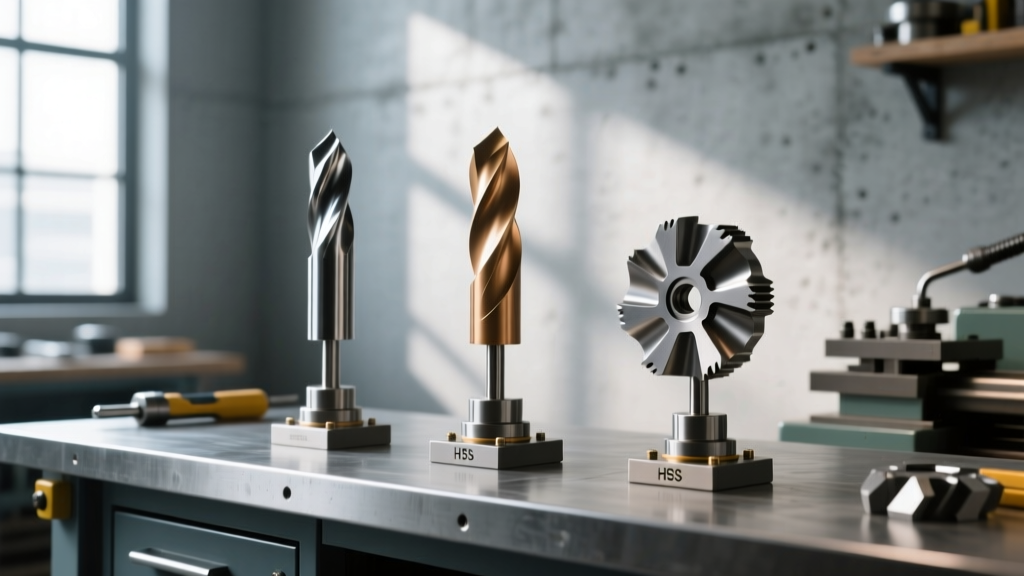
The substrate of modern end mills remains micro-grain tungsten carbide, but the coating technology applied to these milling machine tools has seen a metallurgical leap. Standard Titanium Aluminum Nitride (TiAlN) coatings, which dominated the 2010s, begin to oxidize and soften at approximately 800°C. This is a critical failure point when dry-machining aerospace titanium or hardened die steels.
The 2026 standard for high-performance milling is the AlTiN-Si3N4 (Aluminum Titanium Nitride with Silicon Nitride) nano-composite coating. By embedding silicon nitride into an amorphous matrix, manufacturers have created a coating that forms a stable silicon oxide (SiO2) layer at extreme temperatures, preventing further oxygen diffusion into the cutting edge.
Coating Performance Matrix
| Coating Type | Microhardness (HV) | Max Oxidation Temp | Cost per Insert | Ideal Workpiece |
|---|---|---|---|---|
| Standard TiAlN | 2,800 HV | 800°C | $8 - $12 | Carbon Steel, Cast Iron |
| AlCrN (Aluminum Chromium) | 3,200 HV | 1,050°C | $14 - $18 | Hardened Steels (45-60 HRC) |
| AlTiN-Si3N4 (Nano) | 3,800 HV | 1,200°C | $22 - $28 | Ti-6Al-4V, Inconel 718 |
According to ongoing research tracked by the Society of Manufacturing Engineers (SME), the implementation of nano-composite coatings on milling machine tools reduces flank wear by up to 34% in continuous dry-machining operations compared to standard AlCrN, directly translating to fewer tool changes in automated lights-out manufacturing cells.
AI-Driven Toolpath Compensation and Digital Twins
The physical upgrades to milling machine tools are only half of the 2026 innovation cycle. The software interpreting the tool's behavior has evolved from static CAM output to dynamic, AI-driven compensation. Modern CAM platforms like Mastercam 2026 and Siemens NX 2406 now generate 'digital twins' of the specific cutting tool, including its exact runout, coating thickness, and helix angle.
When a smart toolholder detects an increase in cutting forces—indicating that the AlTiN-Si3N4 coating is beginning to wear through to the carbide substrate—the software doesn't just trigger an alarm. It dynamically recalculates the remaining toolpath, reducing the radial depth of cut (RDOC) by 15% while simultaneously increasing the feed rate by 8% to maintain the material removal rate (MRR) without accelerating the wear curve.
'The latency between tool wear detection and machine response is the new battleground in 5-axis milling. Shops that rely on spindle-load meters are reacting 200 milliseconds too late to save a thin-wall aerospace structural component from scrapping.' — Manufacturing Engineering Lead, Tier 1 Aerospace Supplier.
Decision Framework: Upgrading to Smart Milling Machine Tools
Not every shop requires a $1,200 sensor-embedded toolholder or a $28 nano-coated end mill. Capital allocation must be driven by the cost of failure. Use the following framework to determine when to upgrade your milling machine tools:
When to Invest in Smart Tooling & Nano-Coatings
- High-Value Substrates: The raw material cost of the workpiece exceeds $1,500, and a tool failure mid-cycle will scrap the part.
- Thin-Wall Geometries: Machining walls thinner than 1.5mm where regenerative chatter will instantly cause dimensional scrap.
- Lights-Out Operations: Running unattended weekend shifts where a broken end mill could cause a machine crash without human intervention.
- Exotic Alloys: Machining materials with low thermal conductivity (Titanium, Hastelloy) where heat concentrates at the cutting edge.
When to Stick to Standard Carbide & Toolholders
- High-Volume Aluminum Roughing: Where tool life is highly predictable, parts are cheap, and spindle load monitoring is sufficient.
- Manual or Low-Automation Shops: Where an operator is physically present to listen for chatter and adjust overrides manually.
Real-World Cost Analysis: 5-Axis Aerospace Milling
Consider a mid-sized machine shop milling a complex titanium turbine blade on a 5-axis trunnion table. The raw forging costs $4,200, and the cycle time is 14 hours. Using standard TiAlN coated milling machine tools, the shop experiences an unpredictable tool failure rate of 2.5%, resulting in roughly one scrapped blade per month ($50,400 annualized scrap cost).
By upgrading to sensor-integrated CAT50 holders ($3,600 for three setup holders) and AlTiN-Si3N4 coated end mills (increasing tooling consumable costs by $14,000 annually), the shop eliminates the mid-cycle breakages. The AI-driven CAM compensation ensures the tool is changed precisely when the coating degrades, avoiding catastrophic substrate failure. The net savings in the first year exceed $32,000, yielding an ROI on the smart toolholder investment in under three months. Detailed financial modeling for these upgrades is frequently covered in Modern Machine Shop's cutting tools sector analyses, highlighting that the initial capital expenditure is rapidly offset by scrap reduction.
Edge Cases: The Coolant Interference Factor
A critical, often overlooked limitation of sensor-embedded milling machine tools is the interference caused by high-pressure through-tool coolant (TTC). When running 1,000 PSI coolant through a smart toolholder, the turbulent fluid dynamics inside the toolholder cavity can create acoustic noise that the piezoelectric sensors misinterpret as high-frequency chatter. To mitigate this, shops must apply a digital band-pass filter in the CNC's edge-computing module, isolating the specific structural resonance frequencies of the toolholder from the broadband noise of the pressurized coolant.
As milling machine tools continue to merge physical metallurgy with digital telemetry, the shops that master the calibration of these systems will dictate the profit margins of high-precision manufacturing in 2026 and beyond.