CNC Milling Machine Tool Selection Framework for 2026
Select the right CNC milling machine tool for your shop. Compare spindles, controls, and hidden costs with our 2026 buyer framework and pricing data.
Procuring a new milling machine tool is a capital-intensive commitment that dictates your shop's production capacity, tolerance capabilities, and overhead for the next decade. In 2026, the machine tool market has stabilized regarding lead times, but pricing tiers have distinctly separated entry-level prototyping equipment from high-rigidity production vertical machining centers (VMCs). According to data tracked by the Association for Manufacturing Technology (AMT), shops are increasingly prioritizing thermal stability and high-pressure coolant integration over raw rapid traverse rates when selecting new equipment.
This framework strips away marketing brochures and focuses on the mechanical, electrical, and financial realities of selecting the correct milling machine tool for your specific manufacturing environment.
The Core Selection Matrix: Matching Machine to Application
Before evaluating specific brands, you must categorize your primary workload. A machine optimized for aluminum aerospace structural parts will perform poorly when roughing titanium implants. Use the matrix below to identify your baseline equipment tier.
| Machine Tier | Representative Models | 2026 Price Range | Spindle & Torque Profile | Best Application |
|---|---|---|---|---|
| Entry/Prototyping | Tormach 15L, Haas Mini Mill | $14,000 - $45,000 | 10k RPM, Low Torque (BT30/R8) | Aluminum, plastics, light steel, R&D |
| Mid-Tier Production | Haas VF-2SS, Doosan DNM 4505 | $65,000 - $95,000 | 12k RPM Direct Drive, 150 ft-lb (CAT40) | General job shop, mild steel, batch production |
| High-Performance | DMG MORI CMX 600V, Makino F5 | $130,000 - $220,000+ | 15k-20k RPM, High Rigidity (CAT40/HSK63) | Mold & die, aerospace alloys, tight tolerances |
| 5-Axis Simultaneous | Haas UMC-500, Hermle C 250 | $110,000 - $350,000+ | 15k RPM, Trunnion Table Dynamics | Complex geometries, single-setup machining |
Spindle Architecture and Taper Selection
The spindle is the heart of any milling machine tool. Your selection must balance top-end RPM for finishing with low-end torque for roughing.
Taper Standards: CAT vs. BT vs. HSK
In North America, the CAT (V-flange) taper remains the dominant standard for vertical mills due to its wide availability and compatibility with legacy tooling. However, if your shop frequently machines at RPMs exceeding 12,000, you must transition to HSK (Hollow Shank Taper). HSK-A63 provides simultaneous face-and-taper contact, preventing the tool pull-out and radial runout that plague CAT40 holders at high centrifugal forces. According to Modern Machine Shop, shops machining aerospace aluminum monoliths see a 15% increase in tool life and significantly better surface finishes when switching from CAT to HSK interfaces.
Drive Mechanisms
- Belt-Driven: Cheapest to repair, but prone to vibration at high RPMs. Best for heavy roughing where top speed is below 8,000 RPM.
- Inline Direct-Drive: The motor is directly coupled to the spindle shaft. Eliminates belt slip and provides superior surface finishes. Standard on most 10,000–15,000 RPM machines.
- Integral Motor Spindle: The rotor is built directly onto the spindle shaft. Required for 20,000+ RPM applications (like graphite or hard milling). Extremely expensive to replace if crashed.
Coolant Delivery and Chip Evacuation
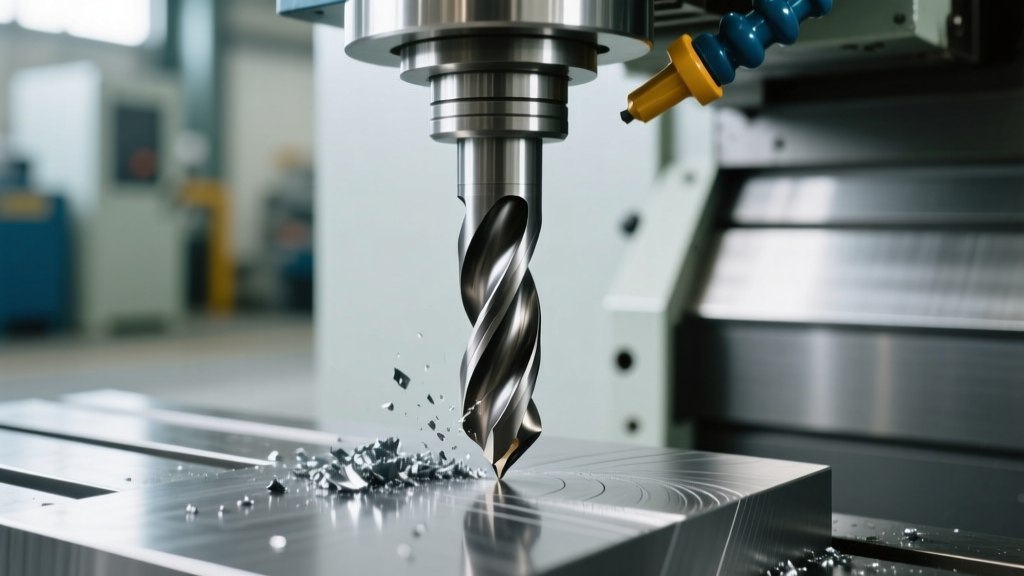
A common mistake in equipment selection is under-specifying the coolant system. Standard flood coolant (typically 70 PSI) is insufficient for deep cavity milling or drilling deep holes in sticky materials like 304 stainless steel or Inconel 718.
For 2026 production environments, Through-Spindle Coolant (TSC) is non-negotiable for job shops handling diverse materials. You must choose the correct pressure tier:
- 300 PSI TSC: The baseline for standard job shops. Sufficient for standard carbide drilling and tapping up to 1/2" diameter.
- 1,000 PSI TSC: Mandatory for aerospace shops machining titanium and high-temperature alloys. This pressure is required to break chips at the cutting edge and prevent work-hardening and premature insert failure.
- Chip Conveyors: Never buy a production VMC without a hinge-belt chip conveyor. Stringy chips from ductile materials will wrap around a standard auger, causing motor burnout and machine downtime.
Control Systems and Look-Ahead Processing
The CNC control dictates how smoothly the machine executes complex 3D toolpaths. While Haas Automation's NGC control is highly intuitive and dominates the North American job shop market due to its conversational programming and ease of use, it is not the only option.
If your shop primarily runs complex 3D surfacing (mold and die, impellers), you must evaluate the control's "look-ahead" capability. The Fanuc 0i-F Plus with the 600-block look-ahead option, or the Siemens Sinumerik One with Advanced Position Control, will dynamically adjust feed rates before sharp corners. This prevents dwell marks, maintains constant chip load, and reduces cycle times on 3D contouring by up to 30% compared to standard 100-block look-ahead systems.
"A machine's mechanical rigidity is useless if the control system cannot process the CAM-generated G-code fast enough to maintain feed rate through complex splines. Always spec the highest block look-ahead your budget allows for 3D work."
The Hidden Costs of Ownership
The sticker price of a milling machine tool is merely the entry fee. When calculating your ROI and securing financing, you must budget for the following peripheral costs, which routinely add 20% to 35% to the base machine price:
Capital Expenditure Additions
- Power Infrastructure: Upgrading to 480V 3-phase power or installing a 20 kVA rotary phase converter ($4,000 - $8,500).
- Rigging and Set-In: Professional machinery movers, crane rentals, and precision leveling ($2,500 - $6,000).
- Tooling Package: A basic CAT40 tooling package (20 pull studs, 10 end mill holders, 5 collet chucks, face mill, dial indicators, edge finders) will cost a minimum of $4,500 using mid-tier brands like Techniks or Maritool.
- Workholding: Standard 6" Kurt-style vises run $800 - $1,200 each. A VMC requires at least two, plus parallels, step blocks, and clamping kits ($3,000+).
- Probing Systems: A Renishaw OMP60 spindle probe and OTS tool setter will add roughly $7,500 to the machine cost, but will reduce setup times by 60%.
Final Procurement Verification
Before signing the purchase order, execute this physical verification checklist on the showroom floor or during the factory run-off:
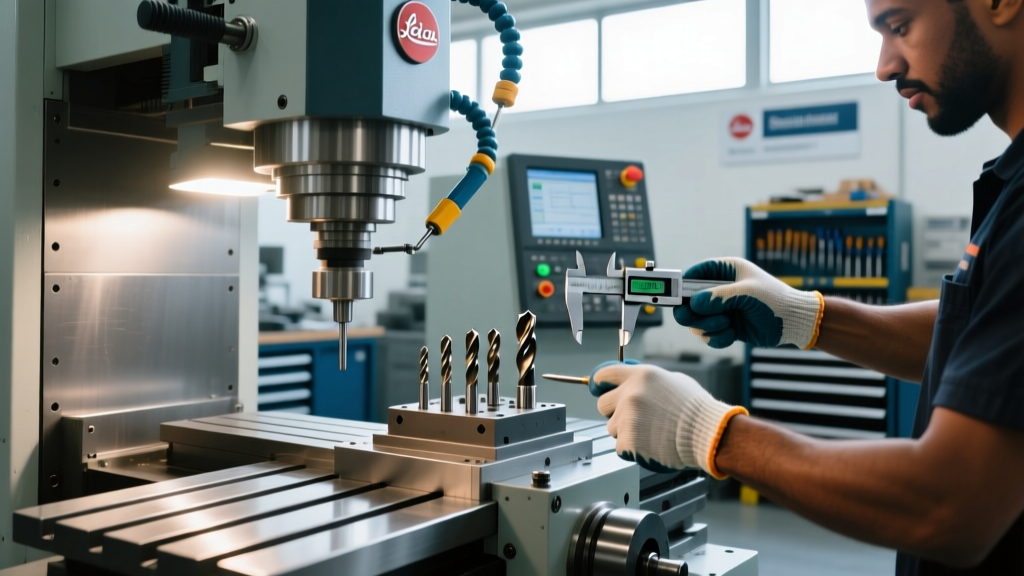
- The Indicator Test: Mount a 0.0001" test indicator in the spindle and sweep the machine table. Traverse the X and Y axes fully. Any deviation greater than 0.0005" over 36 inches indicates poor geometric alignment of the linear guideways.
- The Circle-Diamond-Square Test: Run the standard NAS 979 test part. Inspect the circle for axis reversal spikes (indicating backlash compensation errors) and the square for squareness errors between X and Y.
- Spindle Runout: Verify the spindle taper runout with a certified test arbor. It must not exceed 0.0001" TIR (Total Indicator Reading) at the gauge line for standard production machines, and 0.00004" for high-precision mold machines.
Selecting the right milling machine tool requires looking past the glossy brochures and focusing on spindle taper mechanics, thermal management, control processing speed, and the total cost of integration. By applying this framework, you ensure your capital expenditure directly translates to spindle hours and profitable chip-making.