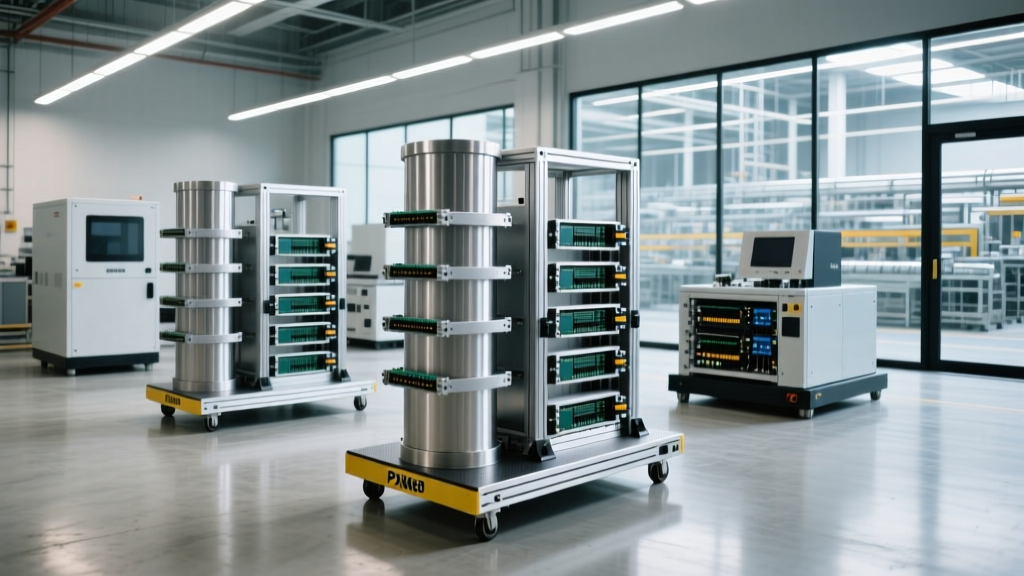
How Testing Equipment Manufacturers Enable Modular Production
Discover how testing equipment manufacturers deploy modular PXIe and skid-based ATE to enable flexible, high-mix manufacturing lines in 2026.
The transition from high-volume, low-mix production to high-mix, low-volume (HMLV) environments has rendered monolithic assembly lines obsolete. Modern factories require reconfigurable manufacturing systems (RMS) that can adapt to new product variants in hours, not weeks. However, while assembly and material handling have largely embraced modularity, end-of-line (EOL) validation has historically remained a rigid bottleneck. Today, leading testing equipment manufacturers are solving this by deploying modular, skid-based Automated Test Equipment (ATE) that integrates seamlessly into flexible production cells.
2026 Market Data Highlight
The global market for modular and reconfigurable manufacturing equipment is projected to grow at a CAGR of 8.4% through 2030. Within this sector, modular ATE skids represent the fastest-growing sub-segment, driven by the EV battery, medical device, and consumer electronics industries demanding rapid changeover capabilities.
The Architecture of Modular Automated Test Equipment
Traditional EOL testers are custom-built, hard-tooled monoliths. If the product changes, the tester is scrapped or heavily re-engineered. In contrast, modern testing equipment manufacturers build systems around open, modular hardware standards—most notably the PXIe (PCI eXtensions for Instrumentation) architecture.
PXIe and Hot-Swappable I/O
PXIe provides a rugged, high-performance backbone for modular test systems. An 18-slot PXIe chassis (such as those from Keysight or National Instruments) costs between $4,500 and $6,000 and serves as the central hub. Engineers can populate this chassis with specific, hot-swappable modules based on the product's test requirements:
- Digital Multimeters (DMMs): 6.5-digit precision modules ($1,800 - $2,500) for voltage and resistance checks.
- Digitizers and Oscilloscopes: High-speed modules (up to 24 GB/s system bandwidth via Gen 4 PCIe) for signal integrity and RF testing ($3,500 - $8,500).
- Programmable Power Supplies: Multi-channel modules for dynamic load and brownout simulation.
When a new product variant is introduced, the factory does not buy a new tester. They simply swap out a $2,000 digitizer module for a different frequency range and update the test sequence software. This hardware modularity reduces CapEx for new product introductions (NPI) by up to 65%.
Software Interoperability: The Backbone of Flexible Lines
Hardware modularity is useless if the test skid cannot communicate dynamically with the broader factory execution system (MES) and the upstream assembly PLCs. Testing equipment manufacturers are now standardizing on two critical protocols to ensure plug-and-play software integration.
PackML (ISA-TR88) for State Management
To ensure a modular test cell behaves predictably when dropped into a new line, vendors are adopting the OMAC PackML (ISA-TR88) standard. PackML enforces a uniform state model across all equipment. Whether the test skid is performing a leak test or an RF calibration, the PLC sees standard states: Aborting, Stopped, Starting, Idle, Execute, Holding, and Complete. This eliminates the need for custom handshaking code every time a test skid is reconfigured or moved to a different production cell.
OPC UA for Secure Data Exchange
For vertical integration, OPC UA (Open Platform Communications Unified Architecture) has become the non-negotiable standard. OPC UA allows the modular test skid to publish structured test results (e.g., pass/fail, specific torque values, leakage rates) directly to the MES or cloud-based digital twin via a secure, platform-independent information model. This ensures that traceability data follows the product serial number, regardless of which physical test skid performed the validation.
Monolithic EOL vs. Modular Skid-Based ATE
| Feature | Monolithic EOL Tester | Modular Skid-Based ATE |
|---|---|---|
| Initial CapEx | $350,000 - $600,000+ | $110,000 - $165,000 |
| Product Changeover Time | 4 to 8 hours (mechanical tooling swaps) | 15 to 45 minutes (software & quick-disconnects) |
| Footprint | Fixed, large footprint (often 150+ sq ft) | Compact skid (40-60 sq ft), easily relocated |
| Upgradability | Requires full system redesign | Hot-swappable PXIe modules & sensor pods |
| End of Life Value | Scrap value (custom tooling is useless) | High (chassis, PLCs, and robots are redeployed) |
Physical Modularity: Vision and Leak Testing Skids
Beyond electronic signals, physical validation steps like machine vision and pneumatic leak testing must also adapt to flexible production. Testing equipment manufacturers are addressing this through quick-disconnect mechanical interfaces.
Interchangeable Vision Pods
Modern vision systems utilize modular lighting and optics skids. Instead of hard-mounting a Cognex or Keyence camera to a custom extrusion, the camera and its specific ring-light are mounted to a standardized kinematic coupling plate (such as a Festo or Item profile adapter). When the line switches from inspecting a flat PCB to a 3D-molded plastic housing, a robotic arm or operator swaps the entire vision pod in under two minutes. The system automatically reads an RFID tag on the pod, loading the correct lens calibration and lighting profile into the vision controller.
Mass Flow vs. Pressure Decay Leak Testing
For fluid and pneumatic products, leak testing is highly sensitive to product volume. Modular test skids now feature dual-circuit pneumatic manifolds. One circuit utilizes pressure decay sensors for high-volume, low-sensitivity testing (e.g., large fluid reservoirs), while the parallel circuit uses mass flow meters for micro-leak detection in small medical devices. The test sequence dynamically routes the air supply to the appropriate sensor bank based on the product RFID, eliminating the need for two separate physical test stations.
"The biggest mistake factories make when transitioning to flexible production is treating the test station as an afterthought. If your assembly cells are modular but your EOL tester is a monolith, your overall equipment effectiveness (OEE) will be entirely gated by the tester's changeover time."
— Director of Advanced Manufacturing Engineering, Tier 1 Automotive Supplier
Calculating the Changeover Dividend (ROI)
The financial justification for modular testing equipment relies heavily on the 'Changeover Dividend'—the revenue recovered by reducing non-productive setup time. Consider a high-mix medical device facility running three product changeovers per week.
The Monolithic Baseline:
A traditional EOL tester requires 4 hours per changeover to swap custom nest fixtures, recalibrate hard-wired sensors, and validate the PLC code.
Calculation: 3 changeovers/week × 4 hours × 52 weeks = 624 hours of lost production annually.
The Modular Skid Reality:
A modular ATE skid uses pogo-pin universal test beds and software-driven sensor routing. Changeover takes 45 minutes (mostly physical nest swapping and automated software validation).
Calculation: 3 changeovers/week × 0.75 hours × 52 weeks = 117 hours of lost production annually.
The Dividend:
The facility recovers 507 hours of production time per year. At a conservative margin of $1,500 per hour of machine time, the modular testing architecture yields $760,500 in recovered annual revenue, paying for the $140,000 modular skid in just over two months.
Procurement Framework: Evaluating Vendors in 2026
When sourcing flexible production equipment, procurement teams must look beyond the initial hardware cost. Use this framework to evaluate testing equipment manufacturers for modular capabilities:
- Demand Open Architecture: Refuse vendors who use proprietary, locked-in I/O modules. Insist on standard PXIe, EtherCAT, or PROFINET I/O blocks that can be sourced from third parties if the original vendor discontinues a part.
- Require Digital Twin Compatibility: The vendor must supply a 3D kinematic model (e.g., Siemens NX MCD or Rockwell Emulate3D) and a virtual PLC instance. This allows your team to perform virtual commissioning and validate the PackML state machine before the physical skid arrives on the dock.
- Verify Hot-Swap Capabilities: Ensure the test chassis supports hot-swapping. If a digitizer module fails mid-shift, an operator should be able to pull it and insert a spare without powering down the entire test skid or dropping the main line PLC connection.
- Audit the Cable Management: Modularity fails if the skid is a rat's nest of proprietary cables. Require standardized, color-coded, quick-disconnect M12 and M8 sensor cables with integrated RFID tags for automatic I/O mapping.
By prioritizing hardware flexibility, standardized software states, and rapid physical changeovers, factories can decouple test capacity from rigid product lifecycles. Testing equipment manufacturers that embrace these modular architectures are no longer just selling validation tools; they are providing the critical enablers of true, agile manufacturing.