CE, UL, CSA Marks for an Industrial Crushing Equipment Manufacturer
Learn how an industrial crushing equipment manufacturer achieves CE, UL, and CSA compliance for global deployment of jaw and cone crushers.
When a 45-ton single-toggle jaw crusher arrives at the Port of Rotterdam or a mining site in Ontario without a valid technical file or recognized control panel mark, it does not just sit in customs. It incurs upwards of $1,200 per day in demurrage fees, delays project commissioning by months, and exposes the builder to severe liability. For an industrial crushing equipment manufacturer, navigating the labyrinth of global safety certifications is not a post-production paperwork exercise—it is a core engineering discipline.
This case study examines the compliance journey of a mid-tier US-based crusher OEM expanding its 42x30 jaw crusher and vibrating grizzly feeder (VGF) line into the European and Canadian markets. We break down the exact technical hurdles, standard interpretations, and financial realities of securing CE, UL, and CSA marks in 2026.
⚠️ 2026 Regulatory Alert: EU Machinery Regulation TransitionThe EU Machinery Directive 2006/42/EC is being replaced by the new EU Machinery Regulation (EU) 2023/1230. While the regulation entered into force in 2023, it becomes fully mandatory and applicable in January 2027. Throughout 2026, an industrial crushing equipment manufacturer must update technical files to address new requirements regarding cybersecurity for remote-access PLCs and AI-driven predictive maintenance sensors, which are now explicitly covered under the regulation's essential health and safety requirements.
CE Marking for Heavy Crushing Machinery: Beyond the Nameplate
Affixing a CE plate to a crusher is the final step of a rigorous risk assessment process governed primarily by EN ISO 12100 (Safety of machinery — General principles for design). For heavy aggregate equipment, the most critical failure modes occur during maintenance and unjamming procedures, not during steady-state operation.
Guarding Nip Points and RFID Interlocks
The flywheel and eccentric shaft assembly on a jaw crusher generate massive kinetic energy. Under EN ISO 14120 (Safety of machinery — Guards), fixed guards must be used where access is not required during operation. However, for tension rod and toggle plate adjustments, hinged access panels are necessary.
- The Failure Mode: Using standard mechanical limit switches on access doors. Operators frequently defeat these with tape or zip-ties to clear tramp iron jams without powering down the 250kW main motor.
- The Compliant Solution: The OEM upgraded to EN ISO 14119-compliant RFID-coded interlock switches (e.g., Schmersal AZM400). These non-contact switches feature a unique actuator code, making defeat practically impossible without specialized tools, and integrate directly into the safety PLC's dual-channel monitoring circuit.
Acoustic Enclosures and EN ISO 11201
Crushing hard basalt generates noise levels exceeding 115 dB(A) at the operator station. To comply with the EU's outdoor noise directive and machinery acoustic standards, the manufacturer engineered a modular acoustic enclosure utilizing 50mm thick composite polyurethane-steel panels. Testing under EN ISO 11201 reduced emitted noise to 82 dB(A) at the designated operator position, a mandatory threshold for CE certification without requiring mandatory double-hearing-protection mandates.
North American Control Panels: UL 508A vs. CSA C22.2
While the mechanical crushing action is universal, the electrical brains of the machine must meet local jurisdictional requirements. In North America, the Authority Having Jurisdiction (AHJ)—usually the local electrical inspector—demands recognized marks on the Motor Control Center (MCC) and main industrial control panels (ICP).
| Feature | UL 508A (United States) | CSA C22.2 No. 14 (Canada) |
|---|---|---|
| Primary Focus | Fire and shock hazard prevention in ICPs. | Fire, shock, and specific Canadian wiring method integrations. |
| Component Recognition | Requires UL Listed or UL Recognized (UR) components. | Requires CSA Certified or cULus Listed components. |
| SCCR Calculation | UL 508A Supplement SB or manufacturer data. | Similar methodology, but strict adherence to Canadian Electrical Code (CEC) fault current availability. |
| Marking | UL Listed mark with specific file number. | CSA mark or cULus (if UL is accredited for Canadian standards). |
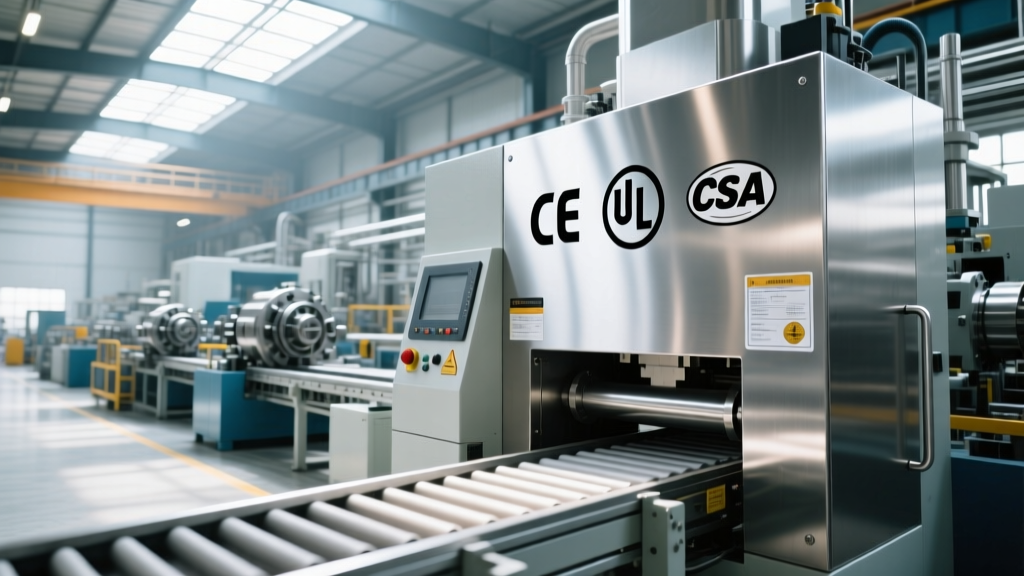
For an industrial crushing equipment manufacturer, building panels to the UL 508A standard with a 'c' designation (cULus) is the most cost-effective route, as it satisfies both US OSHA requirements and Canadian provincial inspectors simultaneously, eliminating the need for dual inventory or separate CSA factory audits.
Case Study: Resolving the 65kA SCCR Bottleneck
During a deployment of a portable cone crusher plant to a copper mine in British Columbia, the site's electrical engineer rejected the main 480V/3-phase MCC. The plant's available fault current was 45kA, but the panel's marked Short Circuit Current Rating (SCCR) was only 5kA.
"The most common SCCR failure mode we see in heavy aggregate equipment is the use of standard, non-coordinated contactors and fuses. If a single branch circuit component isn't tested and listed for Type 2 coordination, the entire panel's SCCR defaults to the lowest rated component—often dropping a 65kA panel down to a dangerous 5kA."
— Senior Electrical Compliance Engineer, Heavy Machinery OEM
The Fix: The OEM's electrical team utilized an SCCR calculation tool to redesign the main motor starter branch. By swapping standard thermal-magnetic breakers and contactors for a pre-tested, Type 2 coordinated combination motor starter (e.g., Rockwell Automation CENTERLINE), the branch SCCR was elevated to 65kA. Because the main bus and feeder components were also rated for 65kA, the overall panel SCCR was legally marked at 65kA, satisfying the mine's AHJ and preventing a $40,000 panel rebuild on-site.
Financial Matrix: Certification Costs and Timelines
Budgeting for compliance requires precision. Below is the estimated cost and timeline matrix for a mid-sized crusher OEM achieving global marks for a new equipment platform in 2026.
| Certification / Mark | Estimated Cost (USD) | Timeline | Primary Cost Driver |
|---|---|---|---|
| CE Technical File (ISO 12100) | $15,000 - $25,000 | 3 - 5 Months | Third-party risk assessment, acoustic testing, translation of manuals into 24 EU languages. |
| UL 508A Panel Listing | $8,000 - $12,000 | 2 - 3 Months | Initial factory inspection (IPI), SCCR engineering review, quarterly follow-up audits. |
| CSA Field Evaluation (SPE-1000) | $4,500 - $7,000 | 1 - 2 Weeks | On-site inspector travel, per-unit labeling for non-listed custom one-off panels. |
Actionable OEM Deployment Checklist
To prevent border holds and site rejections, engineering and project management teams must execute the following prior to final assembly:
- Verify Component Marks: Audit the Bill of Materials (BOM) to ensure every relay, breaker, and terminal block inside the ICP carries the correct UL/cULus mark. A single unrecognized European-only component invalidates the UL 508A panel mark.
- Translate Safety Labels: Ensure all nip-point and crush-zone warning decals meet ISO 3864 standards and are translated into the destination country's official language(s).
- Compile the Digital Twin File: Under the incoming EU Machinery Regulation, technical files must account for software updates. Ensure the PLC logic checksums and safety-relation code versions are locked and documented in the CE technical file.
- Pre-Ship SCCR Audit: Cross-reference the panel's marked SCCR against the destination site's electrical fault current study. Never ship a 5kA panel to a site with 20kA available fault current.
Global expansion for heavy aggregate machinery builders is highly lucrative, but the barrier to entry is strictly regulated. By treating compliance as an upfront engineering parameter rather than a post-build administrative task, manufacturers secure faster deployment, lower liability, and a distinct competitive advantage in international tenders.