Contract Equipment Selection for Agriculture Equipment Manufacturing
Evaluate contract manufacturing equipment for agriculture equipment manufacturing based on operator trainability, HMI usability, and safety criteria.
The Hidden Cost of Poor HMI in Contract Agriculture Equipment Manufacturing
When OEMs evaluate contract manufacturers (CMs) for agriculture equipment manufacturing, the focus typically defaults to machine tonnage, spindle speeds, and ISO 9001 certifications. However, in the current 2026 industrial labor market, the most critical bottleneck is not machine capacity—it is operator trainability. The skilled trades shortage means CMs experience high turnover rates on the shop floor. If a CM relies on legacy fabrication equipment with archaic, text-only G-code interfaces or manual welding rigs requiring decades of muscle memory, your production schedules will suffer from inconsistent quality and delayed changeovers.
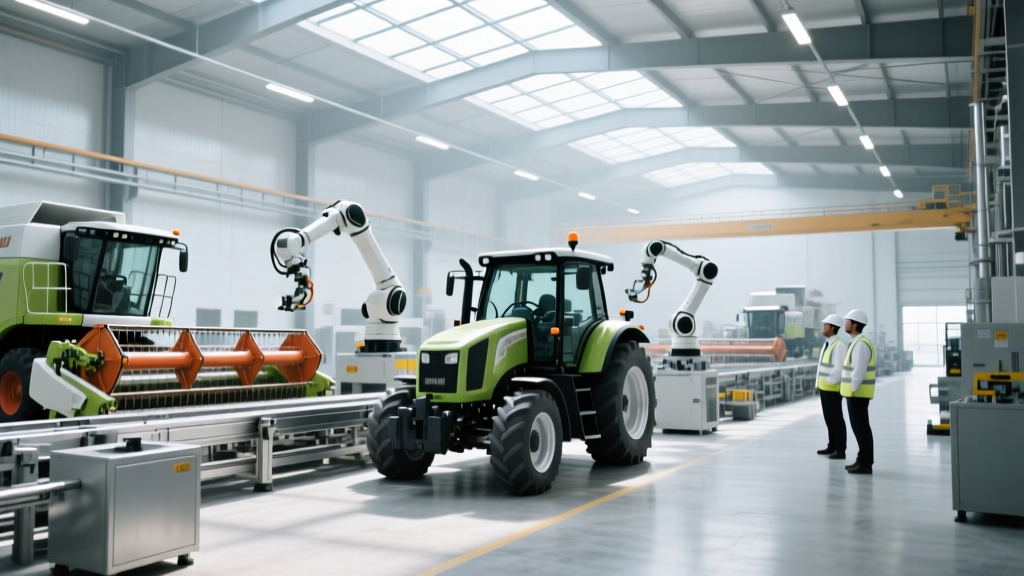
Selecting a CM based on operator-centric equipment criteria ensures that the heavy, complex components used in modern ag machinery—such as combine harvester threshing drums, high-horsepower tractor PTO shafts, and precision planter row units—are machined and welded consistently, regardless of which shift operator is running the cell.
⚠️ The 'Black Box' CM Trap: Do not accept a contract manufacturer's quoted cycle times at face value if they cannot demonstrate their Human-Machine Interface (HMI) and error-proofing protocols. A quoted 45-minute cycle on a manual press brake often balloons to 90 minutes when a newly trained operator struggles with complex back-gauge sequencing for 3/8-inch AR400 steel tillage brackets.Operator-Centric Equipment Selection Matrix for Ag Components
Use this matrix during your CM site audits to benchmark their equipment against modern operator usability standards. Equipment that requires excessive training time introduces severe supply chain risks for seasonal agricultural production runs.
| Equipment Category | Ag Component Application | Modern HMI / Interface Standard | Avg. Operator Training Time | Error-Proofing (Poka-Yoke) Level |
|---|---|---|---|---|
| 5-Axis Mill-Turn Center | Tractor PTO Shafts, Hydraulic Manifolds | Touchscreen 3D Toolpath Simulation (e.g., MAZATROL SmoothG) | 2 - 3 Weeks | High (In-process probing, tool breakage detection) |
| Robotic GMAW Welding Cell | Combine Chassis, Grain Auger Tubing | Pendant with pre-programmed waveform libraries | 40 - 60 Hours | High (Laser seam tracking, arc monitoring) |
| CNC Press Brake | Tillage Brackets, Loader Arms | Graphical bend sequencing with 3D interference checking | 1 - 2 Weeks | Medium (Angle measurement sensors, CNC crowning) |
| Fiber Laser Cutter | Planter Disc Blades, Harrow Spikes | Nesting software with automated nozzle changers | 3 - 5 Days | High (Capacitive height sensing, auto-focus) |
| Manual TIG Welding Rig | Custom Stainless Steel Hoppers | Analog dials / Basic digital readouts | 3 - 5 Years (Mastery) | Low (Entirely operator dependent) |
Evaluating Welding and Machining Automation for Trainability
Agriculture equipment operates in high-abrasion, high-impact environments. This necessitates the use of advanced alloys like AR400 (abrasion-resistant) steel and high-strength low-alloy (HSLA) steels. Welding and machining these materials require precise heat input control to prevent warping or loss of material hardness.
Advanced Waveform Welding for AR400 Steel
When auditing a CM's welding capabilities for heavy ag implements, look for advanced power sources like the Lincoln Electric Power Wave® S500. Traditional constant-voltage MIG welding on thick-gauge AR400 requires a highly skilled welder to manage heat input and prevent hydrogen cracking. Modern waveform control technology allows the CM to program specific pulse-on-pulse waveforms that dramatically reduce spatter and control the puddle fluidity.
Information Gain: A CM utilizing waveform-controlled power sources can cross-train a standard machine operator to load/unload and monitor the robotic weld cell in roughly 40 hours. Conversely, a CM relying on manual short-circuit transfer MIG will require certified 6G welders, who are scarce and command premium hourly rates ($45–$65/hr vs. $25–$35/hr for cell operators), directly inflating your piece-part cost.
Mill-Turn Centers with Graphical HMIs
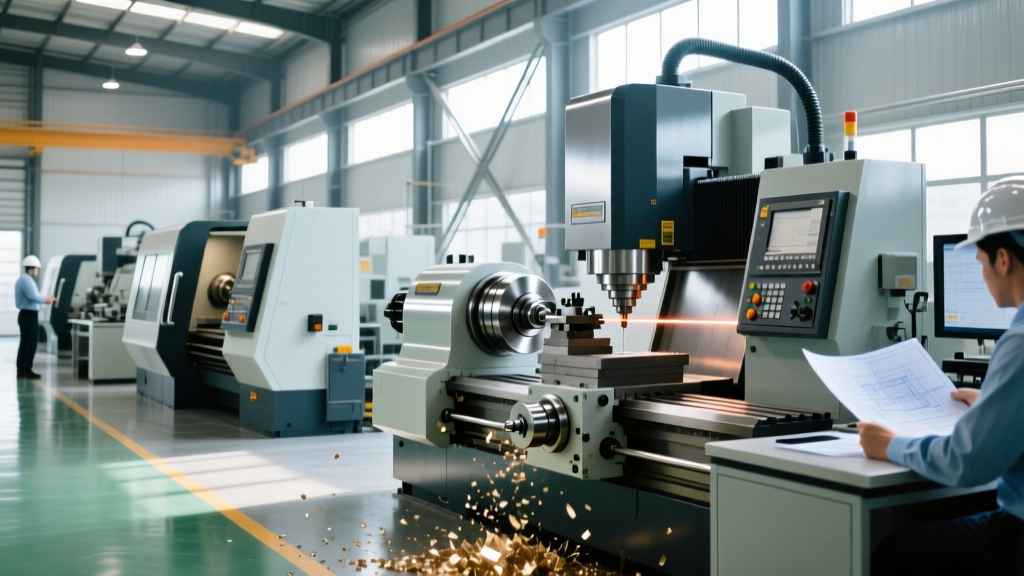
For complex rotational parts like hydraulic cylinder rods or PTO driveline components, 5-axis mill-turn centers (such as the Mazak INTEGREX i-400) are industry standards. The critical selection criterion is the CNC control. Graphical, conversational CNC interfaces allow operators to program complex geometries directly at the machine using touchscreens and 3D solid models, bypassing the need for a dedicated, off-line CAM programmer for every minor design revision. This reduces changeover times from 4 hours to under 45 minutes, a vital metric when manufacturing seasonal ag equipment in high-mix, low-volume batches.
Ergonomics and Safety in Heavy Ag Fabrication
Operator fatigue directly correlates to scrap rates and workplace injuries. Agricultural components are notoriously heavy; a single cast-iron planter row unit can weigh between 150 and 250 lbs, and combine rotor assemblies can exceed 1,500 lbs. According to OSHA's ergonomics guidelines, repetitive lifting of loads exceeding 50 lbs significantly increases the risk of musculoskeletal disorders (MSDs).
When selecting a contract manufacturer, mandate the presence of zero-gravity tool balancers, pneumatic manipulators, and vacuum lifting systems. For example, the use of Schmalz JumboFlex vacuum tube lifters allows a single operator to safely maneuver 200 lb steel sub-assemblies with one hand, eliminating the need for overhead crane wait-times and reducing physical fatigue. Furthermore, verify that the CM adheres to ASABE (American Society of Agricultural and Biological Engineers) safety standards regarding machine guarding and pinch-point mitigation on custom assembly jigs.
💡 Pro-Tip for CM Audits: Look up at the lighting. Precision inspection of weld penetration on critical structural ag components requires a minimum of 500 lux at the work surface. Many older fabrication shops operate at 200-300 lux, forcing operators to rely on handheld flashlights, which leads to missed porosity defects and eventual field failures.Step-by-Step Operator Audit Checklist for CM Site Visits
Do not rely solely on the sales presentation in the front office. Walk the shop floor and execute this operator-focused audit to verify the CM's actual capabilities:
- Observe a Live Changeover (SMED): Time the setup between two different part numbers. Are operators using quick-release tooling and standardized shadow boards, or are they searching for wrenches and manually indicating parts?
- Test the HMI Localization: If the CM employs a multilingual workforce, check if the CNC and PLC interfaces can be toggled into the operators' native languages with a single touch. Misinterpreted error codes cause extended downtime.
- Inspect In-Process Probing: Ask the operator to demonstrate a tool breakage detection cycle or a part-datum probing sequence on a mill-turn center. If the machine lacks Renishaw or Blum touch probes, the CM is relying on manual first-article inspections, which bottlenecks production.
- Evaluate Material Handling Flow: Track a heavy component (e.g., a 400 lb gearbox housing) from the laser cutter to the welding cell. Count the number of times it is manually lifted off the ground. It should be zero; all transfers should occur via roller conveyors or overhead manipulators.
- Review Visual Work Instructions: Look at the workstations. Are instructions buried in 40-page PDF manuals, or are they displayed on digital monitors with 3D exploded views and torque specifications highlighted?
Budgeting for Training and Changeover Realities
Understanding the operator-equipment dynamic allows OEMs to negotiate more accurate pricing models. In 2026, fully burdened machine rates for advanced 5-axis ag equipment machining at top-tier CMs range from $110 to $160 per hour. However, the hidden cost lies in setup and training amortization.
'We shifted our tillage bracket production to a CM that charged 15% less per hour but relied on manual press brakes and legacy welding rigs. The scrap rate on the AR400 steel was 6%, and changeover delays pushed our lead times past the spring planting season. We moved to a highly automated, operator-friendly CM with higher hourly rates, and our total landed cost dropped by 11% due to near-zero scrap and on-time delivery.' — Director of Supply Chain, Mid-West Ag Implement OEM
When finalizing your contract manufacturing equipment selection criteria, require the CM to provide a detailed breakdown of their setup times and operator training protocols. By prioritizing modern HMIs, ergonomic material handling, and automated error-proofing, you insulate your agriculture equipment manufacturing supply chain from the volatility of the skilled labor market, ensuring robust, defect-free machinery reaches the field on schedule.
Related reading
Spare Parts Inventory Rules for Agriculture Equipment Manufacturers

Custom Machine Fabrication: What Manufacturing Analytics Tools Provide Machine-Level Performance Tracking?