Scalable Water Purification Equipment Rental for Manufacturing vs. Permanent Lean Workstations
Compare scalable water purification equipment rental for manufacturing against permanent installs to optimize lean workstation design and reduce CapEx.
The Intersection of Fluid Management and Lean Cellular Design
Integrating water purification into lean manufacturing workstations requires balancing strict quality metrics with the core principles of waste reduction (muda) and continuous flow. When processes like CNC coolant mixing, precision parts washing, or pharmaceutical clean-in-place (CIP) demand high-purity water, plant managers face a critical infrastructure decision. Do you invest in permanent, custom-fabricated point-of-use (POU) skids, or do you leverage scalable water purification equipment rental for manufacturing to maintain operational agility?
According to the Lean Enterprise Institute, true lean design dictates that equipment must support takt time without creating physical or operational bottlenecks. A poorly designed water delivery system creates 'spaghetti'—tangled hoses, excessive operator motion, and floor space violations. This analysis compares modular rental purification systems against permanent lean workstation installations, providing a concrete framework for manufacturing engineers and facility managers.
2026 Industrial Water Data Snapshot
- Average CapEx for a 50 GPM Permanent RO/EDI Skid: $95,000 - $135,000 (including installation and validation).
- Average Monthly Rental Cost (50 GPM Modular Skid): $3,200 - $4,800 (including maintenance and membrane replacement).
- Lead Time: Permanent installs require 14-22 weeks for engineering and fabrication; rental deployments take 7-14 days.
Comparison Matrix: Rental Modules vs. Permanent Lean Skids
Evaluating these alternatives requires looking beyond the initial price tag. The following matrix breaks down how each option aligns with lean manufacturing principles, specifically 5S (Sort, Set in order, Shine, Standardize, Sustain) and cellular flow optimization.
| Criteria | Scalable Rental Purification (Modular Skids/Trailers) | Permanent In-House Lean Water Stations |
|---|---|---|
| Footprint & 5S Alignment | Moderate. External trailers save internal floor space but require external pad space. Internal modular skids can be bulky. | High. Custom-designed to fit exact workstation dimensions, utilizing vertical space and integrated cabinetry. |
| Scalability (Kaizen) | Excellent. Swap a 30 GPM module for an 80 GPM module over a weekend as production volume scales. | Poor. Requires expensive retrofitting, piping changes, and downtime to increase capacity. |
| Maintenance & Downtime | Vendor-managed. Hot-swap capabilities mean zero workstation downtime during membrane changes. | Internal maintenance burden. Requires in-house spares inventory and scheduled line stoppages. |
| Ergonomics & Operator Motion | Requires secondary integration (hose reels, quick-disconnects) to achieve optimal lean ergonomics. | Engineered specifically for the operator, with integrated POU delivery arms and automated valves. |
Deep Dive: Scalable Water Purification Equipment Rental for Manufacturing
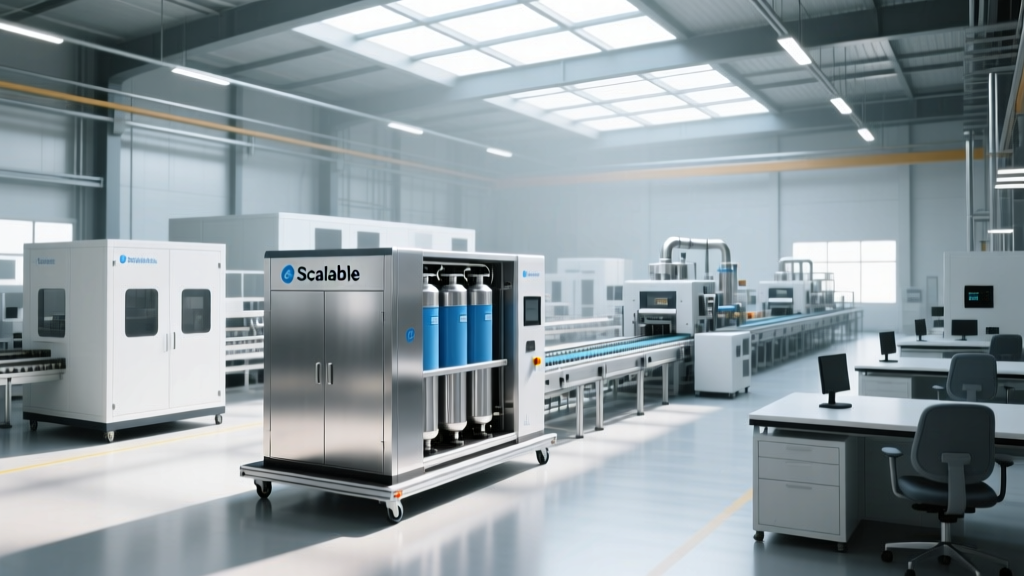
Opting for scalable water purification equipment rental for manufacturing typically involves deploying skid-mounted Reverse Osmosis (RO) and Electrodeionization (EDI) units, or trailer-mounted systems housed in 20-foot ISO containers. These are ideal for facilities experiencing seasonal demand spikes, pilot-line testing, or those delaying CapEx approval while validating a new production cell.
The Rental Advantage in Dynamic Environments
From a lean perspective, renting eliminates the waste of overproduction and over-processing. If a manufacturing cell is reconfigured or decommissioned, the rented water purification asset is simply returned. There is no stranded asset, no decommissioning cost, and no dead space on the factory floor. Furthermore, modern rental agreements include IoT-enabled SCADA monitoring, allowing facility managers to track water conductivity (often maintaining < 1.0 µS/cm for precision washing) and flow rates remotely without burdening internal maintenance teams.
⚠️ Warning: The 'Spaghetti' Risk with RentalsRental skids are standardized, meaning their connection points rarely align perfectly with your specific lean workstation. Failing to plan the secondary routing (using flexible, reinforced polyurethane tubing and overhead Festo pneumatic tracks) will result in floor-level hose clutter, violating 5S principles and creating trip hazards. Always budget $4,000–$8,000 for ergonomic secondary routing when renting.
Deep Dive: Permanent Point-of-Use (POU) Lean Water Stations
Permanent installations are engineered from the ground up to serve a specific manufacturing cell. A permanent lean water station might feature a centralized RO loop feeding multiple miniaturized EDI polishing units located directly at the point of use. This design drastically reduces operator motion. An operator at a CNC parts-washing station simply pulls down an ergonomic, spring-retracted hose reel equipped with a CEJN ultra-flow quick-disconnect nozzle, triggering an automated solenoid valve that delivers 18.2 MΩ·cm ultrapure water exactly when needed.
While the Department of Energy's Industrial Assessment Centers frequently highlight permanent, optimized fluid loops as a key factor in long-term energy and water efficiency, the rigid nature of these systems contradicts lean agility. If the takt time changes or the product mix shifts, the permanent water station becomes a bottleneck or an underutilized asset.
Decision Framework: When to Rent vs. When to Build
Use this IF/THEN logic tree to determine the optimal fluid management strategy for your workstation design:
- IF your production volume is projected to fluctuate by more than 30% annually, THEN choose scalable rental to align OpEx with actual throughput.
- IF the manufacturing cell is in a pilot or validation phase (Phase 1-3), THEN rent to avoid sinking CapEx into unproven process flows.
- IF the water quality requirement is highly specific (e.g., WFI - Water for Injection in biopharma) and requires rigorous, site-specific FDA validation, THEN invest in a permanent, custom-engineered POU skid.
- IF floor space is at an absolute premium and overhead routing is the only option, THEN permanent lean stations with integrated vertical piping are mandatory; rental skids are too large for tight cellular footprints.
Real-World Integration: Designing the Rental Workstation for Lean Flow
If you select the rental route, you must actively engineer the workstation interface to maintain lean standards. Do not accept the rental vendor's standard hose drops. Implement the following integration steps:
- Install Overhead Utility Grids: Mount aluminum extrusion grids (e.g., Bosch Rexroth or Item) above the workstation. Route the rental unit's permeate water up and over the cell using rigid stainless steel or aluminum piping, dropping down only at the exact operator interface point.
- Deploy Zero-Leak Quick Disconnects: Use dry-break couplings (like Staubli Clean-Break) at the workstation terminus. This prevents drips onto the factory floor, supporting the 'Shine' (Seiso) pillar of 5S and preventing slip hazards.
- Automate Flow Control: Integrate a local PLC at the workstation that communicates with the rental skid's VFD (Variable Frequency Drive) pump. This ensures the rental unit only ramps up pressure when the operator triggers the workstation nozzle, saving energy and reducing membrane wear.
36-Month Total Cost of Ownership (TCO) Breakdown
Financial modeling for a standard 50 GPM manufacturing water purification requirement over a 3-year horizon reveals distinct cash flow profiles. While the EPA's sustainable water infrastructure guidelines encourage long-term efficiency investments, the OpEx model of renting preserves vital working capital.
| Cost Category | Scalable Rental Model (36 Months) | Permanent Lean Skid Model (36 Months) |
|---|---|---|
| Initial CapEx & Engineering | $5,000 (Site prep, pad, electrical drop) | $115,000 (Equipment, custom fab, P&ID design) |
| Installation & Commissioning | $3,500 (Rigging, plumbing tie-in) | $22,000 (Specialized pipefitting, validation) |
| Monthly OpEx / Maintenance | $136,800 ($3,800/mo all-inclusive) | $36,000 ($1,000/mo internal labor + parts) |
| Membrane/Resin Replacement | Included in rental agreement | $14,500 (Scheduled swap at month 24) |
| Downtime Cost (Estimated) | $0 (Hot-swap guarantee) | $8,500 (Scheduled line stops for maintenance) |
| Total 36-Month Cost | $145,300 | $196,000 |
Final Verdict on Workstation Fluid Management
The choice between scalable water purification equipment rental for manufacturing and permanent lean workstations hinges on your facility's lifecycle stage and agility requirements. For established, high-volume production cells with fixed takt times and stringent ergonomic demands, permanent POU skids offer superior long-term ROI and seamless 5S integration. However, for dynamic environments, pilot lines, or facilities prioritizing cash flow preservation, modular rental systems provide the necessary scalability. By investing in secondary overhead routing and automated quick-disconnects, engineers can force a standardized rental asset to behave like a bespoke lean workstation, eliminating waste while securing critical fluid supply.