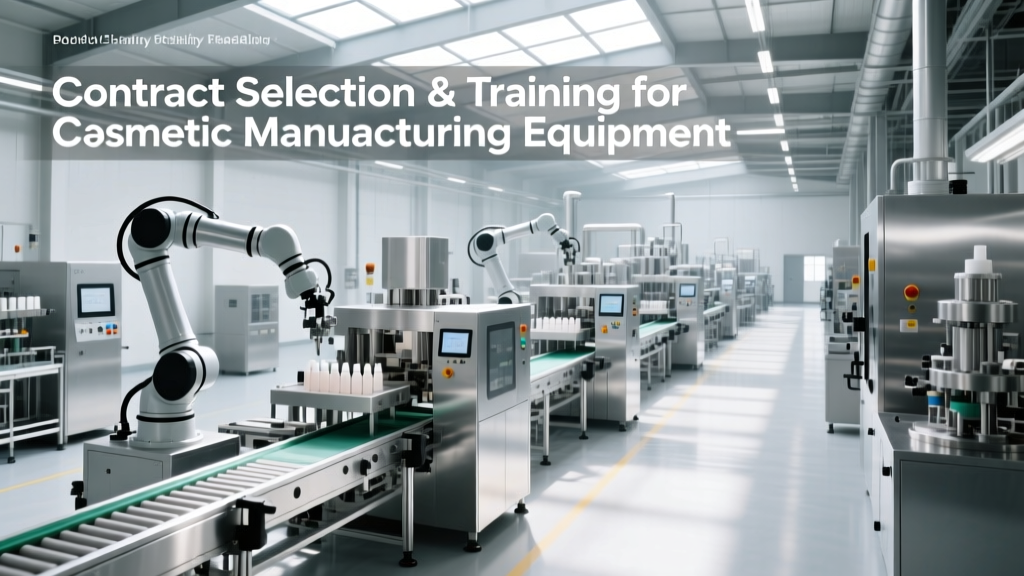
Contract Selection & Training for Cosmetic Manufacturing Equipment
Learn contract selection criteria for cosmetic manufacturing equipment and best practices for operator training to maximize OEE and reduce batch contamination.
Contract manufacturing in the cosmetics sector demands extreme agility. A single facility might produce a thin, alcohol-based toner in the morning and a highly viscous, shear-thickening silicone cream by the afternoon. When procurement teams evaluate cosmetic manufacturing equipment, they typically prioritize maximum throughput and vessel capacity. However, the true bottleneck in contract manufacturing lies at the intersection of equipment design and operator execution. Selecting machinery without considering the operator interface leads to extended changeover times, inconsistent emulsion quality, and costly cross-contamination.
This guide outlines the critical selection criteria for contract cosmetic manufacturing equipment through an operator-centric lens, followed by advanced training best practices to ensure your team can run complex formulations safely and efficiently.
The 'Operator-First' Procurement Checklist
Before signing a purchase order for any mixing, filling, or CIP system, verify the equipment meets these operator-centric requirements:
- Toolless Changeovers: Quick-release tri-clamp fittings and hand-tightened stator swaps instead of bolted flanges.
- Recipe Memory HMIs: PLC interfaces that store specific RPM, shear time, temperature profiles, and valve sequences for up to 500+ SKUs.
- Ergonomic Loading Heights: Powder induction hoppers positioned at 36-42 inches to reduce lifting injuries from 50lb raw material bags.
- Visual Flow Indicators: Transparent sight glasses on transfer lines to allow operators to visually confirm product clearing before CIP cycles begin.
Core Selection Criteria for Contract Cosmetic Lines
1. Viscosity Handling and Shear Sensitivity
Cosmetic formulations are rarely simple Newtonian fluids; most lotions and creams are non-Newtonian, thixotropic emulsions. This means their viscosity changes under shear stress. Contract manufacturers must select mixing equipment that allows operators to precisely control shear rates to avoid breaking the emulsion or entraining excess air.
For batch emulsification, high-shear mixers like the Ross HSM-100LS are industry standards. However, for continuous processing or high-volume runs, inline rotor/stator dispersers (such as the IKA magic LAB or MasterPlant systems) offer superior consistency. Inline systems require operators to manage feed rates and back-pressure valves, demanding a higher baseline of technical training compared to simple batch dumping.
| Parameter | Batch High-Shear (e.g., Ross HSM) | Inline Rotor/Stator (e.g., IKA Inline) |
|---|---|---|
| Capital Cost Range | $15,000 - $35,000 | $25,000 - $65,000+ |
| Changeover Time | 45 - 90 minutes (manual wash) | 20 - 40 minutes (CIP capable) |
| Best Application | Small batches, high-viscosity pastes | High-volume emulsions, low-to-medium viscosity |
| Operator Skill Required | Moderate (timing, temperature monitoring) | High (flow dynamics, pump cavitation prevention) |
2. Clean-in-Place (CIP) Flow Dynamics
Contract manufacturers cannot afford 4-hour manual washdowns between an alpha-hydroxy acid (AHA) serum and a sensitive peptide cream. Equipment must be specified with CIP integration that guarantees mechanical soil removal. The critical metric here is fluid velocity: CIP systems must achieve a minimum velocity of 1.5 meters per second (m/s) at the furthest spray ball to ensure turbulent flow.
When selecting vessels, specify rotary jet heads (like the Alfa Laval GJ 8) over static spray balls for heavily soiled mixing tanks. Rotary heads use up to 80% less water and chemical volume, but they require operators to monitor supply pressure closely, as they need 4-6 bar to rotate correctly. If pressure drops below 3 bar, the jet head stops spinning, resulting in a failed clean that the operator might not notice without proper training.
Operator Training Best Practices for New Cosmetic Lines
Procuring advanced cosmetic manufacturing equipment is useless if the floor staff relies on tribal knowledge rather than standardized work. Implement this phased training protocol for new line installations.
Phase 1: Dry-Run HMI Navigation and Alarm Logic (Week 1)
Before introducing raw materials, operators must master the Human-Machine Interface (HMI). Training should focus heavily on alarm logic. For example, if a high-shear mixer triggers a 'Motor Overload' alarm, operators must know whether this indicates a mechanical jam, a viscosity spike due to improper cooling, or a VFD (Variable Frequency Drive) fault.
- Actionable Tip: Create a physical 'Alarm Response Matrix' laminated and zip-tied to the HMI stand, detailing the exact corrective action for the 10 most common equipment faults.
Phase 2: Rheology and Viscosity Troubleshooting (Week 2)
Operators must understand how their actions affect the physical chemistry of the batch. When cooling an emulsion from 75°C down to 30°C, the cooling rate and agitation speed dictate the final viscosity. If an operator panics and increases the RPM to speed up heat transfer, they risk whipping air into the cooling cream, creating micro-bubbles that will cause filling inaccuracies downstream.
- Actionable Tip: Train operators to use a handheld rotational viscometer (e.g., Brookfield RV series) at the 60°C, 45°C, and 30°C marks to track the emulsion's structural development in real-time, comparing it against the master formula's rheology curve.
Phase 3: CIP Verification and ATP Swabbing (Week 3)
Visual inspection is insufficient for cosmetic contract manufacturing. Residual surfactants or active ingredients can degrade subsequent batches. Operators must be trained in ATP (Adenosine Triphosphate) bioluminescence swabbing to verify CIP efficacy.
- Swab Selection: Target high-risk areas: the mixer shaft seal, the discharge valve seat, and the dip tube of the transfer pump.
- Threshold Setting: While cosmetics are not sterile injectables, the target for critical product-contact surfaces should be <10 RLU (Relative Light Units). Readings between 11-25 RLU require a targeted manual re-wash; >25 RLU requires a full CIP cycle restart.
- Documentation: Log RLU values directly into the batch record to build a historical database of equipment cleanability.
Mitigating Cross-Contamination Through Standardized Work
Equipment selection and operator training must ultimately serve the facility's compliance framework. According to ISO 22716:2007 (Cosmetics — Good Manufacturing Practices), equipment must be designed, located, and maintained to prevent cross-contamination and ensure product quality.
'Equipment should be cleaned according to written procedures... and records of cleaning should be maintained. The cleaning procedures should be validated to ensure they are effective and reproducible.' — ISO 22716:2007, Section 5.4
To meet this standard, contract manufacturers must implement 'Cleaning Validation Matrices' for every piece of cosmetic manufacturing equipment. This matrix dictates the exact chemical concentration (e.g., 1.5% alkaline detergent), temperature (e.g., 65°C), and time (e.g., 20 minutes) required to remove specific active ingredients like titanium dioxide (common in sunscreens and notoriously difficult to clean) or dimethicone.
Frequently Asked Questions
How often should cosmetic manufacturing equipment be calibrated?
Critical process parameters (CPPs) such as vessel temperature probes, inline pH meters, and load cells must be calibrated at minimum every 6 months, or immediately following any maintenance that involves removing the sensor. For contract manufacturers running highly regulated OTC cosmetics (like SPF sunscreens or anti-dandruff shampoos), 3-month calibration intervals are recommended to satisfy FDA audit requirements.
What is the ideal changeover time for a contract cosmetics facility?
World-class contract cosmetic facilities target a 'Product-to-Product' changeover time of under 45 minutes for minor changes (same base, different fragrance/color) and under 120 minutes for major changes (requiring full CIP and sterilization). Achieving this requires equipment with toolless disassembly and operators trained in SMED (Single-Minute Exchange of Die) methodologies.
Can we use the same filling nozzles for foaming cleansers and heavy creams?
No. Foaming cleansers require bottom-up, snorkel-style fill nozzles to prevent the product from expanding and overflowing the bottle. Heavy creams require positive displacement piston fillers with wide-bore, heated nozzles to maintain flow and prevent stringing or tailing at the cut-off point. Forcing operators to use incorrect tooling guarantees high reject rates and frustrated staff.
Related reading
Selecting a Cleanroom Equipment Manufacturer for Startup Scale-Up

Maximizing Energy Efficiency Ratings Using Production Tracking Solutions in Industrial Equipment Manufacturing